The rise of Cobots in Manufacturing is changing how factories compete. Unlike traditional industrial robots, collaborative robots work safely beside humans. As a result, manufacturers gain flexibility without sacrificing safety or speed.
Today, global competition demands faster production, lower costs, and consistent quality. Therefore, businesses are turning to collaborative robots, industrial automation, and smart manufacturing solutions to stay ahead. Yet many leaders still overlook the hidden advantage that cobots bring.
This article explores how Cobots in Manufacturing create measurable value, why they outperform traditional systems in certain tasks, and how your factory can benefit from this quiet revolution.
What Are Cobots in Manufacturing?
Cobots in Manufacturing refer to collaborative robots designed to share workspace with human operators. Unlike traditional robots that require cages, cobots use sensors and smart programming to detect human presence.
Key Features of Cobots
- Built-in force and motion sensors
- Easy programming with drag-and-drop interfaces
- Lower upfront investment compared to industrial robots
- Quick redeployment across production lines
Because of these features, even small and mid-sized factories can adopt industrial automation without massive capital investment.
Why Cobots in Manufacturing Deliver a Competitive Edge
The hidden advantage of Cobots in Manufacturing lies in adaptability. Traditional automation works best for high-volume, repetitive tasks. However, modern factories often produce smaller batches with frequent changes.
Cobots solve this problem.
1. Faster Deployment
Traditional robot systems can take months to integrate. In contrast, cobots often deploy within weeks. Therefore, companies reduce downtime and accelerate ROI.
2. Enhanced Workforce Productivity
Cobots handle repetitive or ergonomically risky tasks. Meanwhile, human workers focus on quality checks and complex assembly. This hybrid approach improves output without increasing headcount.
3. Lower Total Cost of Ownership
Although industrial robots offer speed, they require cages, safety systems, and specialized programming. Cobots cost less to install and maintain.
Cobots in Manufacturing vs Traditional Industrial Robots
Understanding the difference helps decision-makers choose the right solution.
| Feature | Cobots | Traditional Industrial Robots |
|---|---|---|
| Safety Barriers | Not required | Required |
| Programming | User-friendly | Complex |
| Cost | Moderate | High |
| Flexibility | High | Limited |
| Ideal For | Small batches, mixed production | Mass production |
While both systems support smart manufacturing solutions, cobots provide flexibility that modern markets demand.
How Cobots in Manufacturing Improve Safety and Morale
Workplace injuries cost manufacturers billions each year. However, Cobots in Manufacturing reduce strain-related injuries by handling lifting, screwing, and repetitive motion tasks.
Because cobots detect force and stop automatically, they minimize collision risks. As a result, employees feel safer and more confident working alongside machines.
Furthermore, when workers see automation as assistance rather than replacement, morale improves. This psychological shift strengthens company culture and reduces resistance to change.
Real-World Applications of Cobots in Manufacturing
Factories across industries now use collaborative robots in practical ways.
Assembly Lines
Cobots assist with screwdriving, gluing, and part fitting. They ensure consistent torque and reduce human fatigue.
Quality Inspection
Equipped with vision systems, cobots identify defects faster than manual inspection. Consequently, defect rates drop.
Packaging and Palletizing
Cobots manage repetitive boxing and stacking tasks. Meanwhile, staff supervise logistics and workflow optimization.
Research from Gartner predicts that collaborative robotics will become a standard feature in Industry 4.0 factories within the next decade.
Integration Challenges of Cobots in Manufacturing
Although benefits are clear, implementation requires planning.
Common Barriers
- Lack of technical expertise
- Employee resistance
- Integration with legacy systems
However, companies can overcome these barriers through phased deployment and training programs. Start small. Measure results. Then scale gradually.
Because cobots require less infrastructure than traditional robots, integration proves simpler than expected.
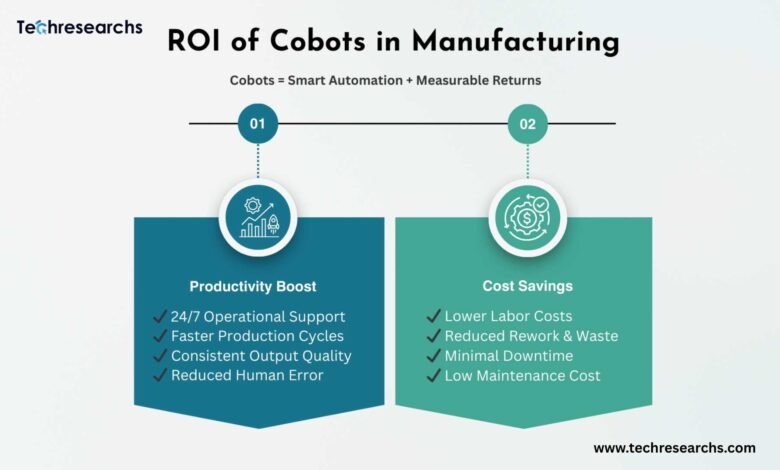
The ROI of Cobots in Manufacturing
Return on investment often drives automation decisions. Fortunately, Cobots in Manufacturing deliver measurable gains.
Cost Savings
- Reduced labor overtime
- Fewer workplace injuries
- Lower error rates
Revenue Growth
- Faster production cycles
- Improved product quality
- Increased capacity without facility expansion
Most companies report ROI within 12–24 months. Therefore, cobots offer both short-term wins and long-term scalability.
Future Trends Shaping Cobots in Manufacturing
The future of Cobots in Manufacturing looks promising. Artificial intelligence integration will enable predictive adjustments and self-optimization.
Moreover, cloud connectivity will allow remote monitoring and data-driven decisions. As industrial automation evolves, cobots will play a central role in decentralized production models.
Small manufacturers will particularly benefit. Since cobots require modest investment, they democratize access to advanced robotics.
Cobots in Manufacturing represent more than a trend. They offer a strategic advantage that many competitors still ignore. By combining human intelligence with robotic precision, companies increase productivity without massive infrastructure changes.
Start with one process. Measure results. Then expand gradually. The hidden competitive edge of Cobots in Manufacturing could define your factory’s future success.
FAQs
1. What makes cobots different from traditional robots?
A. Cobots work safely alongside humans without safety cages. They prioritize collaboration rather than full automation.
2. Are cobots suitable for small manufacturers?
A. Yes. Because of lower costs and easy programming, small and mid-sized companies adopt them successfully.
3. How long does it take to see ROI from cobots?
A. Most manufacturers achieve ROI within 12 to 24 months, depending on application and production volume.
4. Do cobots replace human workers?
A. No. In most cases, cobots handle repetitive tasks while employees focus on skilled and strategic work.