Holographic Communication: The Next Big Shift in Virtual Collaboration

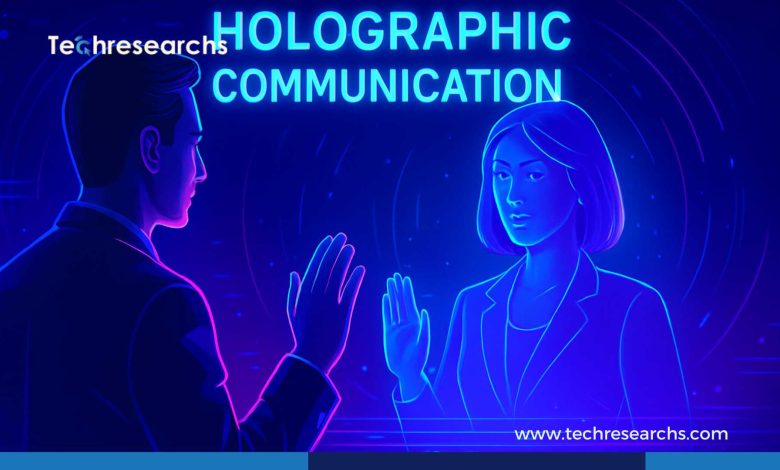
Remote collaboration has improved significantly, yet video conferencing still lacks real presence. Holographic Communication introduces a more immersive way for teams to connect by projecting life-like 3D representations into shared digital spaces. This shift is changing how people collaborate, learn, and make decisions across distances.
As organizations look for deeper engagement and more natural interaction, holographic-based collaboration is becoming a powerful alternative to traditional tools.
What Is Holographic Communication?
Holographic Communication enables real-time 3D interaction using spatial computing, mixed reality, and advanced networking. Instead of appearing on a flat screen, participants are represented as three-dimensional digital forms that exist within a shared environment.
This added depth allows conversations to feel more realistic and engaging.
Core Technologies Powering This Innovation
Several technologies make this experience possible:
- Mixed reality headsets
- 3D depth cameras and sensors
- AI-powered rendering systems
- High-speed networks such as 5G
Together, they support smooth and responsive collaboration.
Why Holographic Communication Improves Virtual Collaboration
Standard video meetings limit body language and spatial awareness. In contrast, immersive collaboration tools add realism and presence.
Key Benefits for Teams
- Stronger engagement during meetings
- Better understanding through visual context
- Improved collaboration across time zones
- Reduced meeting fatigue
As a result, teams communicate more clearly and work more efficiently.
Holographic Communication in the Workplace
Holographic Communication for Remote Teams
Distributed teams benefit significantly from this technology. Seeing colleagues as realistic projections allows for natural gestures, eye contact, and movement, which strengthens team connection.
This creates a sense of working together, even when people are geographically separated.
Holographic Communication for Hybrid Work Models
Hybrid organizations often struggle with inclusion. Immersive collaboration tools help remote employees feel equally present during meetings and workshops.
Industry Applications of Holographic Communication
Healthcare and Medical Collaboration
Doctors use immersive 3D communication to:
- Conduct remote consultations
- Train medical professionals
- Collaborate on complex procedures
This improves precision and saves valuable time.
Education and Training
Schools and universities use holograms for interactive lessons. Students can explore 3D models, virtual labs, and remote instructors, making learning more engaging.
Engineering and Product Development
Design teams collaborate using shared 3D prototypes. This reduces errors and speeds up product development cycles.
Gartner highlights spatial computing as a major driver of enterprise innovation.
Holographic Communication vs Video Conferencing
Comparison Table
| Feature | Video Conferencing | Holographic Collaboration |
|---|---|---|
| Interaction Style | 2D video | Immersive 3D presence |
| Engagement | Moderate | High |
| Non-Verbal Communication | Limited | Natural and visible |
| Collaboration Quality | Functional | Experiential |
| Equipment | Webcam | MR headset |
Challenges of Holographic Communication
Despite its advantages, adoption comes with challenges:
- High initial setup costs
- Dependence on strong network infrastructure
- User learning curve
However, ongoing innovation is steadily reducing these barriers.
Future Trends in Holographic Communication
AI-Driven Realism
Artificial intelligence will enhance facial expressions, motion accuracy, and voice synchronization, making digital presence more lifelike.
Network Advancements
5G and edge computing will support smoother real-time interaction with minimal latency.
Broader Accessibility
As hardware becomes more affordable, adoption will expand beyond large enterprises to smaller teams.
Holographic Communication represents a major step forward in how people connect and collaborate digitally. By combining immersion, realism, and spatial interaction, it enables teams to work together more naturally and effectively. As technology continues to mature, organizations that adopt immersive collaboration early will gain a competitive advantage.
FAQs
1. How is holographic collaboration different from video calls?
A. It offers 3D presence and spatial interaction instead of flat video windows.
2. Is this technology affordable for small businesses?
A. Costs are decreasing, making adoption more accessible over time.
3. Which industries benefit the most?
A. Healthcare, education, engineering, and remote-first organizations.
4. Will it replace video conferencing completely?
A. It will likely complement video tools rather than fully replace them.