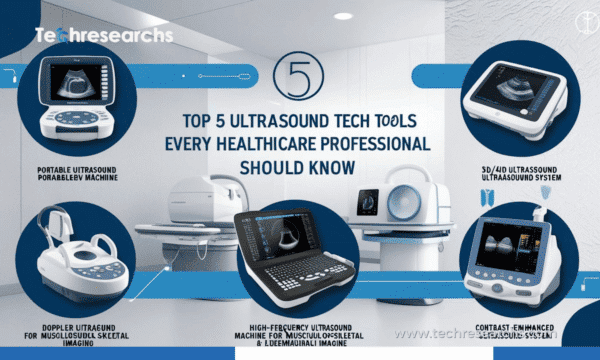
Ultrasound is no longer limited to large machines sitting in dedicated imaging rooms. The technology has become smaller, faster, smarter, and much easier to use at the point of care.
For many healthcare professionals, ultrasound can provide useful information within minutes. A doctor can examine a patient at the bedside, check blood flow, look at soft tissues, or guide a procedure without necessarily sending the patient to another department first.
The technology behind these systems is also changing quickly. Handheld scanners, AI-powered features, advanced Doppler imaging, and 3D capabilities are becoming increasingly common.
So, which ultrasound technologies are worth knowing about in 2026?
Here are five that stand out.
1. Handheld Ultrasound Devices
Imagine carrying an ultrasound scanner in your pocket.
That idea would have sounded unrealistic a few decades ago, but handheld ultrasound devices have made it possible. A compact probe can connect to a mobile device or dedicated display and produce ultrasound images directly at the patient’s bedside.
This can be especially useful when a quick assessment is needed.
Healthcare professionals may use handheld ultrasound for situations such as:
- Checking for fluid buildup
- Looking at the heart and lungs
- Assessing blood vessels
- Supporting emergency examinations
- Performing bedside assessments
- Working in locations where large imaging equipment isn’t available
The real benefit is convenience. Instead of moving the patient to a separate imaging room, clinicians can sometimes bring the imaging tool directly to the patient.
That said, small does not mean simple. Getting useful images still requires appropriate training and an understanding of the device’s limitations.
2. AI-Assisted Ultrasound
Artificial intelligence is finding its way into ultrasound, and this is one of the more interesting developments to watch.
Modern ultrasound software can assist with tasks that traditionally required considerable experience. Depending on the system and application, AI may help identify anatomy, optimize images, provide scanning guidance, or automate certain measurements.
Think of it as having an intelligent assistant built into the ultrasound system.
For someone who is still developing their scanning skills, guided workflows can make it easier to find the right imaging position. For experienced users, automated measurements can potentially reduce some repetitive work.
But there is an important distinction: AI is an assistant, not a replacement for clinical expertise.
Healthcare professionals still need to understand what they are looking at, recognize poor-quality images, and make clinical decisions based on the complete patient picture.
3. Doppler Ultrasound
Sometimes an ordinary ultrasound image isn’t enough. A clinician may also need to know how blood is moving through a vessel.
That’s where Doppler ultrasound becomes useful.
Doppler technology allows healthcare professionals to assess blood flow and can provide information about its direction and velocity. It is widely used in vascular, cardiac, and obstetric applications.
For example, a clinician may use Doppler imaging when evaluating:
- Blood vessels
- Circulation problems
- Certain heart conditions
- Blood flow during pregnancy
- Suspected vascular abnormalities
Color Doppler can make blood-flow information easier to visualize, while spectral Doppler can provide more specific flow measurements.
For healthcare professionals, understanding Doppler is important because it adds another layer of information beyond simply looking at anatomy.
4. 3D and 4D Ultrasound
Most people are familiar with the traditional two-dimensional ultrasound image. But today’s technology can go beyond a flat image.
3D ultrasound creates a three-dimensional representation, while 4D ultrasound adds movement over time.
These technologies are particularly familiar in areas such as pregnancy imaging, but their applications extend beyond that.
Depending on the clinical setting, 3D and 4D imaging can help professionals get a better sense of anatomical structures and view them from different angles.
The advantage isn’t simply that the images look impressive. In the right clinical situation, additional spatial information can make anatomy easier to understand.
Still, more dimensions don’t automatically mean a better examination. The right technology depends on what the clinician is trying to evaluate.
5. Ultrasound-Guided Procedure Technology
Ultrasound can do more than help doctors see what’s happening inside the body. It can also help them perform certain procedures more accurately.
With ultrasound guidance, a clinician can watch anatomy in real time while positioning a needle or other instrument.
This approach can be useful for procedures such as:
- Vascular access
- Regional anesthesia
- Fluid drainage
- Certain biopsies
- Needle-guided interventions
The key advantage is visibility.
Rather than relying only on external landmarks, the clinician can see relevant structures while performing the procedure. This can be particularly valuable when anatomy is difficult to identify by touch or when precision is important.
Modern systems may also include features that make needles easier to see and help clinicians optimize the image while working.
Why These Ultrasound Tools Matter
The biggest change in ultrasound isn’t just better picture quality.
It’s accessibility.
Ultrasound equipment is becoming easier to carry, easier to connect, and increasingly capable of assisting the person using it. That combination is changing where and how ultrasound can be used.
A clinician working in an emergency department may need an immediate bedside assessment. A specialist may need detailed Doppler information. Another professional may need ultrasound guidance during a procedure.
The same basic technology can support very different needs.
This flexibility is one reason ultrasound continues to be important across modern healthcare.
How to Choose the Right Ultrasound Technology
There isn’t one ultrasound device that is perfect for every healthcare professional.
Before choosing a system, it helps to think about the actual work it needs to perform.
Consider the Clinical Application
A device used for cardiac examinations may have different requirements from one intended for musculoskeletal imaging or vascular assessment.
Start with the clinical need rather than simply choosing the device with the longest list of features.
Look at the Probe
The transducer is one of the most important parts of an ultrasound system.
Different probes are designed for different depths, body areas, and examination types. Having the right probe can make a bigger practical difference than having a collection of unnecessary software features.
Check Image Quality
Clear images matter. But image quality should be considered in the context of the examinations you actually perform.
A device that produces excellent images for one application may not be the best option for another.
Don’t Ignore Software
Today’s ultrasound systems are increasingly software-driven.
Image optimization, automated measurements, AI assistance, connectivity, and workflow tools can all affect how practical a system is in everyday use.
Think About Training
Even the most advanced ultrasound machine won’t automatically produce a good examination.
The person operating the system needs appropriate knowledge and hands-on training. This is especially important when ultrasound is being used to support clinical decisions.
What’s Next for Ultrasound?
The direction of ultrasound technology is fairly clear: smaller devices, smarter software, better connectivity, and more point-of-care use.
AI may continue to help clinicians acquire and analyze images. Portable systems may become even more capable. Cloud-based workflows could make it easier to share examinations and information across healthcare teams.
Another important development is the continued growth of point-of-care ultrasound, or POCUS.
Instead of ultrasound being viewed only as a specialized imaging service, it can increasingly become part of a clinician’s bedside toolkit.
That doesn’t mean every healthcare professional needs to become an ultrasound expert. It means the technology is becoming more accessible to professionals who have the right training and a clear clinical reason to use it.
Final Thoughts
Ultrasound technology has changed significantly, and the changes aren’t slowing down.
Handheld ultrasound, AI-assisted imaging, Doppler technology, 3D and 4D imaging, and ultrasound-guided procedures are five areas every healthcare professional should understand as medical imaging continues to evolve.
The most exciting part isn’t necessarily one particular machine or feature. It’s the fact that ultrasound is becoming more practical and available in everyday clinical settings.
For healthcare professionals, keeping up with these developments can help them understand what modern ultrasound can do, when it can be useful, and where professional training and clinical judgment remain essential.
As we move further into 2026, ultrasound is becoming less about simply taking a picture and more about giving healthcare professionals useful information when and where they need it.
Frequently Asked Questions
1. What are the top ultrasound tools healthcare professionals should know?
Handheld scanners, AI-assisted ultrasound, Doppler systems, and 3D/4D ultrasound are key technologies to know in 2026.
2. Is handheld ultrasound useful in everyday healthcare?
Yes. Portable scanners can support quick bedside assessments without moving the patient to a traditional imaging room.
3. How does AI help with ultrasound?
AI can assist with image quality, measurements, anatomy identification, and scanning guidance.
4. Why is Doppler ultrasound important?
Doppler ultrasound helps professionals examine blood flow, circulation, and blood vessels.