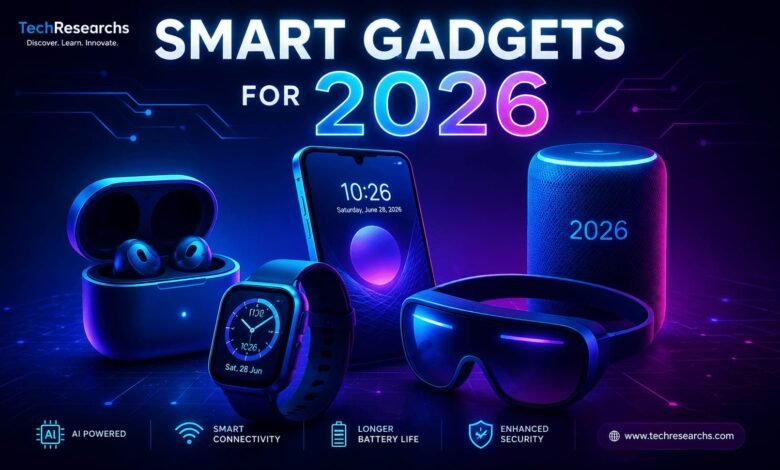
Technology is becoming a bigger part of everyday life, but the most exciting gadgets of 2026 are not simply about adding more features. The focus is shifting toward devices that can understand what users need, work with less input, and fit naturally into daily routines.
Artificial intelligence, advanced sensors, faster connectivity, and edge computing are helping manufacturers create a new generation of smart products. Some are already available, while others are still developing. From AI-powered glasses to smart rings and intelligent home appliances, these gadgets could change how people interact with technology over the next few years.
Here are some of the most interesting smart gadget categories to keep an eye on in 2026.
1. AI-Powered Smart Glasses
Smart glasses have moved well beyond the idea of simply putting a screen in front of your eyes. Newer models are combining cameras, microphones, speakers, and AI assistants to provide hands-free access to information.
Imagine asking your glasses to translate a sign, identify an object, capture a photo, or help you remember something without reaching for your smartphone. That kind of interaction is one reason smart glasses are attracting so much attention.
The technology still has limitations. Battery life, privacy, comfort, and social acceptance all need to improve before smart glasses become an everyday accessory for most people.
Why they matter: Smart glasses could eventually reduce the need to constantly look at a smartphone for simple tasks.
2. Smart Rings
Smart rings are small enough to wear throughout the day but can contain surprisingly capable sensors. They are becoming popular among people who want to monitor activity, sleep, and other wellness-related measurements without wearing a large smartwatch.
One advantage of a ring is its simplicity. There is no large screen competing for attention, and users can generally wear one without thinking about it.
As sensor technology improves, smart rings may become even more useful. The important development will be turning collected data into understandable information rather than simply presenting users with endless statistics.
Why they matter: Smart rings offer a discreet way to collect useful personal data without adding another screen to your day.
3. Screen-Free AI Wearables
One of the more interesting ideas emerging in wearable technology is the move away from screens.
Instead of another smartwatch or display, some companies are experimenting with small AI-powered devices that communicate through voice, sound, or subtle feedback. These gadgets could potentially help with reminders, note-taking, quick questions, translations, and other everyday tasks.
The concept is appealing because technology becomes less distracting. Instead of stopping to look at a screen, users can interact with a device while continuing what they are doing.
However, privacy will be especially important for products that use microphones or cameras throughout the day.
Why they matter: Screen-free wearables could make technology feel more natural and less demanding.
4. AI-Powered Wireless Earbuds
Wireless earbuds have already replaced traditional wired earphones for many people. Their next evolution could turn them into much more capable personal assistants.
Modern earbuds already contain microphones, processors, wireless connectivity, and noise-control technology. Adding stronger AI capabilities could allow them to provide real-time translation, smarter voice assistance, improved call handling, and more personalized audio experiences.
For many users, this may be more practical than buying a completely new type of wearable because earbuds are already part of their daily routine.
Why they matter: Earbuds could become one of the simplest ways to access AI while keeping your hands and eyes free.
5. Smarter Home Appliances
The smart home is gradually moving beyond individual connected products.
Instead of having a separate app for every appliance, future smart homes could allow devices to communicate with one another. Lighting, air conditioning, security cameras, appliances, and entertainment systems could respond to routines and environmental conditions automatically.
For example, a smart home might adjust lighting when you arrive, change the temperature based on your routine, or notify you when an unusual activity is detected.
The challenge is making these systems easy to set up. Smart technology loses its appeal when users have to spend hours configuring different devices.
Why they matter: The goal of a smart home should be convenience, not more complicated technology.
6. AI-Powered Home Robots
Home robots are another category worth watching in 2026.
Robots have traditionally been associated with specific tasks, such as vacuuming floors. Advances in AI and computer vision could make future household robots more flexible and capable of handling a wider range of tasks.
Rather than simply following a fixed route, an intelligent robot could potentially recognize objects, understand its surroundings, and adapt to changes in the home.
That future is still developing, and affordability remains a major obstacle. Consumers will need to see genuine practical value before expensive household robots become mainstream.
Why they matter: Better AI could make home robots more adaptable and useful than today’s task-specific machines.
7. Next-Generation Health and Fitness Wearables
Smartwatches and fitness trackers are becoming increasingly sophisticated. They can monitor activity, sleep patterns, heart-related measurements, and other wellness signals depending on the device.
The next step is likely to involve AI analyzing this information and presenting it in a simpler, more personalized way.
Instead of showing dozens of numbers, a wearable could highlight meaningful changes and trends. This could make health and fitness data easier for ordinary users to understand.
However, consumers should remember that wellness gadgets are not automatically medical devices. Their measurements and insights should not be treated as a replacement for professional medical advice.
Why they matter: The future of wearables is likely to focus more on useful insights and less on raw data.
8. Intelligent Home Security Devices
Smart security cameras and video doorbells are becoming more capable as AI-powered detection improves.
Instead of sending an alert every time something moves, intelligent systems can attempt to determine whether the activity is important. Depending on the product, AI may help distinguish people, vehicles, animals, or other types of movement.
Future security systems could combine cameras, door sensors, motion detectors, and other connected devices to provide a more complete picture of what is happening around a property.
Privacy remains a major consideration. Consumers should understand how recordings are stored, who can access them, and whether processing happens locally or in the cloud.
Why they matter: AI can make home security alerts more useful while reducing unnecessary notifications.
9. AR and Spatial Computing Devices
Augmented reality and spatial computing continue to develop as manufacturers look for alternatives to traditional screens.
AR glasses and spatial devices can potentially place digital information into the user’s surroundings. Applications range from entertainment and gaming to navigation, productivity, education, and professional work.
The technology is impressive, but widespread adoption will depend on practical factors such as comfort, weight, battery life, pricing, and available applications.
If manufacturers can solve those problems, spatial computing could become a much more familiar part of everyday technology.
Why they matter: Spatial devices could change the way people interact with digital content by making information feel more connected to the physical world.
10. Gadgets With On-Device AI
One of the most important developments may not be immediately visible to consumers: AI running directly on devices.
Traditionally, many AI services depend heavily on cloud servers. On-device AI allows compatible hardware to process certain tasks locally.
This can provide faster responses and may offer privacy advantages because some information does not need to leave the device. It can also be useful when internet connectivity is poor or unavailable.
Phones, laptops, cameras, wearables, and other gadgets are increasingly incorporating processors designed to handle AI workloads.
Why they matter: On-device AI could make smart gadgets faster, more private, and less dependent on a constant internet connection.
What Should You Look for in a Future-Ready Gadget?
Buying the newest gadget simply because it has an AI label is not always a good idea. A genuinely useful smart device should solve a real problem.
Before purchasing one, consider:
- Practical value: Does it actually make something easier?
- Battery life: Can you comfortably use it throughout the day?
- Privacy: What information does the device collect?
- Compatibility: Will it work with the devices you already own?
- Software updates: Will the manufacturer continue supporting it?
- Durability: Is it designed for everyday use?
- Price: Are the features worth the additional cost?
- Ease of use: Can you set it up without unnecessary complexity?
These factors often matter more than having the newest specifications.
Are Smart Gadgets Becoming More Useful?
The answer is increasingly yes, but progress is not happening equally across every category.
Some products are already genuinely useful, while others still feel like experiments. Smart rings and AI-enhanced earbuds, for example, fit naturally into existing habits. Advanced home robots and some screen-free AI devices still have more questions surrounding price, reliability, and long-term usefulness.
The biggest change is that smart gadgets are becoming less focused on simply connecting to the internet. They are increasingly designed to understand context, automate repetitive actions, and respond to users more naturally.
That shift could be more important than any individual gadget launch.
The Future of Smart Gadgets in 2026
The smart gadgets worth watching in 2026 are not necessarily the most expensive or technically impressive products. The real winners will be the devices that provide useful technology without making everyday life more complicated.
AI glasses could make information accessible without a phone. Smart rings could provide discreet tracking. Intelligent earbuds could become personal AI assistants. Smart homes could automate routine tasks, while on-device AI could make gadgets faster and more private.
At the same time, consumers should remain realistic. Privacy, battery life, cost, reliability, compatibility, and software support will determine whether these technologies become everyday products or remain interesting experiments.
Final Thoughts
The next generation of smart gadgets is moving toward a simpler idea: technology should work for people instead of constantly asking people to work with technology.
As AI and connected hardware continue to improve, gadgets are likely to become more aware of their surroundings and better at handling routine tasks. That does not mean every new device will be worth buying. It means consumers will have more choices and should focus on products that offer genuine value.
For anyone interested in the future of consumer technology, 2026 is shaping up to be an important year to watch. The most successful gadgets will probably be the ones that quietly become part of everyday life rather than the ones that simply generate the most attention.
Frequently Asked Questions
1. What are the most promising smart gadgets to watch in 2026?
AI-powered smart glasses, smart rings, intelligent earbuds, home robots, smart home devices, and on-device AI gadgets are among the key categories to watch in 2026.
2. Are AI-powered smart gadgets worth buying in 2026?
They can be worth buying when they solve a genuine problem, offer reliable performance, provide regular software updates, and fit your everyday needs.
3. How is AI changing smart gadgets?
AI allows gadgets to understand commands, recognize patterns, automate tasks, provide personalized information, and respond more naturally to users.
4. What should I consider before buying a smart gadget?
Check its practical features, battery life, privacy controls, compatibility, software support, durability, price, and how easily it integrates with your existing devices.