Biotechnology has moved far beyond traditional laboratory research. Advances in artificial intelligence, gene editing, synthetic biology, cell therapy, bioinformatics, and precision medicine are changing how scientists understand biological systems and develop new solutions.
The biotech landscape of 2023 was already defined by rapid innovation, but the industry has since entered a more integrated phase. Today, computational technologies and biological research increasingly work together to accelerate discovery, improve therapeutic development, and create more personalized approaches to healthcare.
As we move through 2026, several biotechnology trends stand out as particularly important.
The Evolution of Biotechnology
Modern biotechnology combines biology with computing, engineering, data science, and automation. Researchers can now analyze enormous biological datasets, model molecular interactions, edit genetic material, and design biological systems with increasingly sophisticated tools.
The biggest change is not simply the arrival of a single breakthrough technology. Instead, multiple technologies are converging to create faster and more data-driven research workflows.
Among the most important developments are:
- AI-powered drug discovery
- Next-generation gene editing
- Personalized and precision medicine
- Advanced cell and gene therapies
- Synthetic biology
- Computational biology and bioinformatics
- Automated laboratories
- Organs-on-chips and alternative testing technologies
- AI-assisted biological design
- More specialized therapies for rare diseases
1. AI Is Becoming a Core Biotechnology Tool
Artificial intelligence is becoming one of the most influential technologies in modern biotechnology.
AI and machine learning can help researchers analyze biological datasets, identify potential drug targets, predict molecular properties, optimize candidate compounds, and prioritize experiments.
The industry is also moving toward more integrated AI-driven research environments rather than using AI only for individual analytical tasks. Recent industry reporting highlights growing investment in AI-based drug discovery and biological design.
AI does not eliminate the need for laboratory experiments. Instead, its major value is helping researchers decide which experiments are more promising before committing significant time and resources.
Why AI matters for biotech
AI can potentially help researchers:
- Analyze complex biological datasets
- Identify promising therapeutic targets
- Predict molecular interactions
- Improve drug candidate selection
- Support protein and biological structure research
- Automate repetitive laboratory processes
- Reduce the number of unnecessary experiments
The next stage of AI-driven biotechnology is likely to involve tighter connections between computational models, laboratory automation, and experimental validation.
2. Gene Editing Continues to Advance
Gene editing remains one of the most important areas of biotechnology.
CRISPR-based technologies have demonstrated that genetic material can be modified with remarkable precision. Research is now expanding toward improving editing accuracy, delivery systems, safety assessment, and the development of therapies for specific genetic conditions.
Regulatory developments also demonstrate how quickly this field is evolving. In 2026, the U.S. FDA issued draft guidance addressing genome-editing products and the assessment of their safety, including approaches for evaluating potential off-target effects.
This suggests that the future of gene editing is not only about discovering new editing technologies. It is also about establishing reliable methods for testing, manufacturing, and regulating these therapies.
3. Personalized Medicine Is Becoming More Precise
Healthcare is gradually moving from a one-size-fits-all approach toward treatments designed around individual biological characteristics.
Genomic information, biomarkers, medical history, and other biological data can help researchers and clinicians identify differences between patients and potentially select more appropriate treatments.
This is particularly important for diseases where conventional treatments do not work equally well for every patient.
The development of individualized therapies is also gaining regulatory attention. In February 2026, the FDA announced a framework aimed at supporting the development of treatments for ultra-rare diseases where conventional large clinical trials may not be practical.
This could support a future in which certain therapies are developed for very small patient populations based on specific genetic or molecular characteristics.
4. Cell and Gene Therapies Are Expanding
Cell and gene therapies have progressed from experimental research toward real-world medical applications.
These approaches can involve modifying cells, replacing or correcting genetic material, or using engineered biological systems to address disease at its underlying biological level.
The FDA reported that its Center for Biologics Evaluation and Research had approved close to 50 cell and gene therapies over the previous decade, demonstrating how significantly the field has advanced.
A major challenge now is scaling these therapies.
Researchers and biotechnology companies must address:
- Manufacturing complexity
- Treatment costs
- Quality control
- Patient-specific production
- Long-term safety monitoring
- Regulatory requirements
- Delivery of therapies to the correct tissues
Future progress will depend not only on discovering new therapies but also on making them easier and more efficient to manufacture and deliver.
5. Synthetic Biology Is Moving Toward Biological Design
Synthetic biology treats biological systems as something that can be engineered for specific purposes.
Researchers can design or modify biological components to create useful functions in healthcare, agriculture, manufacturing, environmental science, and other industries.
The convergence of AI and synthetic biology is particularly significant. AI systems are increasingly being explored for biological design, while laboratory systems can be used to test and refine those designs.
This creates a potential design-build-test-learn cycle in which computational systems propose biological designs, laboratories test them, and experimental results are fed back into future designs.
However, greater biological design capability also increases the importance of biosafety, security, and responsible governance.
6. AI-Designed Biology Raises New Opportunities and Risks
One of the emerging developments in biotechnology is the use of generative AI to design biological systems.
Recent research has demonstrated that AI can be used to generate functional biological designs, highlighting both the potential and the risks of AI-assisted biological engineering.
These technologies could eventually contribute to areas such as:
- Therapeutic development
- Biological research
- Antimicrobial research
- Protein engineering
- Synthetic biology
- Industrial biotechnology
At the same time, biological AI is a dual-use field. The same capabilities that can support beneficial research could potentially be misused.
For this reason, future biotechnology innovation will need strong safety controls, responsible data practices, human oversight, and appropriate regulatory frameworks.
7. Drug Discovery Is Becoming More Computational
Traditional drug discovery can require years of research before a promising candidate reaches advanced development.
AI and computational biology are changing parts of this process by helping researchers analyze targets, predict molecular properties, explore chemical space, and prioritize candidates.
Recent industry developments indicate that AI is increasingly integrated into drug-development pipelines, although computational predictions still require extensive experimental and clinical validation.
The important shift is therefore not “AI replaces drug discovery.” Instead, biotechnology is moving toward a hybrid model in which AI, scientists, laboratory automation, and clinical research work together.
8. Automated Laboratories Are Reshaping Research
Laboratory automation is another important trend.
Robotic systems can perform repetitive tasks, manage samples, execute standardized experiments, and collect large quantities of experimental data.
When combined with AI, automated laboratories can support faster experimental cycles.
A simplified workflow looks like this:
AI model → Experimental design → Automated laboratory → Data collection → Analysis → Improved model
This approach could allow researchers to test more hypotheses while reducing repetitive manual work.
9. Organs-on-Chips and New Testing Methods
Biotechnology is also exploring alternatives and complements to traditional laboratory testing.
Organs-on-chips use engineered systems to model aspects of human organs and biological processes. These technologies can help researchers investigate disease mechanisms, drug responses, and toxicity.
The broader movement toward New Approach Methodologies is also receiving regulatory attention. The FDA has highlighted technologies such as AI-powered models, human organ-on-chip systems, and real-world data as part of efforts to modernize aspects of drug development and reduce reliance on some traditional testing approaches.
These technologies may become increasingly important as researchers look for more human-relevant ways to evaluate potential therapies.
10. Bioinformatics Is Becoming More Important
The amount of biological data being generated continues to increase.
Genomic sequencing, proteomics, medical imaging, clinical information, and other datasets require advanced computational tools for storage, processing, and interpretation.
Bioinformatics therefore remains a critical part of modern biotechnology.
Future bioinformatics platforms will increasingly combine:
- Genomic data
- AI and machine learning
- Cloud computing
- Molecular modeling
- Clinical datasets
- Multi-omics analysis
The ability to connect these datasets could help researchers better understand complex diseases and identify relationships that may not be visible when each dataset is analyzed separately.
11. Biotechnology Is Moving Toward More Targeted Therapies
Another major direction is the development of therapies designed for specific biological targets.
Instead of relying exclusively on broad treatment approaches, researchers are increasingly investigating molecular targets, biomarkers, genetic variants, and disease-specific pathways.
This trend is particularly important in oncology, rare diseases, genetic disorders, and other areas where disease biology can vary significantly between patients.
The result could be more precise therapies with better matching between patients and treatments.
12. Biomanufacturing Is Becoming a Strategic Priority
Biotechnology innovation does not end when a therapy or biological product is discovered.
Manufacturing is often one of the biggest challenges.
Companies are investing in improved bioprocessing, automation, quality control, scalable production systems, and more efficient manufacturing methods.
For cell and gene therapies especially, regulators are exploring ways to make development and manufacturing more efficient without compromising safety. The FDA’s 2026 initiatives emphasize greater use of existing scientific and platform knowledge in the development of certain gene therapies.
13. Biotechnology Is Expanding Beyond Healthcare
Healthcare remains one of biotechnology’s most visible applications, but innovation is also occurring in other industries.
Agriculture
Biotechnology can support:
- Crop improvement
- Disease resistance
- Stress tolerance
- Biological pest management
- Sustainable agricultural production
Industrial Biotechnology
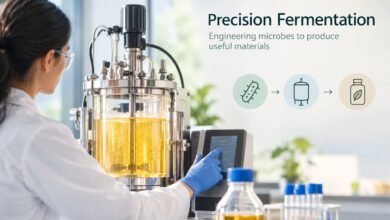
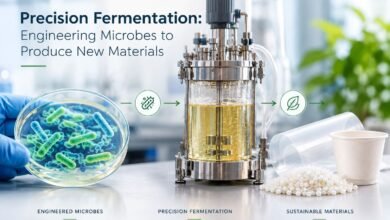
Engineered microorganisms and biological processes can be used to produce chemicals, materials, fuels, and other products.
Environmental Biotechnology
Biological systems are also being explored for:
- Waste treatment
- Pollution reduction
- Resource recovery
- Sustainable manufacturing
This broader application of biotechnology could make biological engineering an important component of future sustainability strategies.
14. The Importance of Biotech Data and Governance
As biotechnology becomes increasingly digital, data governance becomes just as important as scientific innovation.
Researchers and organizations need to consider:
- Data privacy
- Genetic information security
- AI transparency
- Reproducibility
- Model reliability
- Biosafety
- Biosecurity
- Ethical use of biological data
The growing use of AI in biological research makes these issues especially important because biological AI can have both beneficial and harmful applications.
What Will Shape the Future of Biotechnology?
The future of biotechnology will likely be defined by convergence.
AI will increasingly connect with genomics. Robotics will connect with laboratory research. Synthetic biology will connect with computational design. Gene editing will connect with personalized medicine.
Rather than viewing these technologies independently, the biotechnology industry is increasingly building integrated systems that combine them.
This convergence could make biological research faster, more precise, and more scalable.
However, scientific progress will need to be balanced with affordability, safety, regulation, ethical considerations, and responsible innovation.
Challenges Facing the Biotechnology Industry
Despite rapid progress, biotechnology still faces significant challenges.
High Development Costs
Developing new therapies requires substantial investment in research, clinical trials, manufacturing, and regulatory processes.
Regulatory Complexity
Innovative technologies can create regulatory questions that existing frameworks were not originally designed to address.
Data Quality
AI systems depend heavily on high-quality biological data. Incomplete or biased datasets can affect model performance.
Safety
Gene editing, synthetic biology, and AI-assisted biological design require careful safety evaluation.
Manufacturing
Some advanced therapies remain difficult to manufacture at large scale.
Accessibility
A breakthrough is only truly impactful when patients and communities can access it at a reasonable cost.
What Makes 2026 Different From 2023?
The biotechnology industry in 2023 was already experiencing major advances in CRISPR, mRNA technologies, AI-assisted research, and synthetic biology.
By 2026, the emphasis has increasingly shifted toward integration and translation.
The question is no longer simply whether a technology works in a laboratory. Researchers and companies must also determine whether it can be safely manufactured, clinically validated, regulated, and delivered to patients or customers.
This transition from experimentation to scalable application is one of the defining characteristics of today’s biotechnology industry.
Conclusion
Biotechnology has entered a new era in which biology, artificial intelligence, engineering, and data science increasingly operate together.
AI-powered drug discovery, gene editing, personalized medicine, cell and gene therapies, synthetic biology, laboratory automation, and advanced computational biology are among the major forces shaping the sector in 2026.
The next generation of biotechnology will not be defined by one technology alone. Its biggest breakthroughs are likely to come from combining multiple capabilities into integrated research and healthcare systems.
As these technologies mature, responsible development will be essential. Scientific innovation must progress alongside strong safety practices, ethical standards, effective regulation, and broader access.
The biotech revolution is therefore moving from pioneering discoveries toward practical implementation—and the coming years could determine how deeply these technologies transform healthcare, industry, agriculture, and environmental sustainability.
Frequently Asked Questions
1. What are the major biotechnology trends in 2026?
Major trends include AI-powered drug discovery, gene editing, personalized medicine, cell and gene therapies, synthetic biology, laboratory automation, and computational biology.
2. How is AI changing biotechnology?
AI helps researchers analyze biological data, predict molecular interactions, identify potential drug targets, design biological systems, and prioritize laboratory experiments.
3. What role does CRISPR play in modern biotechnology?
CRISPR enables researchers to make targeted changes to genetic material. Current research is focused on improving precision, delivery, safety, and applications in treating genetic diseases.
4. What is the future of biotechnology?
The future is likely to involve greater integration of AI, genomics, synthetic biology, robotics, and personalized medicine, with increasing emphasis on safety, regulation, scalable manufacturing, and accessibility.