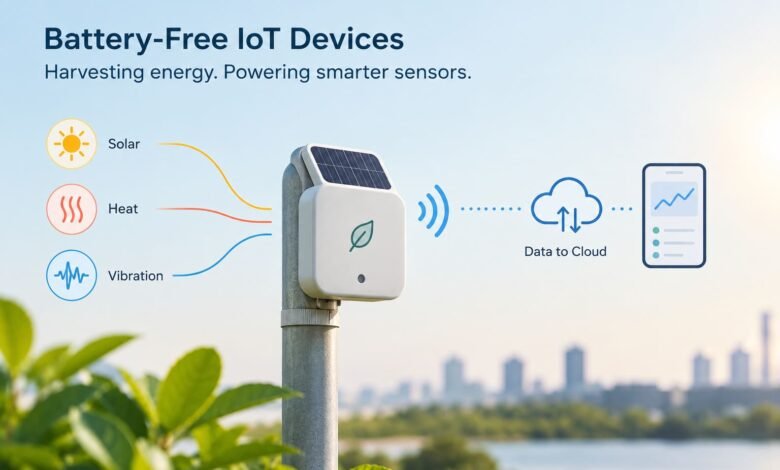
Imagine a temperature sensor installed inside a factory machine that monitors its condition for years without requiring regular battery replacements. Or consider a smart agriculture sensor that collects environmental data using energy from sunlight. These ideas are becoming increasingly practical through advances in battery-free Internet of Things (IoT) technology.
IoT devices help machines, sensors, and everyday objects collect and exchange information. However, many connected devices still depend on batteries, which eventually need recharging or replacement. Maintaining hundreds or thousands of sensors can become expensive and difficult, especially when they are installed in remote locations or hard-to-reach industrial equipment.
Battery-free IoT devices offer another approach. Instead of relying entirely on conventional batteries, these systems collect small amounts of energy from their surroundings and convert it into electricity. This process is known as energy harvesting.
Although the technology still has limitations, it is creating new possibilities for low-power sensors, industrial monitoring, smart buildings, and environmental data collection.
What Are Battery-Free IoT Devices?
Battery-free IoT devices are connected electronic systems designed to operate without conventional batteries. They obtain energy from available sources such as light, heat differences, mechanical vibrations, or radio-frequency signals.
A typical system includes an energy-harvesting component, a power-management circuit, a sensor, a small processing unit, and a wireless communication mechanism. Some devices also use a capacitor or another small energy-storage component to collect energy before performing a task.
For example, a sensor attached to a vibrating industrial machine may capture some of the machine’s mechanical energy. The harvested electricity can then power a low-energy sensing operation or support occasional wireless data transmission.
Not every battery-free sensor works continuously. Some devices collect energy over time and operate only when enough electricity is available. Their performance depends on the surrounding environment and the amount of energy required for each task.
How Does Energy Harvesting Work?
Energy harvesting allows electronic devices to use energy that would otherwise remain unused. The exact process depends on the energy source and the design of the sensor.
1. Solar Energy Harvesting
Small photovoltaic cells convert light into electrical energy. Outdoor sensors can use sunlight, while specially designed indoor photovoltaic cells may collect energy from artificial lighting.
This approach can support applications such as environmental monitoring, smart agriculture, and building automation. However, energy production changes with lighting conditions, and a sensor may struggle to operate when light is unavailable.
2. Thermal Energy Harvesting
Thermal energy harvesters can generate electricity when a suitable temperature difference exists between two sides of a device. Thermoelectric components are one example of this technology.
Industrial equipment, heating systems, and certain pipelines may provide useful temperature differences. A sensor can potentially use this energy to monitor temperature or equipment conditions without depending entirely on a replaceable battery.
The key requirement is a sufficient and reasonably consistent temperature difference.
3. Vibration and Mechanical Energy Harvesting
Machines, motors, vehicles, and moving structures can produce vibrations or movement. Certain harvesting devices convert this mechanical energy into electrical power.
For instance, a vibration-powered sensor installed on a factory motor could collect energy while the motor operates. It might use the harvested electricity to measure vibration levels and report signs of unusual machine behavior.
This method is particularly relevant to industrial monitoring, although its effectiveness depends on vibration strength, frequency, and operating conditions.
4. Radio-Frequency Energy Harvesting
Radio-frequency (RF) energy harvesting collects electromagnetic energy from radio signals and converts it into usable electrical power. Some systems rely on nearby transmitters or dedicated RF sources, while others attempt to capture ambient signals.
RF harvesting can support certain low-power wireless sensors and identification tags. However, the available energy is often very small, so the device must be carefully designed to keep its energy consumption low.
How Do Battery-Free Sensors Collect and Send Data?
Harvesting energy is only one part of the process. The sensor must also manage that energy efficiently to complete useful tasks.
A typical operating sequence looks like this:
- Collect energy: A harvesting component captures light, heat, vibration, or RF energy.
- Convert the energy: An electronic circuit converts the collected energy into a suitable electrical supply.
- Store energy when needed: A small capacitor or other storage component holds energy until the device can use it.
- Measure the environment: The sensor collects information such as temperature, humidity, pressure, or vibration.
- Process and transmit data: A low-power controller processes the measurement and sends it to a receiver when sufficient energy is available.
Some systems communicate by using backscatter technology. Rather than generating a conventional radio signal, a backscatter device changes how it reflects an existing signal to communicate information while consuming relatively little power.
This can be useful for battery-free tags and sensors, although the communication range and reliability depend on the system design and surrounding conditions.
Applications of Battery-Free IoT Technology
Industrial Equipment Monitoring
Factories often need sensors to monitor motors, pumps, bearings, and other machinery. Battery-free sensors can potentially reduce maintenance work in locations where replacing batteries is inconvenient.
Vibration or thermal energy harvesting may be suitable when equipment produces enough usable energy. These sensors could help maintenance teams identify unusual operating conditions before a problem develops.
Smart Agriculture
Agricultural sensors collect information about soil moisture, temperature, humidity, and local environmental conditions. Energy harvesting can help reduce battery-related maintenance across large farming areas.
Solar-powered sensors are especially promising where sufficient sunlight is available. They can support irrigation monitoring and other data-driven farming activities, provided the system accounts for cloudy weather and periods of low light.
Smart Buildings
Buildings use sensors to monitor occupancy, lighting, temperature, and indoor environmental conditions. Some low-power devices can harvest energy from indoor light or other environmental sources.
Reducing battery replacements can be valuable when sensors are installed throughout offices, commercial buildings, and public facilities.
Environmental Monitoring
Sensors placed in remote locations may collect weather data, monitor water conditions, or measure environmental changes. Visiting every device to replace a battery can require considerable time and expense.
Energy harvesting offers a possible way to extend operating life and reduce maintenance requirements. However, designers must ensure that the energy source remains suitable for the location and that the sensor can operate reliably during periods of limited energy.
Asset Tracking and Smart Labels
Warehouses and supply chains use identification technologies to track products, packages, and equipment. Some battery-free tags can obtain energy from a nearby reader or other available RF source.
These devices can be useful when large numbers of objects need identification without installing a conventional battery in every tag. Their capabilities differ from those of GPS trackers or continuously connected tracking devices, which generally have higher energy requirements.
Benefits of Battery-Free IoT Devices
Reduced Maintenance
Eliminating conventional batteries can reduce the need for repeated battery replacements. This is particularly useful when sensors are installed in large numbers or in difficult-to-access locations.
More Flexible Sensor Placement
Smaller battery-free devices may be easier to install on equipment, products, or narrow surfaces. Their practical size still depends on the harvesting component, electronics, antenna, and any required energy storage.
Lower Battery Waste
Reducing disposable battery use can help limit battery waste and the resources required for replacement. The overall environmental benefit depends on the materials, manufacturing process, service life, and disposal of the complete device.
Support for Large Sensor Networks
Battery-free technology can make certain large-scale sensing deployments easier to maintain. When each sensor uses very little power, harvesting energy from the environment may help support applications that would otherwise require frequent servicing.
Challenges and Limitations
Despite its advantages, battery-free IoT technology is not suitable for every application.
Unpredictable energy availability: Sunlight, vibration, heat differences, and radio signals vary by location and time. A device may not always collect enough energy to operate.
Limited power output: Small energy harvesters often generate only tiny amounts of electricity. High-power sensors, continuous data processing, and frequent wireless transmissions may exceed their capabilities.
Intermittent operation: Some devices must wait until enough energy has accumulated before taking measurements or transmitting data. This can introduce delays.
Design complexity: Energy-harvesting circuits, power management, storage components, and low-power communication systems must work together efficiently. This can increase design and integration challenges.
Environmental reliability: Temperature extremes, moisture, dust, physical wear, and changing operating conditions can affect the performance of harvesting components and sensors.
For these reasons, battery-free systems work best when the required sensing tasks, communication frequency, and available energy are carefully matched. Some applications may benefit more from a rechargeable battery or a hybrid design than from a completely battery-free system.
What Is the Future of Battery-Free IoT Devices?
The future of battery-free IoT will depend on improvements in low-power electronics, energy conversion, wireless communication, and energy-management techniques.
Researchers are exploring systems that combine multiple energy sources, such as indoor light and vibration, to improve energy availability. Advances in small power-management circuits may also help devices operate with weaker energy inputs.
Another important development is energy-aware computing. Instead of following a fixed operating schedule, a sensor can adjust when it measures, processes, or transmits information according to the energy currently available.
These improvements could make battery-free sensing more practical for industrial equipment, smart buildings, logistics, and environmental monitoring. However, widespread adoption will require reliable performance under real-world conditions, not just successful demonstrations in controlled environments.
Conclusion
Battery-free IoT devices represent a promising approach to building connected sensors that require less conventional battery maintenance. By harvesting energy from light, heat, vibration, or radio-frequency signals, these devices can power selected sensing and communication tasks using energy available in their surroundings.
Their greatest potential lies in applications where energy requirements are low and the environment provides a suitable source of power. Industrial monitoring, smart agriculture, building automation, and asset identification are examples of areas where this approach may be valuable.
Battery-free technology will not eliminate batteries from every IoT application. Instead, it provides another option for designing efficient, practical, and potentially more sustainable connected systems.
As energy harvesting and low-power electronics continue to improve, battery-free sensors could become an increasingly useful part of the broader IoT ecosystem.
Frequently Asked Questions
1. What are battery-free IoT devices?
Battery-free IoT devices are sensors that operate without conventional batteries by harvesting energy from sources such as light, heat, vibrations, or radio-frequency signals.
2. How do battery-free IoT sensors generate power?
These sensors use energy-harvesting technologies to convert environmental energy into electricity. Solar cells capture light, thermoelectric generators use temperature differences, and vibration-based systems convert mechanical movement into electrical power.
3. Where can battery-free IoT devices be used?
Battery-free IoT devices can support industrial equipment monitoring, smart agriculture, building automation, environmental sensing, and asset tracking where low-power operation is suitable.
4. What are the main limitations of battery-free IoT devices?
The main limitations include inconsistent energy availability, limited power output, intermittent operation, and design complexity. Their performance depends on the available energy source and the device’s power requirements.