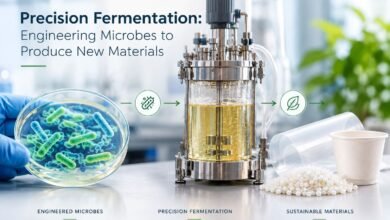
Precision Fermentation: Engineering Microbes to Produce Useful Materials

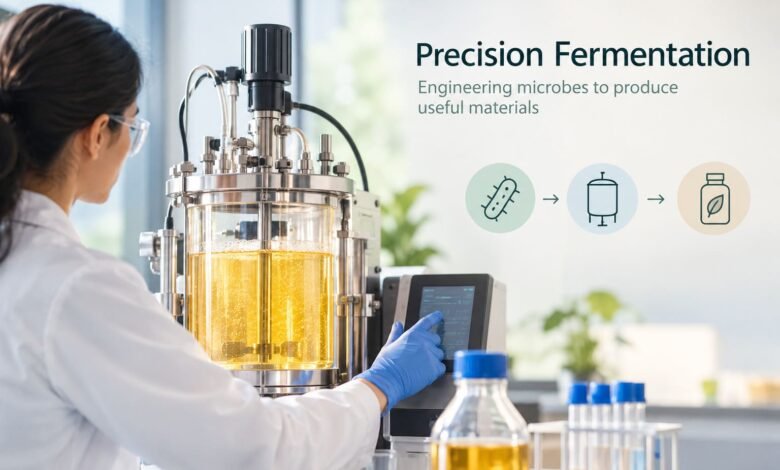
What if scientists could use tiny microorganisms to produce materials that traditionally require farms, factories, or resource-intensive manufacturing processes? This idea is becoming increasingly practical through precision fermentation, a biotechnology approach that uses carefully selected or engineered microorganisms to create specific substances.
Fermentation has been used for thousands of years to make foods such as bread, yogurt, and cheese. Precision fermentation takes this familiar biological process further. Instead of relying only on naturally occurring fermentation, researchers can guide microorganisms to produce particular proteins, enzymes, fats, and other useful compounds.
The technology is attracting attention because it could change how industries manufacture food ingredients, pharmaceutical components, cosmetic materials, and certain industrial chemicals. However, its success depends on more than scientific innovation. Production costs, energy consumption, regulatory requirements, and the ability to scale up manufacturing all play important roles.
What Is Precision Fermentation?
Precision fermentation is a biotechnology process in which microorganisms are used to produce a specific target substance under controlled conditions. These microorganisms may include yeast, bacteria, or fungi.
Scientists can select suitable microbes and, when necessary, modify their genetic instructions so they produce a desired compound. The microorganisms are then grown in fermentation tanks containing nutrients and carefully controlled environmental conditions.
During the process, the microbes use these nutrients to grow and manufacture the target product. Once fermentation is complete, the desired substance is separated from the mixture, purified, and prepared for its intended use.
For example, instead of obtaining a particular milk protein directly from dairy milk, manufacturers can use engineered microorganisms to produce that protein through fermentation. The resulting ingredient can then be used in suitable food formulations after processing and quality testing.
The important distinction is that precision fermentation focuses on producing a defined substance rather than simply encouraging a broad fermentation process.
How Does Precision Fermentation Work?
Although individual applications differ, the process generally follows several stages.
1. Selecting the Right Microorganism
The first step is identifying a microorganism capable of producing the required substance. Yeast and certain bacteria are popular choices because they can grow in controlled environments and are widely studied in biotechnology.
Scientists consider factors such as growth rate, production capability, safety, and the organism’s ability to tolerate industrial conditions.
2. Designing the Biological Instructions
When a microorganism cannot naturally produce enough of the desired compound, researchers may introduce or adjust genetic instructions. These instructions help direct the organism’s cellular machinery toward producing the target substance.
The design process requires careful testing. A genetic change that works well in a laboratory may not deliver the same results when production volumes increase.
3. Growing Microbes in Fermentation Tanks
The selected microorganisms are cultivated in bioreactors or fermentation tanks. These systems control conditions such as temperature, acidity, oxygen supply, and nutrient availability.
Maintaining stable conditions is essential because even small changes can affect microbial growth and product quality. Industrial facilities also monitor contamination risks throughout the process.
4. Producing the Target Material
As the microorganisms grow, they use available nutrients to manufacture the desired compound. Depending on the production system, the target substance may be released into the surrounding liquid or remain inside the cells.
Researchers optimize the process to improve productivity, reduce waste, and maintain consistent results across production batches.
5. Separating and Purifying the Product
After fermentation, the target substance must be recovered. Manufacturers may use filtration, centrifugation, extraction, or other purification techniques, depending on the product.
This stage can significantly affect the overall cost. Producing a compound successfully is only part of the challenge; recovering it at the required purity and quality is equally important.
6. Testing and Preparing for Use
The final product undergoes appropriate quality checks to verify its identity, purity, consistency, and suitability for its intended application. Products used in food, medicine, or cosmetics may also need to meet specific safety and regulatory requirements.
What Materials Can Precision Fermentation Produce?
Precision fermentation has applications across several industries, although the maturity of each application varies.
Food Proteins and Ingredients
One of the best-known applications is the production of specific proteins used in food. For example, fermentation-derived proteins can be designed to match selected properties of proteins traditionally obtained from animal sources.
These ingredients may support the development of certain dairy alternatives, specialty foods, and other products. Their performance depends on the protein produced and how it is processed and formulated.
Enzymes for Industrial Processes
Enzymes help speed up chemical reactions and are already widely used in manufacturing. Precision fermentation can support the production of enzymes for food processing, detergents, textiles, and other industrial applications.
Using a suitable enzyme can improve process efficiency or help manufacturers operate under less demanding conditions. The actual benefits depend on the application and the production method.
Pharmaceutical and Biotech Ingredients
Microorganisms have an established role in biotechnology manufacturing. Fermentation-based processes can produce selected biological ingredients and proteins used in research, medicine, and other healthcare-related applications.
These products require stringent manufacturing controls because their purity, consistency, and safety can be critical to their intended use.
Cosmetic Ingredients
Some cosmetic ingredients, including certain proteins and specialty compounds, can be produced using biotechnology. Precision fermentation may offer manufacturers another way to obtain selected ingredients with consistent specifications.
However, each ingredient must still be evaluated for performance, safety, and suitability for its intended cosmetic application.
Specialty Chemicals and Biomaterials
Researchers and manufacturers are also exploring fermentation-derived compounds for use in materials and industrial chemistry. Depending on the microorganism and production pathway, these compounds may serve as building blocks for coatings, polymers, or other specialty materials.
Commercial viability varies widely. Some products are already manufactured using established fermentation techniques, while others remain under development.
Why Is Precision Fermentation Important?
More Control Over Production
Traditional agricultural production can be affected by weather, disease, growing seasons, and variations in raw materials. Fermentation offers a controlled environment in which manufacturers can manage many production variables.
This control can help deliver more consistent ingredients, although it does not eliminate the need for quality testing or reliable supply chains.
Potential to Reduce Dependence on Certain Resources
For selected products, precision fermentation may reduce the need to obtain the target ingredient directly from animals or particular crops. This could provide alternative supply routes for materials that are difficult or resource-intensive to produce conventionally.
The overall environmental impact, however, depends on factors such as feedstock sourcing, electricity use, water consumption, and downstream processing.
Opportunities for Product Innovation
Because scientists can design microorganisms to produce specific compounds, manufacturers may be able to develop ingredients with carefully defined characteristics.
This creates opportunities in food science, biotechnology, and materials engineering. It also encourages collaboration among microbiologists, genetic engineers, chemical engineers, and manufacturing specialists.
More Flexible Manufacturing Options
Fermentation facilities can potentially be adapted to produce different compounds, depending on their equipment, microbial systems, and process requirements. Such flexibility may be valuable for specialized products and emerging markets.
In practice, changing products can require substantial validation, cleaning, equipment adjustments, and regulatory work.
Challenges That Still Need to Be Solved
Despite its potential, precision fermentation faces several practical barriers.
High Production Costs
Developing an efficient microorganism and operating a fermentation process can require substantial investment. Specialized nutrients, energy, equipment, purification, and quality testing all contribute to manufacturing costs.
For some products, conventional production methods remain cheaper. Wider adoption will depend partly on improving productivity and reducing the cost of recovering the final material.
Scaling From the Laboratory to Industry
A microorganism that performs well in a small laboratory vessel may behave differently in a large fermentation tank. Oxygen transfer, heat removal, mixing, and nutrient distribution become more difficult to manage at industrial scale.
Manufacturers must optimize these conditions without losing productivity or product quality.
Purification and Processing Requirements
Some target compounds are relatively easy to recover, while others require complex separation and purification. These downstream steps can consume considerable resources and may become a major part of the production cost.
Improving recovery methods is therefore just as important as developing more productive microorganisms.
Environmental Considerations
Precision fermentation is not automatically sustainable. Fermentation facilities require energy, water, nutrients, and equipment. Their environmental performance also depends on how raw materials are produced and how waste streams are managed.
A meaningful comparison with conventional manufacturing should consider the entire production life cycle rather than focusing on the fermentation stage alone.
Safety and Regulatory Approval
Products intended for food, medicine, cosmetics, or other regulated uses must meet the requirements applicable to their specific markets. Authorities may assess the production organism, manufacturing process, final product, potential impurities, and intended use.
Clear safety evidence and transparent manufacturing practices are essential for building confidence among regulators, customers, and consumers.
The Future of Precision Fermentation
The future of precision fermentation will depend on improvements in microbial engineering, process monitoring, automation, and large-scale manufacturing. Better strain design could help microorganisms produce more of a target compound, while improved sensors and data analysis could help operators detect production problems earlier.
Researchers are also investigating new feedstocks, more efficient purification techniques, and production systems that reduce resource consumption. These advances could make additional fermentation-derived materials commercially practical.
Nevertheless, progress will not be identical across every industry. A food protein, a pharmaceutical ingredient, and a specialty chemical each have different performance requirements, production costs, and regulatory considerations.
As the technology develops, the most successful applications are likely to be those where fermentation offers a clear advantage in quality, supply reliability, product functionality, or overall cost.
Conclusion
Precision fermentation combines microbiology, genetic engineering, and industrial manufacturing to produce specific substances using microorganisms. Its applications extend from food proteins and industrial enzymes to pharmaceutical ingredients, cosmetic compounds, and emerging biomaterials.
The technology offers new ways to design and manufacture useful materials, but it is not a universal replacement for conventional production. Costs, scalability, purification, environmental performance, and safety requirements will determine where it makes the greatest impact.
As scientific understanding improves and production methods become more efficient, precision fermentation could become an increasingly important part of modern biotechnology and materials manufacturing.
Frequently Asked Questions
1. What is precision fermentation?
Precision fermentation is a biotechnology process that uses selected or genetically engineered microorganisms to produce specific substances, including proteins, enzymes, and specialty ingredients.
2. What materials can precision fermentation produce?
Precision fermentation can produce food proteins, industrial enzymes, certain pharmaceutical ingredients, cosmetic compounds, and specialty chemicals for different applications.
3. Is precision fermentation environmentally friendly?
Precision fermentation may reduce reliance on certain agricultural resources, but its environmental impact depends on energy use, water consumption, raw materials, and manufacturing efficiency.
4. What are the main challenges of precision fermentation?
The main challenges include high production costs, scaling up manufacturing, product purification, quality control, and meeting applicable safety and regulatory requirements.