Imagine receiving a video call from your company’s finance director. The person looks familiar, sounds exactly like the director, and asks you to approve an urgent payment to a new supplier. Everything seems normal, so you follow the instructions.
Later, you discover that the person on the call was never your director.
This is the kind of situation that makes deepfake identity fraud a serious concern for modern businesses. Artificial intelligence can now generate convincing images, videos, and voice recordings that imitate real people. Criminals can use these tools to impersonate company executives, customers, employees, suppliers, and other trusted individuals.
Traditional identity checks are still important, but businesses can no longer assume that a familiar face or recognizable voice is enough to prove someone’s identity.
The real challenge is learning how to verify people through reliable evidence, secure processes, and independent checks without making everyday business activities unnecessarily complicated.
What Is Deepfake Identity Fraud?
Deepfake identity fraud occurs when someone uses AI-generated or manipulated media to impersonate another person and deceive a business, employee, customer, or digital verification system.
A fraudster might create a synthetic video of a senior executive, imitate a customer’s voice, or manipulate a face image submitted during an online identity check. These materials can be used to request payments, access confidential information, open fraudulent accounts, or bypass security controls.
Deepfake fraud is also connected to broader identity theft. A criminal may combine stolen personal information with fabricated images or audio to create a more convincing false identity.
For example, a fraudster could collect an employee’s publicly available photographs, learn their role from a professional networking profile, and use an AI-generated voice to impersonate them during a phone call.
The danger is not limited to whether a video or recording looks genuine. It is whether the business has a reliable way to confirm that the person making the request is actually authorized to do so.
Why Is Deepfake Identity Fraud Becoming a Business Risk?
AI-generated content is becoming easier to create, while business communication increasingly takes place through video meetings, messaging platforms, email, and online portals. This combination creates new opportunities for impersonation.
Several factors make the threat particularly challenging.
1. Faces and Voices Can Be Imitated
Employees often recognize colleagues by their appearance or voice. Deepfake technology can weaken that natural trust by producing media that appears convincing, especially during a brief interaction.
A familiar voice should therefore be treated as a communication signal, not as complete proof of identity.
2. Remote Verification Has Its Limits
Businesses frequently onboard customers, interview candidates, approve suppliers, and conduct financial transactions remotely. When these processes depend heavily on uploaded photographs or video calls, manipulated media may become an additional risk.
The National Institute of Standards and Technology (NIST) addresses forged and manipulated media in its digital identity guidance, including measures to strengthen remote identity-proofing processes.
3. Fraud Can Exploit Workplace Trust
Deepfake attacks often rely on urgency and authority rather than sophisticated technical tricks alone.
A message claiming to come from a CEO may ask an employee to keep a transaction confidential. A supposed supplier may announce a last-minute bank account change. An impersonated customer may request access to an account.
When employees feel pressured to act quickly, they may skip normal verification procedures.
4. One Successful Impersonation Can Have Wider Consequences
A successful attack may lead to financial losses, unauthorized access, disclosure of confidential information, operational disruption, and damage to customer trust.
Businesses must therefore consider deepfake identity fraud as part of their wider cybersecurity, fraud prevention, and identity management strategies.
Common Types of Deepfake Identity Fraud
Understanding how these attacks appear in everyday operations helps organizations prepare appropriate controls.
Executive Impersonation
A criminal imitates a business owner, CEO, finance leader, or other senior employee to request an urgent payment, transfer sensitive documents, or authorize an unusual business activity.
Voice Cloning Scams
Fraudsters use synthetic speech to imitate someone familiar to the victim. The call may sound natural, but the caller could be attempting to obtain money, passwords, or confidential information.
Fake Customer Identities
Manipulated images, fabricated identity documents, or synthetic personal details may be used to create accounts or attempt to pass remote onboarding checks.
Recruitment and Employee Impersonation
A person may use another individual’s identity or manipulated media during a remote job interview, recruitment process, or employee verification procedure. This can create risks involving access to internal systems and sensitive company information.
Supplier and Business Partner Fraud
An impersonator may pretend to represent a legitimate vendor and request payment to a different account. Deepfake media can make the request appear more credible, particularly when combined with compromised email accounts or convincing business details.
How Businesses Can Verify Who Is Real
There is no single tool that can eliminate every deepfake threat. A stronger approach combines independent identity checks, secure authentication, employee awareness, and clear procedures for suspicious requests.
1. Verify Identity Using Trusted Evidence
Businesses should not rely entirely on a face appearing on a screen or a voice sounding familiar.
Where the risk justifies it, verify identity information against appropriate authoritative or credible sources. For customer onboarding, this may involve checking identity document authenticity, validating relevant details, and confirming that the applicant is the rightful holder of the identity.
For employees, executives, and suppliers, verification should also establish whether the person is authorized to perform the requested action.
The process should match the risk involved. A routine inquiry may require little additional verification, while a high-value financial transaction or request for sensitive information may need stronger checks.
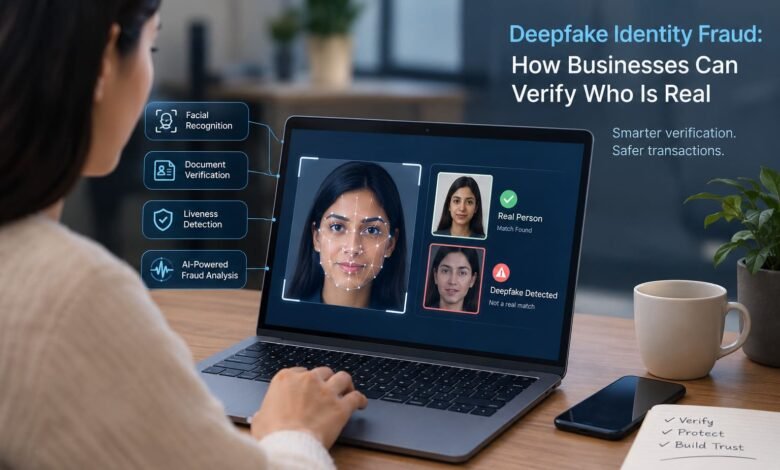
2. Use Liveness Detection and Presentation Attack Detection
Liveness detection helps assess whether a biometric sample appears to come from a live person rather than a static photograph, replayed recording, or other presentation attack.
More advanced systems may combine biometric comparison with checks for manipulated media or attempts to inject synthetic content into the verification process.
However, liveness detection is not a guarantee against every deepfake. Results depend on the technology, the type of attack, the capture environment, and the system’s ability to detect the relevant manipulation.
Businesses should evaluate solutions using realistic testing, monitor their performance, and provide a secure alternative when a legitimate user cannot complete an automated check.
3. Confirm Sensitive Requests Through a Separate Channel
One of the most practical defenses is to verify important requests independently.
Suppose a finance employee receives a video call from someone claiming to be the managing director, asking for an urgent payment. Instead of relying on the video call, the employee should contact the director using a previously registered telephone number or an established internal communication channel.
The employee should not use contact details supplied in the suspicious message.
The same principle applies to supplier bank changes, password resets, confidential document requests, and unusual account recovery activities.
The key rule is simple: verify the request through a trusted channel that is independent of the original interaction.
4. Strengthen Login and Account Security
Deepfake fraud may be used alongside stolen passwords, phishing, session hijacking, or compromised devices. Businesses should therefore protect accounts even when an initial identity check has been completed.
Useful measures include:
- Implementing multifactor authentication appropriate to the risk.
- Using phishing-resistant authentication, such as passkeys or security keys, where suitable.
- Applying role-based access controls and least-privilege permissions.
- Monitoring unusual login patterns and suspicious account activity.
- Reviewing access when employees change roles or leave the organization.
These measures help reduce the damage that can occur if an impersonation attempt succeeds at one stage of the process.
5. Introduce Strong Approval Procedures for Payments
Financial processes deserve particular attention because deepfake impersonation may be used to manipulate employees into authorizing transfers.
Businesses can reduce this risk by establishing written approval rules, independent payment verification, and clear procedures for changing supplier details.
For example, a request to change a vendor’s bank account should require confirmation using a trusted contact already on file. High-value transfers may also require approval from a second authorized employee.
Urgency, seniority, or apparent familiarity should never be accepted as a reason to bypass financial controls.
6. Train Employees to Recognize Manipulation Attempts
Technology alone cannot prevent every fraud attempt. Employees need to understand how impersonation works and what to do when something feels unusual.
Training should cover warning signs such as unexpected requests for secrecy, unusual payment instructions, pressure to act immediately, and requests that fall outside normal business procedures.
Visual or audio irregularities may provide useful clues, but employees should not be expected to identify every deepfake by sight or sound. High-quality synthetic media may appear convincing, and legitimate calls can also suffer from poor audio or video quality.
Instead, staff should be encouraged to pause, independently verify unusual requests, and report concerns without fear of being blamed for delaying a transaction.
7. Use Deepfake Detection as One Layer of Defense
Specialized detection tools can analyze images, videos, audio, and other digital evidence for signs of manipulation. Depending on the system, they may help identify suspicious media or flag cases for further investigation.
Nevertheless, detection systems can produce false positives and false negatives. A genuine recording may be flagged incorrectly, while manipulated media may escape detection.
Businesses should combine automated analysis with human review, document their investigation procedures, and test detection tools against relevant threats. NIST’s guidance on face-image morphing also highlights the importance of combining automated detection with appropriate review and follow-up procedures.
8. Monitor Identity and Activity After Verification
Verifying someone once does not mean every later action is automatically trustworthy.
A legitimate account may be compromised after onboarding. A fraudster may take control of a session or use stolen credentials to act as an authenticated user.
Businesses should therefore monitor activity for unusual behavior, such as unexpected changes to payment details, access from unfamiliar devices, abnormal transaction patterns, or requests that differ from a user’s normal responsibilities.
Where appropriate, sensitive actions should trigger additional authentication or human approval.
9. Protect Biometric and Personal Information
Identity verification often involves sensitive documents, facial images, voice recordings, and personal data. Collecting more information than necessary can create additional privacy and security risks.
Organizations should limit collection to what is needed, restrict access, encrypt sensitive records, establish appropriate retention periods, and assess the privacy implications of verification technologies.
They should also understand how their identity verification vendors store, process, and share biometric information.
A good identity security strategy must protect people from fraud without creating unnecessary exposure of their personal data.
A Practical Deepfake Prevention Framework for Businesses
Organizations can turn these recommendations into a manageable process.
Step 1: Identify high-risk activities. Determine where impersonation could lead to financial loss, unauthorized access, or exposure of confidential information.
Step 2: Match checks to the risk. Use stronger verification for high-impact activities, including account recovery, employee access, supplier changes, and large payments.
Step 3: Establish independent verification. Maintain trusted contact details and require separate confirmation for unusual or sensitive requests.
Step 4: Combine security controls. Bring together identity proofing, secure authentication, media analysis, access controls, and transaction monitoring.
Step 5: Define an escalation process. Give employees clear instructions for pausing suspicious activity, reporting concerns, and involving the appropriate security or fraud team.
Step 6: Review and improve. Test the process regularly, evaluate false alarms and missed detections, and update controls as threats and business operations change.
NIST’s Digital Identity Guidelines, Revision 4, provide a useful reference for organizations developing risk-based identity verification and fraud management processes.
What Should a Business Do If It Suspects a Deepfake Attack?
A quick, organized response can limit potential damage.
First, pause the suspicious transaction or access request if it is safe and practical to do so. Contact the person or organization through a trusted, independent channel to establish whether the request is genuine.
Next, preserve relevant evidence, such as messages, call details, transaction records, and suspicious files, in accordance with company policy and applicable law. Notify the security, IT, finance, or fraud response team as appropriate.
If credentials or accounts may have been compromised, follow the organization’s incident response process to secure access, revoke affected sessions, and reset credentials where necessary. If money has already been transferred, contact the relevant financial institution immediately and follow applicable reporting procedures.
Finally, investigate how the impersonation attempt occurred and whether additional controls are needed. The objective should be to address the underlying weakness, not simply to block one suspicious account or telephone number.
The Future of Identity Verification in an AI-Driven World
As AI-generated media improves, businesses will need identity verification methods that go beyond visual familiarity. Trusted identity evidence, secure authentication, independent confirmation, and ongoing risk monitoring will become increasingly important parts of digital trust.
At the same time, verification should remain accessible and proportionate. Not every customer or employee should face the same level of scrutiny for every activity. Organizations need to balance fraud prevention, privacy, usability, and the consequences of incorrectly rejecting a legitimate person.
The strongest approach is not to assume that every video call is fake or that every AI detection tool is reliable. It is to build processes that remain dependable even when appearances, voices, or digital evidence can be manipulated.
Conclusion
Deepfake identity fraud challenges one of the oldest assumptions in business communication: that seeing or hearing a familiar person is enough to trust a request.
For modern organizations, identity verification must involve more than appearance. Businesses need reliable evidence, secure login methods, independent confirmation for sensitive requests, well-defined approval procedures, and employees who know when to stop and investigate.
No single technology can eliminate the risk completely. A layered, risk-based approach can, however, make impersonation more difficult to carry out and easier to detect before it causes serious harm.
In an environment where digital identities can be imitated, trust should be built through verification rather than familiarity alone.
Frequently Asked Questions
1. What is deepfake identity fraud?
Deepfake identity fraud uses AI-generated or manipulated images, videos, or voices to impersonate real people and deceive businesses, employees, or customers.
2. How can businesses detect deepfake identity fraud?
Businesses can combine identity verification, liveness detection, secure authentication, independent confirmation, and human review to identify suspicious impersonation attempts.
3. Can deepfakes bypass facial recognition systems?
Yes, some deepfakes may fool certain facial recognition systems. Businesses should use tested security controls and additional verification for high-risk activities.
4. How can businesses prevent deepfake payment scams?
Businesses should independently confirm unusual payment requests, verify supplier bank changes through trusted contact details, and require appropriate financial approvals.