Neuro-Symbolic AI: Combining Human Logic with Machine Learning

Artificial intelligence has become remarkably good at recognizing patterns, processing large amounts of information, and making predictions. From recommending products to identifying objects in images, machine learning systems are already part of everyday technology. However, there is still one important challenge: understanding why a particular decision makes sense.
Traditional machine learning often depends on patterns learned from training data. It can produce impressive results, but it may struggle when information is incomplete, situations are unfamiliar, or a decision requires several logical steps. This is where Neuro-Symbolic AI comes into the picture.
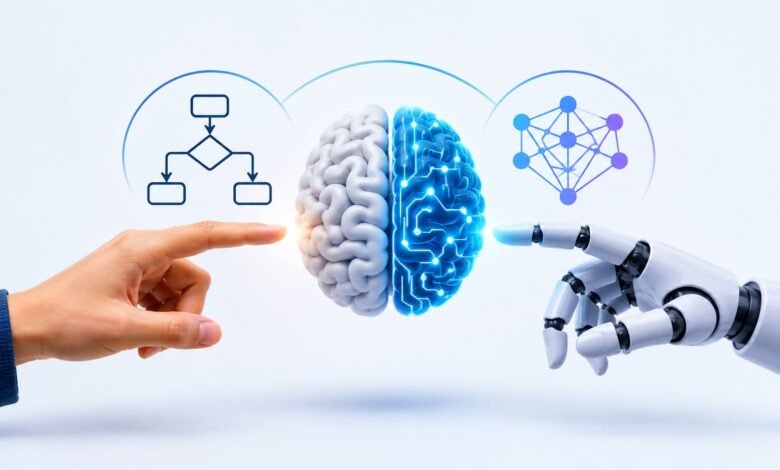
Neuro-Symbolic AI combines the pattern-recognition capabilities of neural networks with the structured reasoning of symbolic artificial intelligence. Instead of relying only on learned patterns or predefined rules, this approach brings both methods together to create AI systems that can recognize information and reason about it.
The idea is simple but powerful: machines should not only learn from examples but also use logic to make better sense of what they learn.
What Is Neuro-Symbolic AI?
Neuro-Symbolic AI is an artificial intelligence approach that combines two different AI techniques: neural networks and symbolic reasoning.
Neural networks learn from data. They identify relationships, recognize patterns, understand images, and process language. Symbolic AI, on the other hand, works with structured knowledge, logical rules, facts, and relationships.
For example, a machine learning model might recognize an image of a bicycle. A symbolic reasoning system can use additional knowledge to understand that a bicycle has two wheels, requires balance, and is commonly used for transportation.
When these two approaches work together, the system can move beyond simple recognition and make more meaningful connections.
In other words, Neuro-Symbolic AI aims to bring together the learning ability of machines and the structured reasoning associated with human problem-solving.
Why Does Artificial Intelligence Need Human-Like Reasoning?
Machine learning has made significant progress, but recognizing patterns is not the same as understanding a situation.
Imagine an AI system used in a hospital. It may identify patterns in medical images and highlight areas that require attention. However, a medical decision can involve several factors, including patient history, symptoms, test results, and clinical guidelines.
A system that considers only one pattern may miss important context.
Similarly, an AI system used in a business might identify unusual financial activity. To understand whether that activity is actually suspicious, it may need to examine transaction relationships, company policies, and other relevant information.
This highlights the importance of reasoning.
Neuro-Symbolic AI offers a way to combine data-driven learning with logical relationships. It can help AI systems work with context, follow structured rules, and explain certain steps behind their conclusions.
How Does Neuro-Symbolic AI Work?
Neuro-Symbolic AI works by connecting neural learning with symbolic knowledge and reasoning. The exact architecture can vary depending on the application, but the general process involves several stages.
1. Learning From Data
The neural network component processes information such as text, images, audio, or numerical datasets. It learns patterns from examples instead of requiring every possible situation to be manually programmed.
For instance, an AI model trained on traffic images may learn to identify cars, pedestrians, traffic signals, and road signs.
2. Representing Knowledge
The symbolic component organizes relevant information into structured forms. These may include facts, concepts, relationships, and logical rules.
In a traffic management application, the system could use rules such as:
- Red traffic signals require vehicles to stop.
- Pedestrians should use designated crossings.
- Emergency vehicles may receive priority under specific conditions.
These rules provide a structured foundation for reasoning.
3. Connecting Patterns With Logic
The system combines information recognized by the neural network with the rules and relationships represented in its symbolic component.
For example, a model may identify an emergency vehicle approaching an intersection. The reasoning component can then consider traffic rules and relevant conditions before determining an appropriate response.
4. Reaching a Reasoned Conclusion
By combining learned information with structured knowledge, the system can produce decisions that are more context-aware.
Depending on its design, it may also provide a traceable explanation of which facts or rules contributed to its conclusion.
Key Benefits of Neuro-Symbolic AI
The combination of neural learning and symbolic reasoning offers several potential advantages.
Better Reasoning Capabilities
Traditional machine learning models are particularly effective at recognizing patterns. Neuro-Symbolic AI adds structured reasoning, allowing systems to consider relationships between different pieces of information.
This can be useful when a task requires multiple steps rather than a straightforward prediction.
Improved Explainability
Understanding why an AI system makes a decision is important, especially in areas such as healthcare, finance, and business operations.
Symbolic rules and structured knowledge can make certain reasoning steps easier to inspect. However, explainability still depends on how the overall system is designed.
Greater Adaptability
AI systems sometimes struggle when they encounter situations that differ from their training examples.
Neuro-Symbolic AI can use existing rules and knowledge alongside learned patterns. This may help it handle unfamiliar situations more effectively, although it does not eliminate the need for suitable training data and testing.
Reduced Dependence on Large Datasets
In some applications, symbolic knowledge can provide useful information that a neural network might otherwise need to learn from many examples.
This can improve learning efficiency in specific situations, particularly where expert knowledge and reliable rules are available.
More Consistent Decision-Making
Symbolic reasoning can help systems follow defined constraints and rules. This is valuable when an application must operate within established requirements.
However, the quality of the result still depends on whether those rules are accurate, complete, and regularly updated.
Real-World Applications of Neuro-Symbolic AI
Neuro-Symbolic AI has potential across several industries. Its combination of pattern recognition and logical reasoning makes it relevant to tasks where both data and structured knowledge matter.
1. Healthcare and Medical Research
Healthcare professionals work with different types of information, including medical images, laboratory results, patient records, and clinical guidelines.
Neural networks can help identify patterns in medical data, while symbolic reasoning can connect those findings with established medical knowledge.
For example, an AI-assisted research system could identify a pattern in patient data and compare it with relevant clinical rules or known relationships. Such systems could support research and decision-making, but medical professionals must remain responsible for clinical judgments.
2. Autonomous Vehicles
Self-driving technology needs to recognize its surroundings and respond to changing road conditions.
Neural networks can identify vehicles, pedestrians, road markings, and traffic signs. Symbolic reasoning can help represent traffic rules, driving constraints, and relationships between road users.
Combining these capabilities may support more structured decision-making in complex driving environments. Safety validation remains essential before such technology can be trusted in real-world conditions.
3. Financial Services
Financial organizations process large volumes of transactions and customer information.
Machine learning can identify unusual transaction patterns, while symbolic rules can represent compliance requirements, transaction limits, and relationships between accounts.
Together, these methods may help financial institutions identify suspicious activity and make their monitoring processes more structured.
4. Robotics and Industrial Automation
Industrial robots must recognize objects, understand their surroundings, and perform tasks in the correct sequence.
Neural networks can help robots identify tools, components, and obstacles. Symbolic reasoning can represent task instructions, operating constraints, and safety rules.
For example, a manufacturing robot could recognize a component and use predefined assembly instructions to determine the next operation.
5. Intelligent Business Systems
Businesses increasingly use AI to support customer service, data analysis, planning, and operational decisions.
A Neuro-Symbolic AI system could combine customer data patterns with business policies and structured organizational knowledge.
This could help businesses build more context-aware applications that do not rely entirely on statistical predictions.
Neuro-Symbolic AI vs. Traditional Machine Learning
Although both approaches use artificial intelligence, their working methods are different.
| Feature | Traditional Machine Learning | Neuro-Symbolic AI |
|---|---|---|
| Main approach | Learns patterns from data | Combines learning with symbolic reasoning |
| Knowledge | Primarily learned from examples | Learned patterns and structured knowledge |
| Reasoning | Often limited in explicit logical reasoning | Supports structured logical reasoning |
| Explainability | Can be difficult to interpret | May provide more traceable reasoning |
| Rules | Usually learned indirectly or added separately | Can explicitly represent logical rules |
| Applications | Prediction, classification, recognition | Tasks involving learning and reasoning |
Traditional machine learning remains highly effective for many applications. Neuro-Symbolic AI is not intended to replace every existing AI technique. Instead, it offers another approach for problems where pattern recognition alone may not be sufficient.
Challenges and Limitations of Neuro-Symbolic AI
Despite its potential, Neuro-Symbolic AI is still an evolving area of research. Combining two different AI approaches also introduces technical difficulties.
Integration Complexity
Neural networks and symbolic systems represent information differently. Connecting their outputs in a reliable way can require complex architectures and careful engineering.
Knowledge Representation
Symbolic systems depend on structured facts and rules. Creating and maintaining this knowledge can be difficult, especially in industries where information changes frequently.
Handling Uncertain Information
Real-world information is not always complete or accurate. Neural networks can work with uncertainty, but symbolic systems often require clearly defined relationships and rules.
Developing systems that handle both uncertain data and logical constraints remains an important research challenge.
Scalability
Large AI applications may involve millions of facts, relationships, and learned patterns. Processing all this information efficiently can require significant computing resources and optimization.
Testing and Reliability
Combining learning with reasoning does not automatically make an AI system accurate or safe. Developers must test its predictions, reasoning processes, edge cases, and potential failures before deploying it in important environments.
The Future of Neuro-Symbolic AI
The future of artificial intelligence may depend not only on building larger models but also on improving how systems use knowledge and reasoning.
Neuro-Symbolic AI represents an important direction in this development. Researchers are exploring ways to connect neural networks with knowledge graphs, logical rules, language models, and other reasoning techniques.
As these methods improve, they could support AI applications that are better equipped to work with complex information, follow constraints, and explain parts of their decision-making processes.
However, progress will depend on solving practical challenges such as integration, reliability, scalability, and the quality of available knowledge.
Rather than viewing Neuro-Symbolic AI as a replacement for traditional machine learning, it is more useful to understand it as a complementary approach. It brings together two capabilities that are often treated separately: learning from experience and reasoning with structured knowledge.
Conclusion
Neuro-Symbolic AI is an important development in the ongoing evolution of artificial intelligence. By combining neural networks with symbolic reasoning, it creates opportunities for systems that can recognize patterns while also working with facts, rules, and relationships.
From healthcare and financial services to robotics and autonomous vehicles, this approach could help address problems that require more than pattern recognition alone.
Although technical challenges remain, the combination of machine learning and logical reasoning offers a promising direction for building AI systems that are more understandable, adaptable, and context-aware.
The next stage of AI development may not be about choosing between machine learning and human logic. It may be about finding better ways to make them work together.
Frequently Asked Questions
1. What is Neuro-Symbolic AI?
Neuro-Symbolic AI combines neural networks with symbolic reasoning. It enables AI systems to learn patterns from data while using logical rules and structured knowledge to make decisions.
2. How is Neuro-Symbolic AI different from traditional machine learning?
Traditional machine learning mainly learns patterns from training data. Neuro-Symbolic AI combines this learning ability with logical reasoning, helping systems understand relationships and follow predefined rules.
3. Where can Neuro-Symbolic AI be used?
Neuro-Symbolic AI can be applied in healthcare, financial services, autonomous vehicles, robotics, and industrial automation. It is useful for applications that require both data analysis and logical reasoning.
4. Can Neuro-Symbolic AI make artificial intelligence more reliable?
Neuro-Symbolic AI can improve reasoning and make certain decisions easier to explain. However, its reliability depends on accurate data, well-designed rules, and proper system testing.