Every day, computers handle an enormous amount of information. From online banking and cloud applications to artificial intelligence and scientific research, digital services depend on the ability to process and transfer data quickly.
As technology continues to advance, computer processors are becoming more powerful. However, there is another challenge that receives less attention: moving information between different parts of a computing system.
A processor may be capable of performing calculations at incredible speeds, but it still needs data from memory, storage, and other processors. When communication becomes slow or consumes too much energy, the entire system can become less efficient.
This challenge has encouraged researchers to explore a different approach to computing: using light instead of relying entirely on electrical signals.
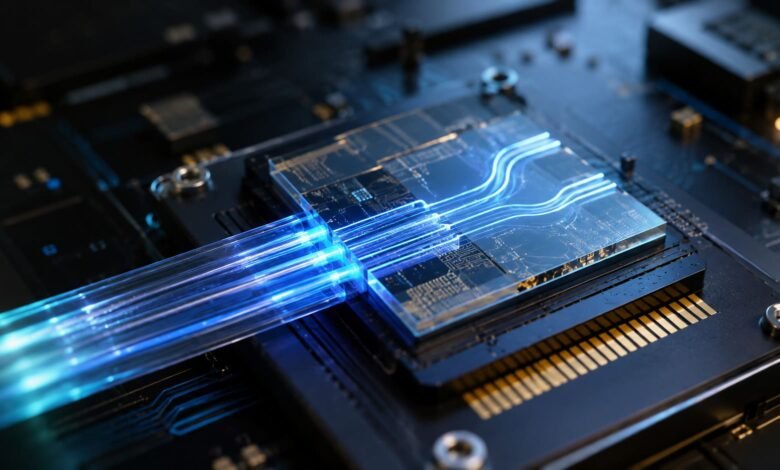
Photonic chips are designed to guide, control, and sometimes process information using light. They could help improve communication between processors, increase data transfer capacity, and reduce energy consumption in certain applications.
The technology is particularly interesting for artificial intelligence, cloud computing, and high-performance data centers, where large amounts of information move continuously between computing components.
Although photonic chips are still developing, research is showing how optical technology could become an important part of future computing infrastructure.
What Are Photonic Chips?
Photonic chips are integrated circuits that use light to transmit, control, or process information.
Traditional electronic chips use electrical signals that travel through transistors and metal connections. Photonic chips use optical components that guide light through carefully designed pathways.
These optical pathways are known as waveguides. They allow light to travel from one part of a chip to another while being controlled by different optical components.
A photonic chip may contain several important elements:
- Optical waveguides: Guide light through the chip.
- Modulators: Encode information onto light signals.
- Optical switches: Direct light into different pathways.
- Photodetectors: Convert light into electrical signals.
- Laser sources: Generate the light used for optical communication.
One of the most important technologies in this field is silicon photonics.
Silicon photonics combines optical components with silicon-based semiconductor manufacturing techniques. This makes it possible to develop compact optical circuits that can work alongside electronic hardware.
The goal is not to replace every electronic component with an optical one. Instead, photonic chips can handle tasks where light offers practical advantages, particularly high-speed communication and specialized data processing.
Why Traditional Electronic Chips Need Better Data Communication
Electronic processors have improved significantly over the years. However, the growing size of computing systems has created new challenges.
Modern AI infrastructure, for example, may contain several processors working together. Each processor handles part of a workload, but the results often need to be exchanged with other processors.
This creates a continuous flow of data.
When communication becomes inefficient, processors may spend time waiting for information instead of performing calculations.
Electrical connections can also experience resistance, capacitance, and signal distortion. At very high data rates, maintaining signal quality can require additional energy and supporting circuits.
These challenges become more noticeable when information needs to travel between separate chips or across large computing systems.
Photonic technology offers an alternative by using optical signals for communication.
Light can travel through optical pathways with relatively low propagation losses, particularly over distances where electrical connections become less efficient. Optical systems can also carry multiple data channels through the same pathway.
This makes photonic technology especially attractive for systems that need high bandwidth and efficient communication.
How Photonic Chips Work
Photonic chips work by manipulating light to carry or process information.
A simplified optical communication process begins with a light source, usually a laser. The light is then modified by a component called a modulator.
The modulator changes a property of the light, such as its intensity or phase, to represent information.
The optical signal travels through a waveguide and may pass through switches, filters, or other optical components before reaching its destination.
At the receiving end, a photodetector converts the light signal into an electrical signal that can be used by conventional electronic hardware.
Some photonic chips are designed to perform calculations directly using optical signals.
For example, optical systems can be configured to perform certain mathematical operations, including matrix multiplication. These operations are widely used in artificial intelligence and machine learning.
Photonic computing can take advantage of the fact that multiple optical signals may travel through a system simultaneously.
This creates opportunities for parallel processing, where several operations can be performed at the same time.
How Light Can Carry More Information
One important technique used in optical communication is wavelength-division multiplexing.
In this approach, different wavelengths of light carry separate information channels.
Imagine several colored light signals travelling through the same optical pathway. Each wavelength represents a different communication channel, allowing multiple streams of information to share one connection.
At the receiving end, optical components separate the wavelengths so that each channel can be processed independently.
This technique can increase the amount of information transferred without requiring a separate physical connection for every data stream.
Photonic systems can also use different optical pathways and spatial channels to increase communication capacity.
These capabilities are particularly useful in data centers, where large numbers of processors need to exchange information continuously.
How Photonic Chips Could Make Data Processing Faster
Photonic chips could improve data processing by reducing communication bottlenecks and supporting more efficient information transfer.
1. Faster communication between processors
Large computing systems often contain multiple processors that need to exchange information during complex workloads.
Photonic interconnects can provide high-bandwidth connections between these components.
This could help processors communicate more efficiently during AI training, scientific simulations, and other demanding applications.
2. More efficient parallel data transmission
Optical communication can carry several data channels using different wavelengths of light.
Instead of creating a separate physical connection for every data stream, multiple channels can share an optical pathway.
This can increase communication capacity while helping reduce the number of connections required.
3. Reduced communication bottlenecks
In some computing systems, the speed of data movement limits overall performance.
Photonic connections could help reduce these bottlenecks by allowing information to move more efficiently between processors and other components.
The improvement depends on the complete system, including optical components, electronic interfaces, and packaging.
4. Faster specialized calculations
Some photonic computing architectures use light to perform mathematical operations directly.
Matrix multiplication is one example. It is an important operation in many AI workloads.
Photonic processors may be able to perform certain calculations with high throughput by processing multiple optical signals in parallel.
However, photonic chips are not automatically faster than electronic processors for every task. Their advantages depend on the type of calculation and the design of the computing system.
Can Photonic Chips Make Computing More Energy Efficient?
Energy efficiency is one of the main reasons researchers are investigating photonic technology.
In conventional computing systems, electrical signals moving through connections require energy. As data rates increase, additional power may be needed to drive communication circuits and maintain signal quality.
Photonic communication offers a different approach.
Light can carry information through optical pathways with relatively low propagation losses. In suitable applications, this can reduce the energy required to transfer data between computing components.
This is particularly important in large data centers, where communication between processors and networking equipment contributes to overall power consumption.
Photonic computing may also improve energy efficiency when certain mathematical operations are performed directly in the optical domain.
However, the energy consumption of a photonic system depends on more than the optical signal itself.
Lasers, electronic drivers, photodetectors, data converters, and temperature-control systems all require power.
For this reason, researchers are working to improve the efficiency of the entire photonic system rather than focusing only on the optical processing component.
The real benefit will come when photonic technology reduces total system energy while delivering useful improvements in performance.
Photonic Chips vs. Traditional Electronic Chips
Photonic chips and electronic chips are designed around different physical principles.
| Feature | Electronic Chips | Photonic Chips |
|---|---|---|
| Main signal | Electrical signals | Optical signals |
| Data movement | Electrical connections | Optical pathways |
| Main strength | General-purpose computing | High-bandwidth optical communication |
| Processing approach | Digital and electronic operations | Optical communication and specialized optical operations |
| Energy considerations | Power used by circuits and connections | Optical components plus electronic support circuits |
| Current maturity | Widely used across computing | Established in optical communication, developing in computing |
Electronic processors remain essential because they can perform a wide range of general-purpose tasks.
Photonic chips offer advantages in specific areas, especially when large amounts of information need to move between components or when calculations can benefit from optical parallelism.
The two technologies are therefore more likely to work together than compete as complete replacements.
The Role of Silicon Photonics
Silicon photonics is an important part of the development of photonic chips.
It uses silicon-based manufacturing processes to create optical components that can be integrated with semiconductor technology.
This approach is attractive because silicon manufacturing already supports the production of complex electronic circuits at large scale.
Silicon photonics can combine optical waveguides, modulators, photodetectors, and other components within compact integrated circuits.
One major application is optical communication in data centers.
As data transfer requirements increase, silicon photonics can help provide high-bandwidth optical connections between computing components.
Researchers are also exploring ways to integrate photonic components more closely with electronic processors.
This could reduce the distance that electrical signals need to travel before being converted into optical signals.
The closer integration of electronics and photonics is becoming an important direction for future computing hardware.
What Is Co-Packaged Optics?
Co-packaged optics is a technology that places optical components close to electronic chips within the same package.
Traditionally, optical communication components may be located farther away from the processor, requiring electrical signals to travel through connections before reaching the optical interface.
Co-packaged optics aims to shorten this electrical path.
By bringing optical components closer to processors, the system may reduce some communication-related power consumption and support higher bandwidth.
This approach is particularly relevant to AI accelerators and high-performance networking equipment.
In August 2026, a review published in Nature Electronics examined co-packaged optics for high-performance computing and AI. The research discussed how optical connections could help address bandwidth and energy challenges while highlighting the importance of thermal management, manufacturing, and standardization.
Co-packaged optics is not a complete optical computer. It is an approach to improving communication between electronic and optical components.
Its importance lies in making photonic technology more practical for large computing systems.
Latest Research and Developments in Photonic Computing
Photonic computing research has continued to advance, with increasing attention on practical integration and scalable architectures.
In March 2025, researchers reported a three-dimensional photonic integration approach for high-bandwidth data links between chips. The work explored how optical transmitters and receivers could be integrated closely with electronic hardware.
In June 2026, researchers published a photonic mixture-of-experts architecture designed to support multiple tasks using parallel optical computing cores. The study demonstrated an integrated photonic processor for image-classification workloads and explored ways to improve scalability.
In September 2026, a review in Nature Photonics examined photonic accelerators for AI across cloud and edge computing. The article discussed the potential of optical processing while identifying challenges involving optical losses, electronic interfaces, and scaling.
These developments show that researchers are increasingly looking at photonic technology as part of complete computing systems.
However, laboratory demonstrations should not automatically be treated as commercially available products. Practical adoption requires reliable manufacturing, consistent performance, and measurable benefits under real workloads.
Where Photonic Chips Could Be Used
Artificial intelligence and machine learning
AI systems require large amounts of data to move between processors, memory, and networking components.
Photonic chips could support high-bandwidth communication and specialized optical calculations in AI infrastructure.
This may become particularly useful as AI systems grow and communication requirements increase.
Data centers
Data centers depend on fast connections between servers, processors, and networking equipment.
Photonic technology can help provide high-bandwidth optical links while reducing some limitations associated with electrical connections.
Silicon photonics and co-packaged optics are especially relevant to this application.
Scientific computing
Scientific research often involves complex calculations that require substantial computing resources.
Photonic accelerators could help perform certain mathematical operations more efficiently, particularly in workloads that involve parallel data processing.
Edge computing
Edge computing involves processing information closer to where it is collected, such as in cameras, sensors, and connected devices.
Photonic systems could support specialized processing for applications involving images, optical signals, and real-time sensor information.
Optical communication networks
Photonic chips are already important in optical communication systems.
They help transmit information through fiber-optic networks and support the high data rates required by modern communication infrastructure.
As computing systems become more connected, optical communication is likely to remain an important application of photonic technology.
What Are the Challenges of Photonic Chips?
Despite their potential, photonic chips still face several technical and practical challenges.
Integration with electronic hardware
Most computing systems continue to rely on electronic processors and memory.
Photonic chips must communicate with these components, which often requires converting information between electrical and optical formats.
These conversions can introduce additional energy consumption and delays.
Optical signal loss
Light can lose strength as it travels through optical components.
When a photonic circuit becomes larger or more complex, maintaining signal quality becomes increasingly difficult.
Engineers need to reduce optical losses while making circuits more compact and scalable.
Manufacturing and packaging
Photonic chips require precise optical components and careful alignment.
Integrating lasers, optical pathways, electronic circuits, and cooling systems into a compact package can be challenging.
Manufacturing processes must become reliable and cost-effective before photonic computing can be adopted widely.
Accuracy and reliability
Some photonic computing systems use analog optical operations.
These systems may be affected by noise, temperature changes, and variations in optical components.
Maintaining accurate results can require calibration and additional electronic control.
Software compatibility
Another challenge is developing software that can effectively use photonic hardware.
Most existing computing applications are designed for electronic processors.
Photonic systems may require specialized algorithms, programming tools, and methods for transferring data between electronic and optical components.
Developers will need to understand which workloads benefit from photonic processing and how to integrate it into existing software environments.
Will Photonic Chips Replace Traditional Processors?
Photonic chips are unlikely to replace traditional electronic processors completely in the near future.
Electronic processors are highly versatile and can perform a wide range of computing tasks. They also benefit from mature manufacturing processes and established software ecosystems.
Photonic technology has different strengths.
It can support high-bandwidth communication and specialized optical operations, but it still needs electronic components for many functions, including memory, control, and general-purpose processing.
A more realistic future is a hybrid computing architecture.
In this approach, electronic processors handle general computing tasks, while photonic components support communication-intensive operations or specialized calculations.
This combination could help computing systems achieve better performance without requiring every operation to be performed using light.
The Future of Photonic Chips
The future of photonic chips will depend on how effectively researchers solve the challenges of integration, energy consumption, manufacturing, and scalability.
As AI systems and cloud infrastructure continue to grow, the need for efficient data communication is likely to remain important.
Photonic technology could become a valuable part of future computing systems by helping information move between components more efficiently.
The most promising developments may not involve a completely optical computer. Instead, they may involve carefully designed systems where electronic and photonic components work together.
With continued improvements in silicon photonics, optical packaging, and photonic processing architectures, the technology could gradually become more practical for high-performance computing and specialized applications.
Conclusion
Photonic chips represent a promising direction for improving data communication and certain types of computing.
By using light to carry information, they could help increase bandwidth, support parallel data transmission, and reduce some of the energy costs associated with moving data through large computing systems.
Their potential applications include artificial intelligence infrastructure, data centers, scientific computing, optical communication, and edge processing.
At the same time, photonic chips still face challenges involving optical losses, electronic conversion, manufacturing, software compatibility, and integration.
Rather than replacing traditional processors entirely, photonic chips are more likely to complement electronic hardware.
As research progresses, combining electronics with photonics could help build computing systems that process and transfer information more efficiently.
Frequently Asked Questions
1. How do photonic chips improve data processing speed?
Photonic chips use light to transfer information and perform certain calculations. They can support high-bandwidth communication and parallel data transmission, helping reduce communication bottlenecks in advanced computing systems.
2. Can photonic chips reduce energy consumption in data centers?
Photonic chips may reduce the energy required to transfer data between computing components. However, overall energy savings depend on supporting components such as lasers, electronic circuits, and optical conversion systems.
3. What is the difference between photonic chips and electronic chips?
Electronic chips use electrical signals to process information, while photonic chips use light to transmit, control, or process data. Photonic technology is particularly useful for high-speed optical communication and specialized computing operations.
4. Will photonic chips replace traditional computer processors?
Photonic chips are more likely to complement traditional electronic processors rather than replace them completely. Future computing systems may combine electronic processing with photonic communication and specialized optical operations.