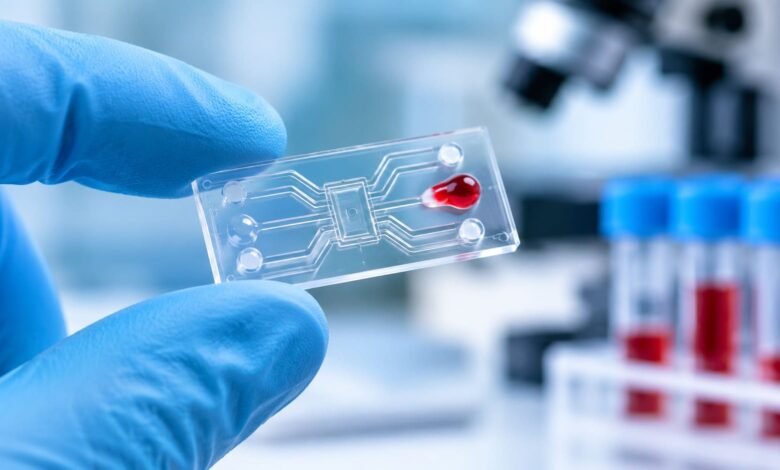
Imagine getting the results of a medical test without sending a sample to a large laboratory or waiting several hours for an analysis. A small device, using only a tiny amount of blood or saliva, could potentially perform several laboratory processes within a compact space. This is the idea behind Lab-on-a-Chip (LoC) technology.
Medical testing has traditionally depended on laboratory equipment, trained professionals, and carefully controlled environments. Although these methods remain important, healthcare increasingly needs diagnostic technologies that are faster, more accessible, and easier to use. Lab-on-a-chip technology is helping researchers explore new ways to meet these needs.
By combining microfluidics, biosensors, and miniature detection systems, these devices bring several laboratory functions onto a small chip. They have the potential to support disease detection, biological research, drug development, and point-of-care testing.
But how does this technology actually work, and why is it attracting attention across the medical and biotechnology industries? Let’s explore.
What Is Lab-on-a-Chip Technology?
Lab-on-a-Chip technology is a miniature analytical system designed to perform laboratory procedures on a small device. It uses specially designed microscopic channels, chambers, and sensors to handle and examine small quantities of biological samples.
Instead of transferring samples between multiple pieces of laboratory equipment, an LoC device can combine several steps into one compact platform.
These devices commonly work with samples such as:
- Blood
- Saliva
- Urine
- Other biological fluids
The technology relies heavily on microfluidics, a field that studies how extremely small amounts of liquid move through tiny channels.
For example, a lab-on-a-chip device may receive a small blood sample, separate particular components, react with selected chemicals, and detect specific biological markers. The results can then be interpreted using an integrated reader or connected electronic system.
The main objective is to make complex testing processes more compact, efficient, and accessible.
How Does Lab-on-a-Chip Technology Work?
Although these devices are small, their internal processes can be quite sophisticated. Each chip is designed with a specific testing purpose in mind.
Here are the major stages involved.
1. Sample Collection
The process begins when a small biological sample is introduced into the device. Depending on its design, the chip may require only a small quantity of blood, saliva, or another fluid.
Reducing sample requirements can be particularly useful when repeated testing is necessary or when collecting larger samples is difficult.
2. Microfluidic Sample Movement
After collection, the sample travels through tiny channels built into the chip. These channels guide liquid toward specific testing areas.
The movement of fluids can be controlled through pressure differences, capillary action, electrical forces, or miniature mechanical components.
This controlled movement allows different testing operations to happen within a limited space.
3. Sample Preparation and Separation
Some medical tests require samples to be prepared before analysis. Lab-on-a-chip systems can incorporate processes such as filtration, mixing, and separation.
For example, certain designs can separate blood cells from plasma or direct specific biological components toward a detection area.
This reduces the need for several separate laboratory procedures.
4. Detection and Analysis
The prepared sample reaches a detection area containing biosensors or other analytical components.
These sensors identify particular substances, including proteins, chemicals, or disease-associated biomarkers.
Depending on the device, detection may involve optical, electrical, electrochemical, or biochemical methods.
5. Result Interpretation
Finally, the detected signals are converted into information that can be interpreted by a reader or electronic system.
Some platforms can connect with computers or mobile devices to display and store results. However, the level of automation and connectivity depends on the specific device.
Key Technologies Behind Lab-on-a-Chip Devices
Several scientific and engineering technologies work together to make miniature laboratory systems possible.
Microfluidics
Microfluidics is the foundation of most lab-on-a-chip platforms. It allows researchers to control tiny liquid volumes inside microscopic channels.
This makes it possible to perform sample preparation, chemical reactions, and fluid separation without conventional laboratory equipment for every step.
Biosensors
Biosensors detect biological substances and convert their presence or concentration into measurable signals.
They can be designed to identify specific proteins, enzymes, antibodies, or other biomarkers associated with particular biological conditions.
Microfabrication
Microfabrication involves creating extremely small structures and channels on materials such as glass, silicon, and polymers.
The precision of this manufacturing process is important because even minor differences in channel dimensions can influence how a sample moves through the device.
Optical and Electronic Detection
Optical systems may use light to identify changes in a sample, while electronic detection methods measure electrical signals generated during a reaction.
These techniques help convert biological activity into information that can be processed and displayed.
Major Medical Applications of Lab-on-a-Chip Technology
The potential of lab-on-a-chip technology extends across several areas of healthcare and biomedical research.
1. Rapid Disease Detection
One of the most promising applications is point-of-care diagnostics.
Miniature testing platforms can be designed to detect specific biomarkers or biological agents closer to where patients receive care. This may help reduce dependence on centralized laboratories for selected tests.
For example, researchers are developing microfluidic systems for infectious disease detection and other diagnostic applications.
However, each device must demonstrate reliable performance before it can be used for clinical decision-making.
2. Blood Analysis
Traditional blood testing often involves multiple preparation and analysis steps.
Lab-on-a-chip platforms can integrate selected blood-processing functions into a compact device. Depending on the design, they may help examine blood cells, measure biomarkers, or separate specific blood components.
Such capabilities could support testing in smaller clinics and resource-limited healthcare settings.
3. Cancer Research
Cancer research frequently involves studying biological markers, cellular behavior, and changes in the tumor environment.
Microfluidic platforms can help researchers investigate cancer cells and examine how they respond to different treatments.
Some advanced systems also support organ-on-a-chip research, where miniature tissue models are used to study biological processes under controlled conditions.
These technologies are research tools and do not independently replace established cancer diagnostic procedures.
4. Drug Discovery and Development
Developing new medicines requires extensive testing to understand how potential treatments interact with biological systems.
Lab-on-a-chip devices can help researchers perform controlled experiments using small sample volumes and carefully managed conditions.
For instance, microfluidic platforms can be used to study cellular responses to different drug concentrations. This can help researchers compare experimental conditions while reducing the quantity of materials required.
5. Personalized Healthcare
Patients do not always respond to the same treatment in the same way. Personalized medicine aims to use relevant biological information to support more individualized healthcare decisions.
Lab-on-a-chip technology may contribute by helping researchers analyze specific biomarkers and biological responses.
When combined with suitable diagnostic methods and clinical information, these systems could become useful components of future personalized healthcare approaches.
Benefits of Lab-on-a-Chip Technology
The growing interest in this technology comes from its ability to combine several testing functions within a compact platform.
Smaller Sample Requirements: Many microfluidic systems work with very small quantities of biological material, helping reduce sample and reagent consumption.
Faster Testing Processes: Integrating multiple testing stages into one device can reduce the time required for certain analyses.
Compact Design: Portable formats may allow selected diagnostic procedures to take place outside traditional laboratory environments.
Reduced Reagent Consumption: Because the system handles small fluid volumes, it can use fewer chemicals and testing materials.
Potential for Automation: Integrated channels, sensors, and electronic readers can reduce the need for manual handling during selected testing procedures.
Support for Decentralized Testing: These devices could make certain types of testing more accessible in clinics, remote healthcare facilities, and other locations.
The actual benefits depend on the specific test, device design, manufacturing quality, and clinical application.
Challenges and Limitations of Lab-on-a-Chip Technology
Despite its potential, lab-on-a-chip technology still faces several challenges before it can become a routine part of healthcare.
Manufacturing Complexity
Producing miniature channels, chambers, and sensors requires precision engineering. Small manufacturing variations can affect device performance and testing consistency.
Scaling production while maintaining quality is another important challenge.
Testing Accuracy and Reliability
A diagnostic device must deliver consistent and dependable results. Sample contamination, temperature changes, unwanted chemical reactions, and variations in biological samples can affect performance.
Each application therefore requires appropriate analytical testing and clinical validation.
Standardization Issues
Different manufacturers may use different materials, chip designs, detection methods, and operating procedures.
A lack of standardization can make it difficult to compare results between devices and laboratories.
Integration With Existing Healthcare Systems
Some devices require external readers, power sources, software, or specialized equipment. Integrating these components into existing clinical workflows can increase complexity.
Cost and Accessibility
Although miniature devices may reduce reagent consumption, developing and manufacturing them can be expensive.
The overall cost of a test also depends on consumables, equipment, maintenance, training, and production volume. Therefore, smaller devices do not automatically mean cheaper healthcare.
The Future of Lab-on-a-Chip Technology
The future of lab-on-a-chip technology will depend on improvements in materials, sensor performance, manufacturing methods, and device integration.
One important development is the combination of microfluidics with artificial intelligence. AI-based systems may help interpret complex sensor signals, identify patterns, and support the analysis of large amounts of biological data.
Another promising direction is the development of more advanced organ-on-a-chip platforms. These systems use living cells and microfluidic environments to model selected functions of human organs. Researchers can use them to study diseases and investigate how potential treatments affect human tissues.
Wearable and portable diagnostic technologies are also attracting interest. Future devices may combine miniature sensors, compact readers, and connected software to support selected health-monitoring applications.
However, widespread adoption will require more than technological innovation. Researchers and manufacturers must demonstrate consistent results, improve usability, establish reliable production methods, and meet relevant regulatory requirements.
Conclusion
Lab-on-a-Chip technology represents an important development in the effort to make laboratory testing smaller, more integrated, and potentially more accessible. By bringing microfluidics, biosensors, and analytical processes together on a miniature platform, it offers new possibilities for medical diagnostics, blood analysis, cancer research, and drug development.
The technology is not a complete replacement for conventional laboratories, and several technical and clinical challenges remain. Nevertheless, continued progress in microfabrication, biosensing, and intelligent data analysis could expand its role in healthcare.
As research advances, these miniature devices may help bring selected laboratory capabilities closer to patients and healthcare professionals, making them an important area to watch in the future of biotechnology.
Frequently Asked Questions
1. What is Lab-on-a-Chip technology?
Lab-on-a-Chip technology is a miniature laboratory system that performs selected testing and analysis processes on a small device. It uses microfluidic channels and sensors to examine tiny biological samples such as blood, saliva, and urine.
2. How is Lab-on-a-Chip technology used in medical testing?
It is used to analyze biological samples, detect specific biomarkers, and support selected diagnostic procedures. These devices can combine sample preparation and detection within a compact platform, making certain tests possible closer to the patient.
3. What are the main benefits of Lab-on-a-Chip devices?
Lab-on-a-Chip devices can reduce sample requirements, minimize reagent consumption, and combine multiple laboratory functions in one compact system. Depending on the application, they may also support faster testing and portable diagnostic solutions.
4. What challenges limit the widespread use of Lab-on-a-Chip technology?
Some major challenges include manufacturing complexity, testing accuracy, device standardization, and production costs. Researchers must also ensure that these devices deliver reliable results and meet clinical requirements before wider healthcare adoption.