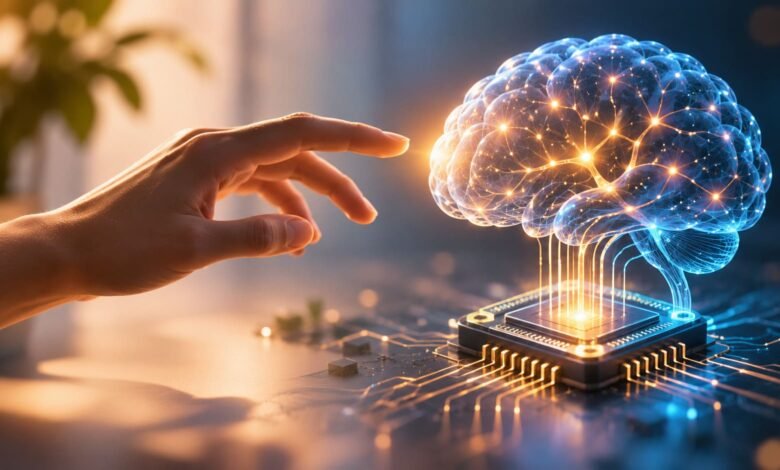
The human brain can perform millions of complex activities while using remarkably little energy. It can recognize faces, understand sounds, remember experiences, and respond to changing situations almost instantly. Traditional computers, although extremely powerful, work differently. They depend on processors, memory units, and programmed instructions to complete tasks.
What if computers could process information more like the human brain?
This idea is driving the development of neuromorphic computing, an emerging technology that takes inspiration from the way biological brains communicate and learn. Instead of relying entirely on conventional computing architectures, researchers are developing specialized chips and systems that imitate certain behaviors of neurons and their connections.
The goal is not to build an artificial human brain. It is to create computing systems that can handle particular tasks more efficiently, especially when dealing with real-time information, complex patterns, and energy-sensitive applications.
As artificial intelligence continues to grow, neuromorphic computing could introduce new possibilities for robotics, smart devices, scientific research, and intelligent machines.
What Is Neuromorphic Computing?
Neuromorphic computing is a computing approach that designs hardware and software based on selected principles of the human nervous system. It attempts to reproduce how biological neurons communicate, how connections between them change, and how information moves through interconnected networks.
In conventional computers, processing and memory are generally organized as separate components. Data frequently moves between these components while calculations are performed.
Neuromorphic systems take a different approach. They can combine memory and computation more closely, allowing information to be processed through interconnected artificial neurons and synapses.
These systems commonly use small electrical signals called spikes to communicate information. Rather than continuously processing every possible input, an event-driven system can respond when relevant activity occurs.
This approach is particularly interesting for applications that need to recognize changes, respond quickly, or operate with limited power.
How Does Neuromorphic Computing Work?
To understand this technology, it helps to look at three important elements of the human brain: neurons, synapses, and electrical signals.
1. Artificial Neurons
Neurons are specialized cells that receive and transmit information throughout the nervous system. Neuromorphic hardware uses electronic models that imitate selected characteristics of these biological cells.
An artificial neuron receives signals from connected units. When its internal activity reaches a particular threshold, it generates an output signal called a spike.
This process allows information to travel through a network without requiring every unit to remain continuously active.
2. Artificial Synapses
In the human brain, synapses connect neurons and influence how strongly signals pass between them.
Neuromorphic systems represent these connections using adjustable electronic or computational elements. Their connection strengths can influence how information moves through the network.
Some designs also explore ways to update these connections based on previous activity, taking inspiration from biological learning mechanisms.
3. Spiking Neural Networks
Spiking Neural Networks (SNNs) are computational models that represent information through timed electrical-like events called spikes.
Unlike conventional artificial neural networks that commonly process numerical activations in layers, SNNs can use both the timing and frequency of signals.
This makes them particularly useful for studying time-dependent information, such as movement, sound, and changing sensor readings.
Together, these elements allow neuromorphic systems to process information through networks inspired by biological communication.
Neuromorphic Computing vs. Traditional Computing
Both computing approaches can perform calculations and support artificial intelligence, but their architectures are different.
| Feature | Traditional Computing | Neuromorphic Computing |
|---|---|---|
| Architecture | Conventional processor and memory organization | Brain-inspired network structure |
| Processing | Often clock-driven | Frequently event-driven |
| Information | Binary data and numerical operations | Can use spike-based signals |
| Memory | Generally separate from processing | Can integrate memory and computation |
| Energy use | Depends on workload and hardware | Designed to improve efficiency in suitable tasks |
| Learning | Often uses separate training and inference processes | Can support brain-inspired learning approaches |
Neuromorphic computing is not automatically faster or more efficient for every application. Its advantages depend on the type of workload, hardware architecture, and software being used.
Why Is Neuromorphic Computing Becoming Important?
Modern technology is generating more information than ever before. Smart cameras, connected sensors, autonomous machines, and artificial intelligence applications continuously collect and process data.
Handling this information can require considerable computing resources.
Neuromorphic computing is attracting attention because it explores a different way to manage these demands.
1. Reducing Energy Requirements
Large computing systems can consume substantial electricity, particularly when running complex AI workloads.
Neuromorphic architectures are designed to activate processing elements when relevant events occur. This can reduce unnecessary activity in certain applications.
For example, a smart sensor may need to identify meaningful changes in its surroundings rather than repeatedly processing an unchanged scene.
2. Supporting Real-Time Processing
Some applications cannot afford long delays between receiving information and responding to it.
Neuromorphic systems can process event-based signals as they arrive. This makes them promising for applications such as robotic movement, environmental monitoring, and intelligent sensing.
3. Improving Pattern Recognition
The brain is particularly effective at recognizing patterns in complicated environments.
Neuromorphic computing attempts to use similar principles to identify meaningful patterns in visual, audio, and sensor information.
This could help intelligent devices interpret changing environments more efficiently.
4. Supporting Edge Devices
Edge computing processes information close to where it is generated instead of sending everything to a distant cloud server.
Neuromorphic chips could become useful in small devices that need to perform intelligent tasks while operating under limited power and hardware constraints.
Real-World Applications of Neuromorphic Computing
Although the technology is still developing, researchers are exploring several areas where brain-inspired hardware could provide practical benefits.
1. Robotics and Autonomous Machines
Robots frequently interact with unpredictable environments. They need to recognize objects, understand movement, and respond to changes without unnecessary delays.
Neuromorphic systems could help robots process sensor information and adjust their actions in response to changing conditions.
For example, a robotic machine working in a manufacturing facility could use event-based vision to detect movement on a production line.
2. Smart Cameras and Visual Recognition
Conventional cameras generally capture images at regular intervals, even when very little changes in the scene.
Event-based vision sensors work differently. They detect changes in brightness at individual pixels and generate signals when those changes occur.
Neuromorphic processing can work with this information to support applications such as motion detection, object tracking, and fast visual responses.
3. Healthcare and Biomedical Research
Healthcare technologies depend on accurate information from sensors and monitoring equipment.
Researchers are exploring neuromorphic approaches for processing biomedical signals, supporting wearable devices, and studying neural activity.
For example, an intelligent wearable monitoring system could analyze changing signals and identify patterns that deserve further attention.
However, such applications require careful validation before they can be used in clinical settings.
4. Autonomous Vehicles
Autonomous vehicles need to interpret information from cameras, radar, and other sensors to understand their surroundings.
Neuromorphic vision and event-based processing could help these systems detect rapid changes, track moving objects, and respond to dynamic road conditions.
This remains an area of research and development rather than a replacement for established vehicle safety systems.
5. Internet of Things (IoT)
Connected devices often operate with limited battery capacity and processing resources.
Neuromorphic technology could support intelligent IoT devices that monitor environmental conditions, recognize unusual activity, and respond to important events.
This may be useful in smart buildings, industrial monitoring, and remote sensing applications.
Neuromorphic Chips: The Hardware Behind Brain-Inspired Computing
Neuromorphic computing depends on specialized hardware that can reproduce selected behaviors of neural networks.
Several research projects and processors demonstrate different approaches to this technology.
Intel Loihi: Intel’s Loihi research processors explore programmable neuromorphic computing using spiking neural networks. They are designed to support experiments involving adaptive computation and event-based processing.
IBM NorthPole: IBM’s NorthPole architecture explores a different approach to AI hardware by bringing computation and memory closer together. It is inspired by principles of brain architecture, although it is not a conventional spiking neuromorphic chip.
SpiNNaker: Developed through research at the University of Manchester, SpiNNaker is a massively parallel computing platform designed to simulate large-scale spiking neural networks.
These projects demonstrate how researchers are investigating alternative ways to build computing systems for specialized workloads.
Challenges Facing Neuromorphic Computing
Despite its potential, neuromorphic computing still faces several technical and practical challenges.
1. Software Compatibility
Most existing applications are designed for conventional processors and established AI frameworks.
Neuromorphic hardware often requires specialized algorithms, programming methods, and development tools. This makes it difficult to move existing applications directly onto these systems.
2. Limited Standardization
Different neuromorphic platforms use different hardware designs, communication methods, and programming environments.
The lack of common standards can make development, testing, and comparison more complicated.
3. Training Complexity
Training spiking neural networks can be more challenging than training conventional artificial neural networks.
Researchers are exploring new learning techniques, optimization methods, and training frameworks to improve performance.
4. Scaling the Technology
Building a small neuromorphic prototype is different from developing a large, reliable system that can support real-world workloads.
Researchers must address hardware integration, communication between processing units, memory organization, and system-level reliability.
5. Limited Commercial Adoption
Neuromorphic computing is not yet a general replacement for traditional processors or GPUs.
Many applications still depend on conventional computing because its software ecosystem, hardware availability, and development tools are more mature.
What Does the Future Hold for Neuromorphic Computing?
The future of neuromorphic computing will depend on how successfully researchers connect brain-inspired hardware with practical software applications.
One important direction is the development of more scalable neuromorphic processors. Larger and more capable systems could help researchers investigate complex applications involving perception, robotics, and adaptive decision-making.
Another promising area is the combination of neuromorphic computing with edge artificial intelligence. Small intelligent devices could potentially process sensor information locally while reducing their dependence on continuous cloud communication.
Research into new electronic materials and memory technologies may also help create hardware that more closely reproduces the behavior of biological neurons and synapses.
However, progress will require more than advanced chips. Better development tools, standardized testing methods, reliable algorithms, and practical applications will all play important roles.
Neuromorphic computing is unlikely to replace every conventional computing system. Instead, it may become another specialized approach that works alongside CPUs, GPUs, and other accelerators.
Conclusion
Neuromorphic computing represents an interesting shift in how researchers think about the future of computer architecture. By taking inspiration from the brain’s interconnected neurons, adaptive connections, and event-based communication, this technology explores new ways to process information.
Its potential applications range from robotics and intelligent cameras to healthcare research and connected devices. At the same time, software compatibility, training complexity, scalability, and commercial adoption remain important challenges.
As research continues, neuromorphic computing could become a valuable part of the broader artificial intelligence ecosystem. Its biggest contribution may not be creating machines that think exactly like humans, but developing computers that handle certain complex tasks in more efficient and adaptable ways.
Frequently Asked Questions
1. What makes neuromorphic computing different from AI computing?
Neuromorphic computing uses brain-inspired hardware and event-based signals, while conventional AI computing generally relies on traditional processors and numerical operations to perform machine learning tasks.
2. Can neuromorphic computers learn from new information?
Yes. Some neuromorphic systems support adaptive learning methods that adjust connections between artificial neurons based on incoming signals and previous activity.
3. Why is neuromorphic computing useful for robotics?
It can help robots process changing sensor information, recognize movement, and respond to their surroundings. This makes it a promising approach for developing more responsive robotic systems.
4. Is neuromorphic computing ready for everyday commercial use?
Neuromorphic computing is still developing. Researchers are improving its hardware, software, and learning methods, but widespread commercial adoption remains limited compared with traditional computing.