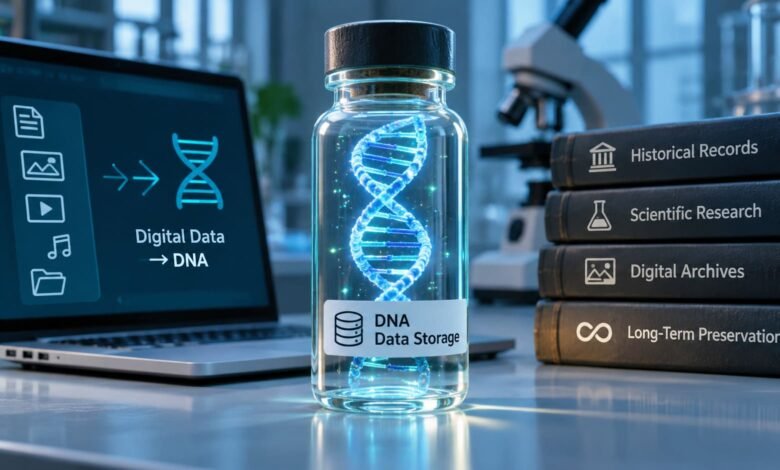
Think about how much information we create every day. From personal photographs and business documents to scientific discoveries and digital videos, almost everything we do now produces information that needs to be stored somewhere.
Traditional storage technologies such as hard drives, SSDs, memory cards, and cloud platforms make this possible. However, preserving information for extremely long periods is a different challenge. Storage devices can fail, hardware becomes outdated, and older digital formats may eventually become difficult to access.
This creates an important question: How can we make sure that valuable information created today remains available to future generations?
Researchers are exploring an unusual possibility known as DNA data storage. Instead of storing information entirely on electronic devices, this technology uses synthetic DNA molecules to represent digital files.
The idea brings biology and computing together in a fascinating way. Although the technology is still developing, it could offer a new approach to preserving important information for much longer periods.
What Is DNA Data Storage?
DNA data storage is an emerging technology that uses synthetic DNA molecules to store digital information.
DNA, or deoxyribonucleic acid, is naturally responsible for carrying genetic instructions in living organisms. Its structure contains four chemical bases:
- Adenine (A)
- Thymine (T)
- Cytosine (C)
- Guanine (G)
These four bases form different sequences that carry biological information. Scientists can use specially designed encoding methods to represent digital information through similar sequences.
Computers normally process information using binary code, which consists of zeros and ones. DNA storage systems translate this information into sequences made from A, T, C, and G.
The resulting sequences can then be produced as synthetic DNA molecules and preserved for future use.
What makes this technology particularly interesting is its potential to store enormous amounts of information in a very small physical space.
How Does DNA Data Storage Work?
The process of storing digital information in DNA involves several scientific steps. Each step is important because the original information must be converted, preserved, and recovered accurately.
1. Converting Digital Information into DNA Code
The process begins with an ordinary digital file, such as a photograph, document, or video.
Specialised encoding software converts the binary information into sequences represented by the four DNA bases.
This creates a biological representation of the original digital information.
2. Creating Synthetic DNA Molecules
After encoding, scientists use DNA synthesis technology to produce artificial DNA molecules containing the required sequences.
These molecules are manufactured in laboratory environments specifically for information storage. The process does not require modifying the DNA of a living person, animal, or plant.
3. Preserving the Stored Information
Once the synthetic DNA has been created, it must be protected from environmental conditions that could damage it.
Researchers investigate preservation techniques such as drying DNA and protecting it inside specialised materials.
Suitable storage conditions help maintain the stability of the DNA sequences over time.
4. Retrieving the Original Information
When someone needs the stored information, scientists use DNA sequencing technology to read the molecular sequences.
Decoding software then translates the sequences back into their original digital representation.
The recovered information can be reconstructed into its original file format, whether it is a photograph, document, video, or another type of digital record.
Why Are Researchers Interested in DNA Data Storage?
The amount of digital information being created worldwide continues to increase. Businesses, research institutions, governments, and individuals all depend on reliable storage systems.
However, not every file needs to be accessed every day. Some information is important because it may be needed many years or even generations later.
DNA storage attracts attention because it offers several potential advantages.
High Storage Density
One of the biggest advantages of DNA is its potential to hold large amounts of information within an extremely small physical space.
Traditional data centres require storage equipment, buildings, cooling systems, and supporting infrastructure. DNA-based storage could potentially reduce the physical space required for selected archival applications.
Potential for Long-Term Preservation
Electronic storage devices eventually require replacement, maintenance, or migration to newer systems.
DNA can remain stable for extended periods when preserved under suitable conditions. This makes it an interesting option for maintaining historical documents, scientific discoveries, and important digital records.
However, its actual lifespan depends on the quality of the DNA and the preservation environment.
Lower Continuous Power Requirements
Unlike electronic storage devices, DNA does not require continuous electricity simply to retain its molecular structure.
This could make it attractive for archival applications where information needs to remain preserved without being accessed regularly.
The processes of producing, sequencing, and decoding DNA still require specialised equipment and energy.
Supporting Scientific Research
Research organisations generate enormous quantities of valuable information through experiments, simulations, and observations.
Some datasets are difficult or expensive to recreate. DNA storage could eventually provide another method for preserving selected research information for future scientific studies.
Where Could DNA Data Storage Be Used?
Although DNA data storage is not yet widely available, several industries and organisations could benefit from its development.
1. Historical Records and Libraries
Libraries, museums, and historical institutions preserve valuable documents, photographs, manuscripts, and cultural records.
DNA storage could provide another way to maintain digital copies of these materials for future generations.
2. Scientific Research Organisations
Scientific research generates large datasets through experiments, simulations, and observations.
Researchers could potentially use DNA storage to archive important scientific information that needs to remain available for extended periods.
3. Government Archives
Government organisations maintain historical, administrative, and legal records that may need to be preserved for decades.
DNA-based storage could eventually become an additional option for maintaining selected digital archives.
4. Digital Media Preservation
Films, photographs, music, and other digital creations represent important parts of human culture.
DNA storage could potentially support the preservation of selected digital collections so future generations can access and study them.
5. Long-Term Business Records
Businesses regularly generate financial documents, contracts, research reports, and historical records.
For information that does not need frequent access but must be preserved for extended periods, DNA storage could become an additional archival solution.
What Challenges Does DNA Data Storage Still Face?
Despite its potential, DNA data storage is not ready to replace traditional storage devices. Researchers still need to address several technical and practical challenges.
High Production Costs
Creating synthetic DNA requires specialised laboratory equipment and scientific processes.
These costs currently make DNA storage less practical than conventional storage technologies for everyday applications.
Reducing the cost of DNA synthesis and sequencing will be important for wider adoption.
Slow Data Retrieval
Hard drives and SSDs allow users to access files almost instantly.
DNA storage involves laboratory processes such as sample preparation and sequencing before information can be recovered.
This makes it more suitable for long-term archives than files that require frequent access.
Data Accuracy and Errors
Errors can occur when DNA sequences are produced or read.
Even small errors may affect the recovery of the original information. Researchers use error-correction techniques, redundancy, and verification methods to improve reliability.
DNA Preservation Requirements
DNA can deteriorate when exposed to unsuitable environmental conditions.
Temperature, moisture, and chemical exposure can affect its stability. Proper preservation methods are therefore essential for protecting stored information.
Lack of Common Standards
For DNA storage to become widely adopted, organisations will need consistent methods for encoding, labelling, preserving, and retrieving information.
Without common standards, recovering information across different systems could become difficult.
Will DNA Data Storage Replace Hard Drives and Cloud Storage?
DNA data storage is unlikely to replace hard drives, SSDs, or cloud platforms in the near future.
Each technology serves a different purpose.
Traditional storage systems are designed for fast access, everyday computing, and continuous data management. DNA storage is being explored primarily for high-density, long-term information preservation.
For example, a research organisation might use SSDs for everyday work, cloud platforms for collaboration, and DNA storage for selected historical research archives.
This combination could allow organisations to benefit from different storage technologies rather than depending on a single solution.
The future of digital storage may not involve replacing existing systems. Instead, different technologies could work together to address different storage requirements.
What Does the Future Hold for DNA Data Storage?
The future of DNA data storage will depend on improvements in DNA synthesis, sequencing accuracy, automation, and production costs.
As these processes become more efficient, researchers may find ways to make the technology more practical for organisations that manage large digital archives.
Another interesting possibility is the development of automated DNA storage systems. Such systems could eventually help convert digital files into DNA sequences, preserve the molecules, and retrieve information when required.
However, storing information is only one part of the challenge. Future generations must also have access to the technology and knowledge required to read and understand the stored sequences.
Researchers will therefore need to consider data integrity, long-term compatibility, and standardisation alongside improvements in storage capacity.
DNA data storage remains an emerging field, but it demonstrates how biological science and computing could work together to address the growing challenge of digital preservation.
Conclusion
The world is producing more digital information than ever before, and keeping that information safe for future generations is becoming increasingly important.
DNA data storage offers a different approach by using synthetic DNA molecules to represent and preserve digital information. Its high storage density and potential for long-term stability make it an exciting area of scientific research.
However, high production costs, slow retrieval, and technical limitations still need to be addressed before it becomes a practical storage solution.
Rather than replacing existing technologies, DNA could eventually support specialised archival systems designed to preserve information for extended periods.
The most interesting possibility is that photographs, research, discoveries, and cultural records created today could potentially remain accessible to people living many generations from now.
Frequently Asked Questions
1. What is DNA Data Storage?
DNA Data Storage is an emerging technology that converts digital information into DNA sequences using four chemical bases: A, T, C, and G. These sequences can be preserved and decoded when needed.
2. How does DNA Data Storage work?
DNA Data Storage works by converting binary information into DNA sequences, creating synthetic DNA molecules, and preserving them. Scientists can later use DNA sequencing to recover the original digital information.
3. Can DNA Data Storage preserve information for centuries?
DNA can remain stable for extended periods when stored under suitable conditions. This makes it a promising option for preserving historical records, scientific research, and important digital information for future generations.
4. What are the main challenges of DNA Data Storage?
The main challenges include high production costs, slow data retrieval, DNA degradation, sequencing errors, and the need for standardised storage methods before widespread adoption becomes practical.