Can AI Understand Human Emotions or Does It Only Recognize Patterns?

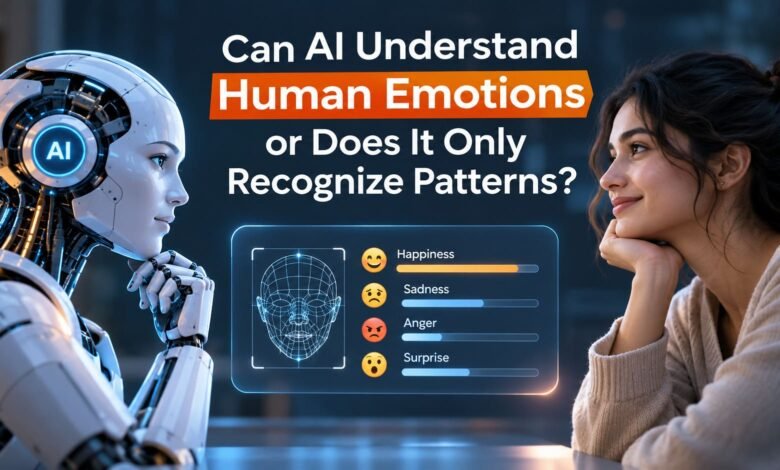
Have you ever wondered whether artificial intelligence can actually understand how you feel? Imagine telling an AI assistant that you are having a difficult day. It responds with comforting words, recognizes that you might be upset, and even suggests ways to improve your mood. But does it genuinely understand your emotions, or is it simply choosing a response based on the words you use?
This question is becoming increasingly important as artificial intelligence becomes part of everyday communication. From virtual assistants and customer support chatbots to mental wellness applications and facial recognition systems, AI is being designed to identify and respond to human emotions.
Although these systems can recognize emotional signals with impressive accuracy in certain situations, recognizing an emotion is not necessarily the same as experiencing or understanding it. The difference between identifying emotional patterns and genuinely understanding human feelings is what makes this technology so interesting.
How Does AI Recognize Human Emotions?
Artificial intelligence does not usually recognize emotions in the same way humans do. Instead, it analyzes information such as words, voice patterns, facial expressions, and other signals to identify possible emotional indicators.
This technology is commonly associated with emotion recognition and affective computing.
For example, when someone writes, “I have been working all day, and nothing seems to be going right,” an AI system may identify frustration or disappointment through the language used.
Similarly, an emotion recognition system may examine:
- Text and language: Identifying emotional words, sentence structure, and communication patterns.
- Facial expressions: Analyzing visible movements around the eyes, eyebrows, and mouth.
- Voice patterns: Detecting changes in pitch, speaking speed, pauses, and tone.
- Behavioral signals: Examining interaction patterns that may indicate changes in emotional responses.
By combining these signals, AI can estimate which emotions a person might be expressing. However, these estimates are interpretations of available information, not direct access to someone’s inner feelings.
Does AI Actually Understand Emotions or Just Recognize Patterns?
This is where the real distinction begins.
AI systems are trained using large amounts of data. During training, they learn relationships between different inputs and possible outputs. When they encounter new information, they use those learned relationships to generate predictions or responses.
For example, if a person frequently uses words such as “exhausted,” “worried,” or “overwhelmed,” an AI system may identify a possible connection with stress.
It can then generate a supportive response based on the context.
However, the same words can have different meanings depending on the situation. Someone saying “I’m fine” might genuinely be happy, hiding disappointment, or simply avoiding a conversation.
A human listener may consider personal experiences, relationships, circumstances, and unspoken context before interpreting those words. AI can analyze some contextual clues, but it does not automatically possess the personal experience or emotional awareness that humans bring to communication.
In simple terms, AI can recognize patterns associated with emotions without necessarily experiencing or fully understanding those emotions.
How AI Uses Different Signals to Identify Emotions
Modern AI systems can examine several types of information to estimate emotional states. Each method provides a different perspective.
1. Understanding Emotions Through Text
Natural Language Processing (NLP) allows AI systems to analyze written communication and identify emotional language.
For example, customer feedback such as “I have contacted support three times, and my issue is still unresolved” may indicate frustration.
Businesses use sentiment analysis to understand customer opinions, monitor feedback, and identify common concerns.
However, sarcasm, cultural differences, and indirect communication can make emotional interpretation difficult.
2. Recognizing Facial Expressions
Computer vision technology enables AI systems to examine facial movements and visible expressions.
For instance, a system may identify a smile, a frown, or raised eyebrows and associate these signals with possible emotional states.
But facial expressions do not always reveal what someone is actually feeling. A person may smile when nervous or maintain a neutral expression while experiencing sadness.
This is why facial expression analysis should not be treated as definitive proof of someone’s emotional state.
3. Analyzing Voice and Speech Patterns
The human voice communicates more than spoken words. Pitch, volume, rhythm, pauses, and speaking speed can provide additional clues about someone’s emotional condition.
AI-powered speech analysis can examine these characteristics to estimate whether a speaker sounds excited, frustrated, calm, or uncertain.
For example, a sudden change in speaking speed or tone may suggest an emotional shift.
However, accents, background noise, individual speaking habits, and cultural differences can affect the accuracy of these interpretations.
4. Combining Multiple Sources of Information
Some advanced systems combine text, voice, facial expressions, and other signals to build a broader picture of an interaction.
This approach is known as multimodal emotion recognition.
Rather than depending on one signal, the system considers multiple sources of information before making an estimate.
Although this can provide richer context, it does not eliminate the possibility of misunderstanding human emotions.
Where Is Emotion Recognition AI Being Used?
Emotion-related AI technology is finding applications across several industries.
Customer Experience and Support
Businesses can use sentiment analysis to identify frustrated customers, understand feedback, and improve customer service interactions.
For example, customer support platforms may flag conversations containing negative sentiment so that support teams can review them.
Healthcare and Mental Wellness
Some digital wellness applications use conversational AI to help users reflect on their feelings, organize thoughts, or access supportive information.
These tools may help with communication and self-reflection, but they should not be confused with professional psychological assessment or human clinical judgment.
Education and Learning
AI-powered educational platforms can examine student responses and interaction patterns to identify possible difficulties with learning materials.
This may help educators recognize when a student needs additional support. However, emotional conclusions should not be drawn from limited behavioral signals alone.
Marketing and Consumer Research
Businesses can analyze customer reviews, surveys, and social media conversations to understand how people respond to products and services.
Sentiment analysis can reveal recurring opinions and customer concerns, helping marketing teams make more informed decisions.
Why Understanding Human Emotions Is Still Difficult for AI
Human emotions are complicated. They are influenced by personal experiences, social environments, relationships, culture, and individual personalities.
A single expression or sentence rarely tells the complete story.
Here are some major challenges that make emotional understanding difficult for AI.
1. The same expression can communicate different feelings.
A smile may indicate happiness, politeness, nervousness, or discomfort. AI cannot always determine the reason behind it.
2. Cultural differences influence emotional expression.
People from different cultural backgrounds may express feelings differently. An emotional recognition model trained on limited demographic data may misunderstand these differences.
3. Context changes the meaning of communication.
The sentence “That’s wonderful” could express genuine excitement or sarcasm. Understanding the difference requires more than identifying individual words.
4. Emotional experiences are personal.
Two people can experience the same situation but respond emotionally in completely different ways. AI predictions may overlook these individual differences.
5. Training data can introduce bias.
If an AI model is trained using unrepresentative or incomplete datasets, its emotional predictions may become less reliable for certain groups of people.
These limitations highlight why emotional recognition should be treated as an estimate rather than an unquestionable conclusion.
Can AI Become More Emotionally Intelligent in the Future?
AI technology will likely become better at interpreting communication as models improve their ability to process language, voice, visual information, and context.
Future systems may offer more natural conversations, recognize subtle communication patterns, and adapt their responses according to the information available.
For example, an AI assistant may become better at identifying when a customer needs a detailed explanation rather than a short response. Similarly, educational tools may provide different learning suggestions based on a student’s interaction patterns.
However, better emotional prediction does not automatically mean genuine emotional understanding.
There is an important distinction between responding appropriately to human emotions and actually experiencing them.
Even as AI becomes more sophisticated, responsible development will require attention to privacy, consent, fairness, transparency, and the consequences of incorrect emotional predictions.
Final Thoughts
So, can AI understand human emotions, or does it only recognize patterns?
The most accurate answer is that today’s AI systems can identify and interpret patterns associated with human emotions, but this does not establish that they genuinely experience or understand feelings in the human sense.
AI can recognize emotional language, analyze facial expressions, examine voice patterns, and generate supportive responses. These capabilities can make communication more useful and help businesses understand customer feedback.
Nevertheless, human emotions involve personal experiences, relationships, memories, and circumstances that cannot always be captured through data.
As artificial intelligence continues to develop, its ability to recognize emotional signals may become more advanced. But the difference between identifying how someone might feel and truly knowing what that person is experiencing will remain an important question in the future of human-AI interaction.
Frequently Asked Questions
1. Can AI really understand human emotions?
AI can recognize emotional signals through text, voice, and facial expressions. However, it does not experience emotions like humans and mainly relies on learned patterns.
2. How does AI recognize human emotions?
AI uses machine learning, natural language processing, and computer vision to analyze words, speech patterns, and facial expressions to estimate emotional states.
3. What are the limitations of AI emotion recognition?
AI may struggle to understand sarcasm, cultural differences, personal experiences, and context, which can lead to incorrect emotional predictions.
4. Where is AI emotion recognition technology used?
It is used in customer service, marketing, healthcare applications, education, and conversational AI to analyze communication and improve user interactions.