What Happens When Businesses Trust AI Without Checking Its Results?

Artificial Intelligence has changed the way businesses handle everyday work. From analysing customer information and preparing reports to managing customer support and predicting market trends, AI tools are helping companies complete tasks that once required considerable time and effort.
For many organisations, using AI has become part of their daily routine. Employees rely on it to find information, generate ideas, understand data, and support important decisions. It can make work easier, but there is one question businesses should not ignore: What happens when people start trusting AI without checking whether its answers are actually correct?
Consider a company preparing its quarterly business strategy. Its team uses an AI tool to analyse sales figures and identify future opportunities. The system produces a detailed report and recommends investing more money in a particular product category. The recommendation looks reasonable, so management accepts it.
A few weeks later, the company discovers that the analysis was based on incomplete sales information. The decision has already affected its budget and business priorities.
This situation highlights an important reality. AI can process information quickly, but speed does not always mean accuracy.
As businesses become more dependent on artificial intelligence, understanding its limitations is just as important as learning how to use it. Let’s explore what can happen when organisations accept AI-generated results without proper verification.
1. Convincing AI Answers Can Hide Incorrect Information
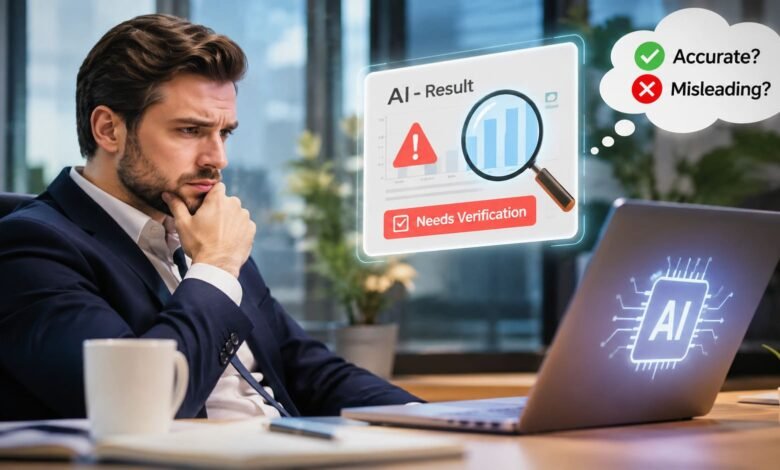
One of the biggest challenges with modern AI tools is that incorrect information can sometimes appear completely believable.
AI-generated responses are often well-organised, detailed, and written with confidence. This makes it difficult for employees to recognise when something is inaccurate, particularly when they are working in an unfamiliar area.
For example, an employee may ask an AI tool to prepare a report about competitors in a particular industry. The response might include company details, market observations, product comparisons, and business statistics.
However, some information could be outdated, certain details might be incorrectly interpreted, or the system might generate information that cannot be verified.
If employees copy this information directly into presentations or business reports, inaccurate details can quickly spread across the organisation.
The concern is not that AI always provides incorrect information. It is that a convincing response can encourage people to stop questioning its accuracy.
Businesses should make fact-checking a normal part of using AI, especially when the information will influence important decisions.
2. Poor AI Analysis Can Lead to Expensive Business Decisions
Business decisions depend on accurate information. A small mistake in a report might appear harmless, but when that information influences financial planning, sales strategies, or resource allocation, the consequences can become significant.
Imagine an online retailer using AI to analyse customer purchasing behaviour. The system identifies a particular product as one of its strongest performers and recommends increasing stock.
However, the analysis does not account for a temporary promotional campaign that caused an unusual increase in sales.
Management accepts the recommendation without reviewing the circumstances. The company purchases additional inventory, only to discover that normal customer demand is much lower.
The result is unnecessary spending and excess stock.
This example shows why businesses should understand the information behind AI-generated recommendations rather than accepting the final conclusion alone.
Before making important decisions, teams should check the original data, consider external factors, and compare AI recommendations with actual business performance.
3. Customers Can Lose Trust When AI Provides the Wrong Information
Many companies now use AI-powered chatbots, automated email systems, and virtual assistants to communicate with customers.
These technologies can help businesses respond faster and manage large volumes of enquiries. However, a quick response is not always a helpful response.
Think about a customer contacting a company because a product has not arrived. The chatbot checks the available information and incorrectly confirms that the order has already been delivered.
The customer receives an answer, but the actual problem remains unresolved.
Situations like this can make customers feel that the company is not listening to them. If incorrect automated responses happen repeatedly, customers may begin questioning the reliability of the entire service.
Businesses should regularly review chatbot responses, update their information sources, and provide a way for customers to reach a human representative when necessary.
Automation should make customer communication easier, not create another problem for customers to solve.
4. AI Does Not Always Understand the Complete Business Situation
Numbers and patterns can tell businesses a lot, but they do not always explain the complete situation.
AI systems can identify trends in large datasets, yet their conclusions may overlook important details such as seasonal changes, customer expectations, market conditions, and company-specific objectives.
For instance, an AI tool might report that website traffic has increased by 40% and recommend continuing the current marketing strategy.
At first, this sounds like positive news. But what if most of those visitors are leaving the website without making an enquiry or exploring the company’s services?
The increase in traffic may not be producing meaningful business results.
A marketing team needs to examine more than visitor numbers. It should also consider engagement, lead quality, conversion rates, and the actual contribution of website traffic to business goals.
This is where human experience becomes valuable. Employees can connect the information with the company’s objectives and identify questions that an automated analysis may have overlooked.
5. Overdependence on AI Can Weaken Human Decision-Making
AI is becoming a convenient assistant for many professionals. Employees can use it to prepare documents, summarise information, generate ideas, and solve routine problems.
The difficulty begins when convenience turns into complete dependence.
If employees accept every AI suggestion without thinking independently, they may gradually lose the habit of questioning information and exploring alternative solutions.
For example, a marketing team might ask AI to suggest a campaign strategy. The system provides a plan based on general customer behaviour, and the team implements it without checking whether it matches its actual audience.
The campaign may fail because the recommendation does not reflect the company’s customers, industry, or market position.
AI should help employees think through problems, not make independent thinking unnecessary.
Businesses need people who can interpret information, challenge assumptions, recognise mistakes, and take responsibility for decisions.
6. Unchecked AI Usage Can Create Data Privacy and Security Problems
Accuracy is not the only concern when businesses use AI. The way employees handle company information also deserves attention.
Many AI tools allow users to enter text, upload documents, or share information to receive automated assistance. Employees may unknowingly include confidential business details, customer records, financial information, or internal documents.
If an organisation has not established clear rules for using external AI platforms, this information could be exposed to inappropriate systems or handled in ways that do not meet company requirements.
Another concern involves AI-generated recommendations in areas such as recruitment, finance, and cybersecurity. If these systems are not properly evaluated, they may produce biased or misleading results.
For example, an AI recruitment tool could rank candidates using patterns that unfairly disadvantage certain applicants.
Companies should therefore establish clear guidelines about approved AI tools, permitted data sharing, access controls, and human review.
Responsible AI adoption requires protecting information as carefully as businesses protect their other digital assets.
7. Why Human Verification Still Matters in the Age of AI
As AI tools become more capable, it may be tempting to assume that human involvement will become less important.
In reality, human verification remains essential because business decisions involve more than processing information.
People understand organisational priorities, customer expectations, professional responsibilities, and the consequences of taking action.
An AI tool might identify a possible opportunity, but a business professional must decide whether that opportunity is realistic and appropriate.
Similarly, AI might recommend a change in pricing, customer targeting, or operational processes. Before implementing it, employees should examine the evidence and consider the potential impact.
Human oversight does not mean checking every minor AI-generated sentence manually. It means establishing appropriate levels of review based on the importance and potential consequences of the task.
For routine work, simple checks may be sufficient. For financial, legal, security, recruitment, or customer-impacting decisions, stronger verification is necessary.
8. Practical Ways Businesses Can Avoid Blindly Trusting AI
Businesses do not need to stop using AI to avoid these problems. They need a better approach to using it.
Here are some practical steps organisations can introduce:
Verify Important Information: Check facts, figures, calculations, and recommendations against reliable sources before using them in important reports or decisions.
Maintain Good Data Quality: Provide AI systems with relevant, accurate, and updated information. Poor-quality input can produce misleading conclusions.
Introduce Human Approval: Establish review processes for decisions involving finances, customers, employees, security, and business strategy.
Test AI Results Against Real Outcomes: Compare predictions and recommendations with actual performance to identify errors and understand where improvements are required.
Protect Confidential Information: Set clear rules about which AI platforms employees can use and what company or customer information they are allowed to share.
Train Employees to Question AI Responses: Help teams understand that AI-generated information should be evaluated rather than accepted automatically.
Review AI Tools Regularly: Monitor the accuracy, reliability, and suitability of AI systems as business requirements and technologies change.
These practices can help organisations use AI more confidently without giving up control over important decisions.
9. Responsible AI Adoption Will Shape the Future of Business
Artificial Intelligence will continue influencing how companies work. Businesses are already exploring ways to use AI for predictive analysis, automation, customer engagement, cybersecurity, and operational planning.
However, successful AI adoption is not simply about introducing more tools or automating more tasks.
It is about understanding where AI adds value, recognising where it can make mistakes, and creating processes that keep those mistakes from affecting business outcomes.
Companies that invest in employee training, data quality, transparency, and human oversight can build a stronger foundation for responsible AI use.
The organisations that benefit most from AI will not necessarily be those that automate everything. They will be the ones that understand when to use technology, when to question its output, and when human judgement should take priority.
Conclusion
Artificial Intelligence has created new opportunities for businesses to improve productivity, understand information, and simplify complex tasks. But relying on AI without checking its results can turn these advantages into unnecessary risks.
Incorrect reports, misleading predictions, poor customer experiences, and data privacy problems are all possible when organisations treat AI-generated information as automatically reliable.
Businesses should remember that using AI is not the same as making a well-informed decision. The information still needs to be reviewed, understood, and evaluated before it is put into action.
AI can help businesses work smarter, but responsible human judgement is what helps them work reliably.
The future of business will not depend only on how much AI a company uses. It will also depend on how carefully that company verifies and applies the information AI provides.
Frequently Asked Questions
1. Why should businesses verify AI-generated information?
Businesses should verify AI-generated information because AI can produce inaccurate answers, outdated facts, or misleading recommendations. Checking results helps prevent mistakes and supports better business decisions.
2. What are the risks of trusting AI without checking its results?
Trusting AI without verification can lead to poor business decisions, financial losses, incorrect customer information, data privacy concerns, and unreliable business reports.
3. Can AI-generated results affect business performance?
Yes. Incorrect AI analysis can influence marketing strategies, sales forecasts, customer service, and financial planning, potentially affecting business performance and productivity.
4. How can businesses use AI more responsibly?
Businesses can use AI responsibly by checking important information, maintaining accurate data, protecting confidential details, training employees, and keeping human oversight in important decisions.