Imagine a robot that can pick up a delicate glass object without breaking it, recognize when a surface is too hot to touch, or gently hold a person’s hand without applying too much pressure. These abilities may sound like something from a science-fiction movie, but researchers are working to make them possible through a technology called electronic skin (e-skin).
Unlike traditional robotic sensors that mainly detect movement, position, or pressure at specific points, electronic skin is designed to cover surfaces and detect different types of physical interactions. It can help robots understand what they are touching, how much force they are applying, and whether the object around them is changing.
As robotics continues to develop, electronic skin could become an important technology for creating machines that interact more naturally and safely with the physical world.
What Is Electronic Skin Technology?
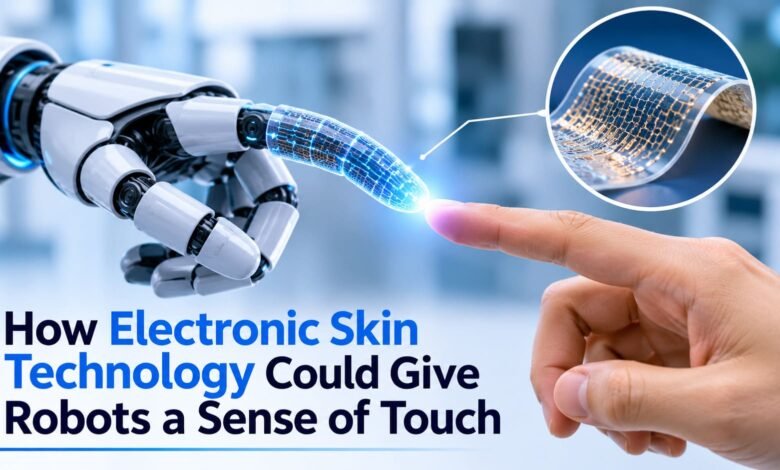
Electronic skin is a flexible, sensor-based material designed to imitate some functions of human skin. Human skin helps us recognize pressure, temperature, texture, and pain. Electronic skin aims to provide robots with similar sensing abilities through electronic components.
It is generally made using flexible materials, conductive layers, and tiny sensors that respond to physical changes.
When an object touches the surface, these sensors detect the interaction and convert it into electrical signals. A connected processing system then interprets those signals to help the robot understand what is happening.
For example, if a robot touches a soft object, its electronic skin may detect gentle pressure. If it touches a harder surface, the sensors may register a different pressure response.
This information can help the robot adjust its movements instead of relying only on pre-programmed instructions.
How Electronic Skin Helps Robots Develop a Sense of Touch
Electronic skin works through different sensing technologies that collect information from the surrounding environment. Each sensing capability helps robots respond more intelligently to physical contact.
1. Pressure Detection for Better Object Handling
One of the most important functions of electronic skin is pressure detection.
Robots often use mechanical grippers to pick up and move objects. However, without accurate touch feedback, they may apply too much force or fail to hold an object securely.
Pressure-sensitive electronic skin can help solve this problem by detecting how strongly a robot is touching an object.
For instance, when handling an egg, a robot could use pressure information to maintain a gentle grip. When lifting a heavy tool, it could apply more force to prevent slipping.
This capability could make robotic handling more accurate and reliable.
2. Temperature Detection for Safer Interaction
Human skin naturally senses temperature, allowing us to recognize hot and cold surfaces. Electronic skin can provide robots with a similar capability.
Temperature-sensitive sensors can detect changes in the temperature of objects and surrounding surfaces.
This could be useful in manufacturing facilities, laboratories, and environments where robots work near heated equipment.
For example, a robot could identify an unusually hot machine component before attempting to handle it. This information could help prevent equipment damage and improve operational safety.
3. Texture Recognition Through Physical Contact
Recognizing different surface textures is another interesting possibility.
A human can often distinguish between smooth glass, rough wood, soft fabric, and hard plastic simply by touching them.
Electronic skin systems can combine pressure, vibration, and other tactile measurements to help robots identify differences between surfaces.
This could improve robotic inspection, material sorting, and product handling. A robot equipped with advanced tactile sensors may eventually identify certain material characteristics without depending entirely on cameras.
4. Detecting Slipping Objects
Holding an object securely is not always easy for robots. A small change in grip pressure or movement can cause an object to slip.
Electronic skin may help robots detect early signs of slipping through changes in pressure distribution, vibration, or movement at the contact surface.
When the system detects a possible slip, the robot can adjust its grip before dropping the object.
This could be especially useful for warehouse robots, industrial automation systems, and robots designed to assist people.
Key Technologies Behind Electronic Skin
Several technologies work together to make electronic skin possible.
Flexible Sensors: These sensors can bend and stretch while detecting physical interactions. They allow electronic skin to cover curved robotic surfaces such as fingers, hands, and arms.
Conductive Materials: Special conductive materials help transmit electrical signals when pressure or movement changes occur.
Microelectronic Components: Small electronic components collect and process signals from different sensing areas.
Artificial Intelligence: AI can analyze sensor information, identify patterns, and help robots decide how to respond to physical contact.
Wireless Communication: Some electronic skin designs explore wireless signal transmission, reducing the need for complicated wiring across robotic surfaces.
Together, these technologies can create a sensing system that helps robots understand their physical surroundings more effectively.
Real-World Applications of Electronic Skin in Robotics
Electronic skin is not limited to one type of robot. Its potential applications extend across several industries.
Healthcare and Medical Assistance
Robots used in healthcare need to interact carefully with people. Electronic skin could help medical assistance robots recognize physical contact and adjust the pressure they apply.
For example, a rehabilitation robot could use tactile feedback to provide controlled physical support during movement exercises.
It could also help robotic prosthetic systems provide users with more useful information about physical contact, although delivering natural touch sensations to the human nervous system remains a complex challenge.
Industrial Manufacturing
Factories increasingly use robots for handling, assembling, and inspecting products.
Electronic skin could help these machines recognize contact pressure, detect slipping components, and handle fragile materials more carefully.
This could be particularly valuable in electronics manufacturing, where small components require precise handling.
Service and Domestic Robots
Home robots are expected to perform more physical tasks in everyday environments.
They may eventually help people organize household items, carry objects, or assist with basic daily activities.
Electronic skin could make these interactions safer by allowing robots to detect unexpected contact and respond with appropriate movements.
Search and Rescue Operations
Robots working in disaster areas often operate in unpredictable environments.
Electronic skin could help them detect contact with surrounding objects, identify changes in surface pressure, and handle materials more carefully.
These capabilities may support inspection and navigation in areas where direct human access is difficult.
Challenges That Electronic Skin Technology Still Needs to Overcome
Despite its potential, electronic skin is still developing, and several technical challenges remain.
Durability: Robotic systems may experience repeated pressure, stretching, friction, and environmental exposure. Electronic skin must remain functional under these conditions.
Sensor Accuracy: Detecting small differences in pressure, temperature, and texture requires reliable sensors. Inaccurate readings could lead to incorrect robotic movements.
Power Consumption: Large sensor networks need energy to collect and transmit information. Developing energy-efficient systems is important for practical applications.
Data Processing: Electronic skin can generate large amounts of sensor information. Robots need efficient processing systems to interpret these signals quickly.
Manufacturing Costs: Producing flexible materials and integrating thousands of tiny sensors can be expensive. More affordable manufacturing methods will be necessary for widespread adoption.
Researchers are exploring new materials, sensor designs, and processing methods to address these limitations.
The Future of Electronic Skin and Touch-Sensitive Robots
The future of electronic skin could change how robots interact with people, objects, and their surroundings.
As flexible materials, artificial intelligence, and sensor technologies improve, robotic systems may become better at recognizing physical contact and responding to unexpected situations.
One exciting possibility is the development of robotic hands that can perform delicate tasks with greater control. Another is the use of electronic skin across entire robotic bodies, allowing machines to detect contact from multiple directions.
In the longer term, electronic skin could also contribute to more advanced prosthetics and human-robot interaction systems.
However, developing a truly human-like sense of touch will require more than simply adding sensors. Robots must also learn to interpret tactile information and use it to make appropriate decisions.
Conclusion
Electronic skin technology represents an important step toward making robots more aware of their physical surroundings. By combining flexible sensors, pressure detection, temperature sensing, and intelligent data processing, it could give machines a more advanced sense of touch.
From healthcare assistance to industrial manufacturing, the technology has the potential to improve how robots handle objects and interact with people.
Although challenges such as durability, accuracy, and production costs remain, continued research could make touch-sensitive robotics increasingly practical.
Robots may not experience touch exactly as humans do, but electronic skin could help them move beyond simply seeing and detecting objects toward understanding how they physically interact with the world.
Frequently Asked Questions
1. What is electronic skin technology in robotics?
Electronic skin is a flexible sensor-based material that helps robots detect physical contact, pressure, temperature, and surface changes, giving them improved touch-sensing abilities.
2. How does electronic skin help robots handle objects?
Electronic skin detects pressure and contact changes, allowing robots to adjust their grip and handle delicate or heavy objects with better control.
3. Where can electronic skin technology be used?
It could be used in healthcare robots, industrial manufacturing, robotic prosthetics, service robots, and search-and-rescue systems.
4. What are the main challenges of electronic skin?
The main challenges include sensor accuracy, material durability, power consumption, data processing, and high manufacturing costs.