How Biometric Technology Is Changing the Future of Digital Identity Security

Imagine accessing your bank account without remembering a password or verifying your identity with just a fingerprint or facial scan. What once seemed like advanced technology has now become part of everyday digital life.
As more people rely on online banking, digital payments, cloud platforms, and mobile applications, protecting personal identity has become increasingly important. Traditional passwords still play a role in online security, but they are no longer enough to address every modern cybersecurity threat. Stolen credentials, phishing attacks, identity theft, and account takeovers continue to create challenges for individuals and businesses.
This is where biometric technology is bringing a significant change.
Biometric authentication uses unique human characteristics, including fingerprints, facial features, iris patterns, and voice characteristics, to help verify an individual’s identity. Instead of relying entirely on information that someone remembers, these systems use personal characteristics to support digital authentication.
From unlocking smartphones to securing financial transactions, biometric technology is changing how people access digital services. However, its growing adoption also raises important questions about data privacy, security, and the future of identity protection.
Understanding these developments helps explain why biometrics is becoming an important part of modern digital identity security.
What Is Biometric Technology and How Does It Work?
Biometric technology is a method of identifying or verifying individuals through their unique physical or behavioural characteristics.
The process generally begins when a person registers their biometric information. The system captures the relevant characteristics and creates a digital representation known as a biometric template.
When the individual attempts to authenticate again, the system captures a new sample and compares it with the registered template. If the similarity meets the system’s acceptance threshold, access may be granted.
Some commonly used biometric methods include:
- Fingerprint Recognition: Identifies individuals through unique fingerprint patterns. It is commonly used in smartphones, attendance systems, and access control.
- Facial Recognition: Examines facial characteristics to help verify an individual’s identity.
- Iris Recognition: Analyses distinctive patterns in the iris for identity verification.
- Voice Recognition: Uses characteristics of a person’s voice to support authentication.
- Behavioural Biometrics: Examines patterns such as typing rhythm, mouse movements, and touchscreen interactions.
Each method offers different advantages and limitations. The appropriate technology depends on the security requirements, environment, privacy considerations, and user experience.
Why Traditional Passwords Are No Longer Enough
Passwords have protected online accounts for many years, but managing digital identities has become more complicated.
People now access multiple platforms for banking, shopping, communication, entertainment, and professional work. Remembering unique passwords for every account can be difficult, which often leads to password reuse or weak combinations.
This creates several security challenges.
1. Password Theft
Cybercriminals use phishing websites, fraudulent emails, and malicious software to collect login credentials.
2. Credential Stuffing
Attackers use previously exposed usernames and passwords to attempt access to other accounts.
3. Social Engineering
Fraudsters manipulate individuals into sharing confidential information or approving fraudulent authentication requests.
4. Account Takeovers
Stolen login credentials can allow attackers to access personal accounts, confidential information, and financial services.
Biometric authentication can reduce dependence on traditional passwords. However, it should be combined with additional security measures rather than treated as a complete replacement for every authentication method.
How Biometric Technology Is Transforming Digital Identity Security
Biometric technology is influencing how organizations verify users, protect accounts, and manage access to sensitive information.
1. Making Digital Banking More Secure
Financial institutions are increasingly using biometric authentication to make digital banking more convenient.
Customers can use fingerprints or facial recognition to access banking applications and approve certain activities. Remote identity verification can also combine facial matching with identity document checks.
Liveness detection can provide another layer of protection by helping determine whether a biometric sample comes from a real person rather than a photograph or recorded video.
These methods can improve the authentication experience while supporting existing fraud prevention systems.
2. Improving Remote Identity Verification
Many services now allow individuals to register and complete identity verification without visiting a physical office.
Biometric technology can support this process by comparing a live facial image with an identity document or previously verified reference.
This is particularly useful for digital onboarding, financial services, and online platforms that need to establish customer identities remotely.
3. Strengthening Workplace Access Control
Businesses manage confidential documents, internal applications, customer information, and restricted physical areas.
Biometric authentication can help organizations verify employees before allowing access to sensitive systems or locations.
For example, fingerprint authentication can be used for controlled entry, while device-based biometrics can support secure access to workplace applications.
4. Supporting Passwordless Authentication
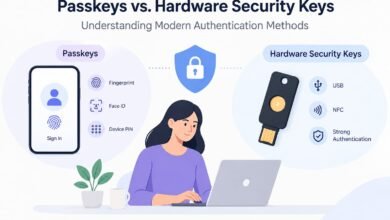
One important development in digital identity security is the growing adoption of passkeys.
Passkeys use public-key cryptography to authenticate users without traditional passwords. Individuals can approve authentication using their device’s fingerprint reader, facial recognition, or PIN.
Importantly, biometric information generally remains on the user’s device when used to unlock a passkey. The online service receives cryptographic proof instead of the actual fingerprint or facial data.
This helps reduce risks associated with password theft, reuse, and phishing.
The Growing Role of Artificial Intelligence in Biometric Security
Artificial intelligence is making biometric systems more capable of analysing identity-related information and detecting suspicious authentication attempts.
Machine learning can help systems recognise patterns, evaluate biometric samples, and identify unusual behaviour.
Some important applications include:
- Advanced Facial Matching: AI analyses facial characteristics to support identity comparison.
- Liveness Detection: Helps distinguish genuine users from photographs, recordings, and certain spoofing attempts.
- Behavioural Analysis: Identifies unusual patterns in typing, device usage, and digital interactions.
- Fraud Detection: Helps identify suspicious authentication attempts and potentially fraudulent activity.
However, AI does not automatically guarantee accurate authentication. Poor-quality data, algorithmic bias, manipulated media, and implementation weaknesses can affect system reliability.
Organizations should regularly evaluate biometric solutions across different users and real-world conditions.
Deepfakes and Biometric Spoofing: A Growing Security Challenge
As biometric authentication becomes more common, cybercriminals are also exploring ways to bypass it.
AI-generated images, synthetic voices, manipulated videos, and artificial fingerprint replicas can create new challenges for identity verification systems.
For example, an attacker may attempt to use a manipulated facial video to deceive a poorly protected facial recognition system. Similarly, AI-generated voice recordings may be used against voice-based authentication.
This makes liveness detection and Presentation Attack Detection (PAD) increasingly important.
Organizations should consider the following security measures:
- Use reliable liveness detection mechanisms.
- Protect biometric sensors and communication channels.
- Combine biometrics with additional authentication factors.
- Monitor unusual login attempts and repeated verification failures.
- Regularly test systems against new spoofing techniques.
The NIST Digital Identity Guidelines, SP 800-63-4, published in July 2025, provide updated guidance on digital identity, authentication, biometrics, and presentation attack detection.
Privacy Concerns: Protecting Sensitive Biometric Information
Biometric information is different from an ordinary password.
If a password is compromised, users can change it. However, changing a fingerprint or facial structure is not realistically possible.
This makes biometric information particularly sensitive.
Some important privacy concerns include:
Biometric Data Breaches: Exposed biometric templates can create long-term identity risks.
Unauthorized Data Collection: Individuals may not always understand how their biometric information is collected and processed.
Excessive Data Retention: Keeping biometric information longer than necessary increases potential exposure.
Third-Party Security Risks: External service providers may introduce additional vulnerabilities.
Surveillance Concerns: Facial recognition and behavioural monitoring can raise questions about consent and personal privacy.
Organizations should protect biometric information through encryption, restricted access, clear consent policies, secure storage, and appropriate retention limits.
Where possible, processing biometric information directly on a user’s device can reduce unnecessary sharing of sensitive data.
What Businesses Should Consider Before Adopting Biometric Technology
Introducing biometric authentication requires more than purchasing a fingerprint scanner or facial recognition solution. Businesses must understand their security requirements and privacy responsibilities.
Here are five important considerations:
1. Select the Appropriate Technology
Choose a biometric method based on the organization’s security requirements, operational environment, and user needs.
2. Protect Biometric Data
Use encryption, secure storage, and strict access controls to prevent unauthorized access to biometric templates.
3. Combine Authentication Methods
Biometric verification should complement multi-factor authentication and other security controls, particularly when protecting sensitive accounts.
4. Evaluate Accuracy and Reliability
Test systems across different demographic groups, devices, and environmental conditions to identify potential weaknesses.
5. Maintain Transparent Privacy Policies
Explain what information is collected, why it is required, how it is protected, and how users can access alternative authentication methods.
These practices can help organizations adopt biometric technology responsibly without overlooking security and privacy requirements.
What Does the Future of Digital Identity Security Look Like?
The future of digital identity security will likely involve a combination of biometrics, artificial intelligence, cryptographic authentication, and privacy-focused technologies.
Rather than depending on one authentication method, organizations are moving towards systems that evaluate multiple security signals.
Some important developments to watch include:
Device-Based Identity Verification
Secure hardware and on-device biometric processing can help reduce unnecessary exposure of personal information.
Wider Adoption of Passkeys
Passwordless authentication is expected to become increasingly common as organizations look for phishing-resistant authentication methods.
Advanced Deepfake Detection
Improved detection techniques will help identify manipulated images, synthetic voices, and other forms of biometric spoofing.
Privacy-Preserving Authentication
Technologies that minimise the collection and sharing of sensitive personal information will become increasingly important.
Continuous Risk Assessment
Security systems may increasingly examine device activity, login context, and unusual behaviour throughout a session rather than relying only on the initial login.
These developments suggest that digital identity security is moving towards more adaptive, convenient, and privacy-conscious authentication.
Conclusion
Biometric technology is changing how individuals and organizations protect digital identities. Fingerprints, facial recognition, iris scanning, and behavioural analysis are creating new ways to verify users and secure access to digital services.
However, the growing use of biometric authentication also brings responsibilities. Organizations must protect sensitive information, address deepfake threats, evaluate system accuracy, and respect individual privacy.
The combination of biometric authentication, AI-powered security, passkeys, and privacy-focused identity management will play an important role in shaping the next generation of digital security.
Ultimately, the future is not simply about recognizing someone’s face or fingerprint. It is about ensuring that people can access digital services securely while maintaining control over their personal identity.
Frequently Asked Questions (FAQs)
1. What is biometric technology in digital identity security?
Biometric technology uses unique physical or behavioural characteristics, such as fingerprints, facial features, iris patterns, and voice recognition, to verify an individual’s identity and protect digital accounts.
2. How does biometric authentication improve digital security?
Biometric authentication reduces dependence on traditional passwords by using personal characteristics for identity verification. When combined with multi-factor authentication and secure devices, it can help prevent unauthorized account access.
3. Can deepfake technology bypass biometric authentication?
Yes, some poorly protected biometric systems may be vulnerable to AI-generated faces, manipulated videos, and synthetic voices. Liveness detection and presentation attack detection can help identify and reduce these threats.
4. What are the major privacy risks of biometric technology?
Major privacy risks include biometric data breaches, unauthorized data collection, excessive data storage, and misuse of personal information. Encryption, secure storage, access restrictions, and transparent consent policies help reduce these risks.