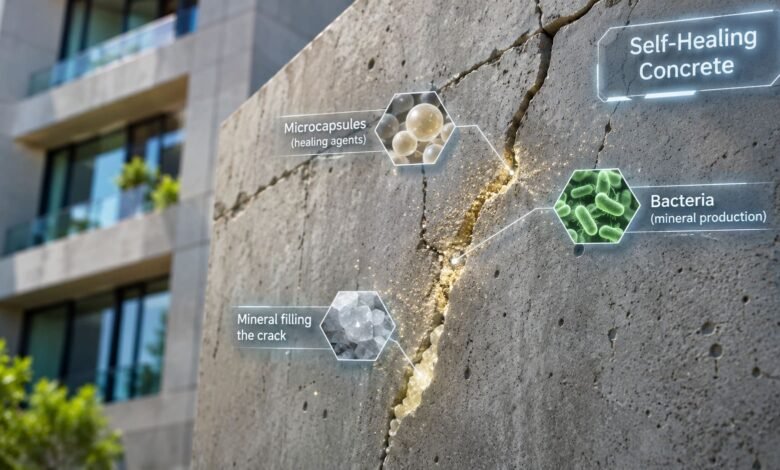
Imagine walking past a building that has developed a small crack in one of its concrete walls. Instead of sending workers to inspect the damage and arrange repairs, the building begins fixing the problem on its own.
It may sound like something from a science-fiction movie, but scientists are already exploring materials that can repair certain types of cracks without requiring people to apply traditional repair methods.
This technology is known as self-healing concrete, and it could change how engineers think about the future of construction.
Concrete has been one of the most important materials in modern infrastructure. It is used in homes, bridges, tunnels, roads, parking structures, and countless other buildings. However, even strong concrete can develop cracks over time because of temperature changes, shrinkage, heavy loads, and environmental exposure.
The interesting part is that researchers are now trying to give concrete something it naturally lacks: the ability to respond to damage and repair itself.
Why Do Buildings Develop Cracks in the First Place?
Concrete may look solid and permanent, but it is not completely immune to damage.
As concrete dries, it can shrink slightly. Changes in temperature can cause it to expand and contract. When the material experiences stress beyond what it can comfortably withstand, small cracks may begin to appear.
Some cracks are harmless and mainly affect appearance. Others can become more serious when water, air, or chemicals enter the material.
For example, water can travel through tiny openings in concrete and reach the steel reinforcement inside. Over time, this may contribute to corrosion, which can weaken the structure.
The real problem is not always the first crack. It is what happens when that crack remains unnoticed and gradually becomes larger.
Traditional repairs usually involve inspecting the damaged area, preparing the surface, and applying suitable repair materials. These methods are effective, but they require time, labour, equipment, and sometimes temporary restrictions on the use of a building.
Researchers are exploring whether some of these repairs could happen automatically before the damage becomes more difficult to manage.
What Is Self-Healing Concrete?
Self-healing concrete is a specially designed construction material that can seal or repair certain cracks through natural reactions or built-in healing mechanisms.
Unlike ordinary concrete, which generally requires external repair when damage occurs, self-healing concrete contains materials or components that help respond to cracking.
The idea is simple: when a crack develops, the concrete should have a way to fill the opening, reduce water movement, or restore some of its original performance.
There are different ways to achieve this.
Some types of concrete use the material’s own chemical properties to heal small cracks. Others contain special capsules, minerals, or microorganisms that become active when damage occurs.
Researchers are studying these approaches because even a small improvement in concrete durability could make a difference across large infrastructure projects.
How Can Concrete Repair Itself?
1. Natural Healing Through Cement Reactions
One of the simplest forms of self-healing happens naturally in conventional concrete.
Concrete contains cement, water, and other materials. Even after the concrete has hardened, some unreacted cement particles may remain inside it.
When a small crack forms and moisture enters, these particles can continue reacting with water. The reaction produces additional solid material that may help fill the crack.
Another process involves calcium carbonate formation. When certain chemical conditions are present, minerals can gradually accumulate inside the opening.
This natural process is called autogenous healing.
It is particularly useful for very small cracks, especially when moisture is available. However, it cannot reliably repair every crack, and its effectiveness becomes limited as the damage grows.
2. Bacteria That Help Produce Minerals
One of the most fascinating approaches involves microorganisms.
Scientists have developed experimental concrete mixtures containing specially selected bacteria or bacterial spores. These microorganisms can remain inactive inside the material until suitable conditions become available.
When water enters a crack, it may activate the biological system. With the right nutrients and chemical environment, the bacteria can help produce calcium carbonate, a mineral that can accumulate within the damaged area.
Over time, this mineral may partially or completely fill certain cracks.
The bacteria are not rebuilding an entire wall like living tissue repairing a wound. Instead, they help create mineral deposits that seal the opening and reduce the movement of water through it.
Researchers are investigating how to protect these microorganisms from the harsh environment inside concrete and how to keep them effective for longer periods.
3. Tiny Capsules That Release Repair Materials
Another approach uses small capsules containing healing agents.
These capsules are mixed into the concrete during construction. If a crack passes through one of them, the capsule can break and release its contents into the damaged area.
The released material may flow into the crack and harden, helping to seal the opening.
Think of it as a material carrying its own emergency repair supply.
The challenge is to design capsules that remain stable during construction but break at the right time. They must also release enough healing material to make a meaningful difference.
Researchers are studying different capsule materials and healing compounds to improve the reliability of this process.
4. Built-In Networks That Carry Healing Materials
Some experimental systems use small channels or networks inside concrete.
These channels can transport healing agents toward damaged areas, somewhat like a delivery system hidden inside the material.
When a crack develops, the network may help direct a repair substance into the opening.
This approach could be useful where damage is more difficult to reach from the outside. However, creating these internal networks without weakening the concrete is a major engineering challenge.
Each method has its own advantages, and researchers are still investigating which approaches work best under different conditions.
Could Buildings Really Repair Themselves Automatically?
The short answer is: certain types of concrete can already demonstrate self-healing behaviour under controlled conditions, but fully self-repairing buildings are not yet a normal construction reality.
The technology is developing, and laboratory research has shown promising results. Some systems can reduce crack openings and improve resistance to water penetration.
However, sealing a crack does not automatically mean that a structure has regained all of its original strength.
A building may have cracks caused by serious structural problems, such as excessive loading, foundation movement, or damaged reinforcement. These issues cannot simply be ignored because a healing material has filled the visible opening.
Self-healing concrete is best understood as a technology that may help manage certain forms of damage and improve durability.
It is not a replacement for structural inspection, engineering assessment, or necessary repairs.
Where Could Self-Healing Concrete Be Useful?
The technology could become particularly valuable in places where repairing concrete is difficult, expensive, or disruptive.
Bridges and elevated roads
Bridges experience repeated loading, changing temperatures, and exposure to rain and road salts. Self-healing materials could help reduce the movement of water through small cracks and support longer-lasting infrastructure.
Underground tunnels
Tunnels are often difficult to inspect and repair because they operate in confined environments. Materials that can seal minor cracks internally could help reduce maintenance requirements.
Parking structures
Parking buildings are exposed to moisture, vehicle loads, and chemicals carried by vehicles. Self-healing concrete may help protect vulnerable areas from gradual deterioration.
Water-retaining structures
Water tanks, reservoirs, and similar structures need to control leakage. Crack-sealing materials could help improve water resistance in suitable applications.
Buildings in remote locations
Structures located far from repair facilities may benefit from materials that can manage small cracks without immediate external intervention.
These are potential applications rather than a guarantee that every structure will be able to repair itself automatically.
Could This Technology Make Construction More Sustainable?
One of the biggest reasons researchers are interested in self-healing concrete is its potential to extend the useful life of infrastructure.
Constructing a building requires raw materials, energy, transportation, and labour. When concrete structures deteriorate earlier than expected, repairing or replacing them can create additional environmental and financial costs.
If self-healing materials can reduce certain maintenance activities and delay deterioration, they may help buildings and infrastructure remain useful for longer.
This could reduce the need for repeated repair work and make better use of the materials already used in construction.
However, sustainability depends on the complete life cycle of the material. The production of healing agents, capsules, or biological components also requires resources.
The environmental benefit therefore depends on whether the longer service life and reduced maintenance outweigh the additional impacts of producing the self-healing material.
What Challenges Still Need to Be Solved?
Although the concept is promising, several challenges remain before self-healing concrete can become widely used.
Cost: Special healing materials and manufacturing processes may increase the initial cost of concrete.
Crack size: Many healing systems work best with small cracks. Larger damage may require conventional repair.
Environmental conditions: Moisture, temperature, and chemical conditions can influence how well healing reactions work.
Long-term performance: Researchers need more evidence about how healing materials behave after many years inside real structures.
Structural safety: A sealed crack does not necessarily mean the concrete has recovered its original strength or that the underlying cause of damage has been resolved.
These challenges explain why self-healing concrete is still an active area of research rather than a universal solution for construction.
The Future of Buildings May Be More Responsive
The future of construction may not depend only on making buildings stronger. It may also depend on making materials more capable of responding to damage.
Imagine a future bridge where sensors identify a developing crack, a built-in healing system helps seal it, and engineers receive information about the condition of the structure before the problem becomes serious.
Such a system would combine self-healing materials with monitoring technology. The building would not simply wait for damage to become visible; it could help manage certain problems at an earlier stage.
This does not mean that future buildings will become completely independent of maintenance. Instead, they may become better at protecting themselves against small, predictable forms of deterioration.
The most useful innovation may be one that quietly prevents a minor problem from turning into a major repair.
Final Thoughts
Buildings are designed to last for decades, but the materials used to construct them are constantly exposed to stress and environmental changes.
Self-healing concrete offers an interesting possibility: construction materials that can respond to certain types of damage instead of depending entirely on external repair.
From bacteria that help produce minerals to capsules that release healing agents, researchers are developing different ways to make concrete more durable and responsive.
The technology still has limitations, and engineers will continue to need inspections and conventional repairs. But the idea of buildings that can help maintain themselves is becoming more than just a futuristic concept.
In the coming years, self-healing materials could become an important part of creating infrastructure that lasts longer, requires less frequent maintenance, and makes better use of the resources invested in construction.
The future of buildings may not be about preventing every crack from appearing. It may be about giving materials a better way to deal with cracks when they happen.
Frequently Asked Questions
1. What is self-healing concrete?
Self-healing concrete is a specially designed construction material that can seal certain small cracks through natural chemical reactions, bacteria, or built-in healing agents.
2. How does self-healing concrete repair cracks?
It can repair small cracks through processes such as continued cement reactions, mineral formation by bacteria, or capsules that release healing materials when a crack develops.
3. Can self-healing concrete repair large structural cracks?
Most self-healing concrete technologies are designed for small cracks. Large or serious structural cracks still require professional inspection and appropriate engineering repairs.
4. Is self-healing concrete environmentally friendly?
Self-healing concrete may improve sustainability by extending the service life of structures and reducing maintenance. Its overall environmental benefit depends on the materials used and their production impact.