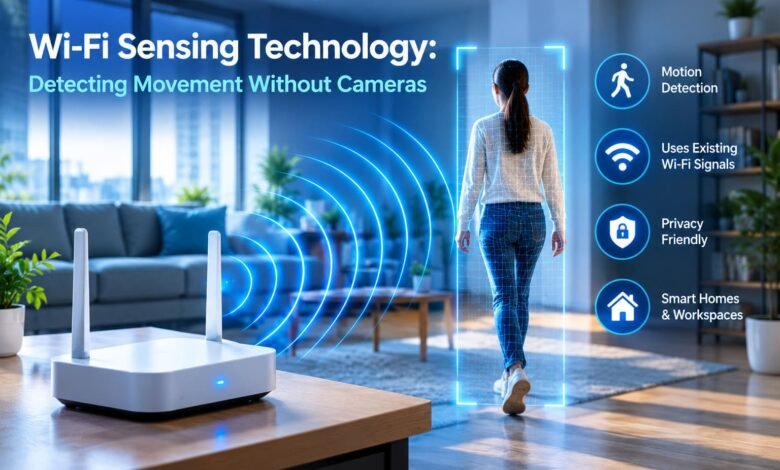
Imagine knowing when someone enters a room, detecting movement in a building, or identifying unusual activity without installing a camera or asking people to wear a sensor. This may sound futuristic, but Wi-Fi sensing technology is making these possibilities increasingly realistic.
Traditional security and monitoring systems often depend on cameras, motion detectors, or wearable devices. Wi-Fi sensing takes a different approach. It analyzes how wireless signals behave as they travel through an environment and interact with people and objects. Changes in those signals can reveal movement, even when a camera is not present.
As wireless networks become more common in homes, offices, factories, and public buildings, researchers and technology developers are exploring how existing Wi-Fi infrastructure could support a new generation of sensing applications.
What Is Wi-Fi Sensing Technology?
Wi-Fi sensing is a technology that uses changes in wireless signals to detect movement or certain activities within an area. Instead of capturing images, it examines how Wi-Fi signals change when people move, objects shift, or the environment changes.
A Wi-Fi router or access point transmits radio signals that travel through a room. When these signals encounter walls, furniture, or people, they may reflect, scatter, or follow different paths before reaching a receiver.
A moving person can alter these signal paths. Wi-Fi sensing systems analyze those variations to estimate whether movement is occurring and, depending on the system, where it may be happening.
Some systems use measurements known as Channel State Information (CSI), which describe how a wireless signal changes as it travels between devices. By processing these measurements over time, software can identify patterns associated with movement or specific activities.
The important difference is that Wi-Fi sensing does not need to produce a photograph or video to detect motion.
How Does Wi-Fi Sensing Work?
Wi-Fi sensing combines wireless communication, signal processing, and software analysis. Although the implementation varies, the general process follows several steps.
1. Wi-Fi Signals Travel Through an Environment
A router or compatible access point sends wireless signals to connected or sensing-enabled devices. These signals move through the environment and interact with nearby objects.
2. Movement Changes the Signal
When a person walks across a room, sits down, or moves an arm, the surrounding radio environment changes. These actions can affect the strength, phase, timing, or pattern of the signals received by another device.
3. Devices Collect Signal Measurements
Compatible receivers collect wireless measurements. Some systems examine CSI, while others use different signal characteristics depending on the hardware and sensing method.
4. Software Analyzes the Data
Signal-processing algorithms and, in some cases, machine-learning models examine the collected measurements. They look for patterns that may indicate movement, presence, or a particular activity.
5. The System Identifies a Possible Event
Based on its capabilities, the system may report that movement has occurred, estimate occupancy, or recognize a previously trained activity. The accuracy depends on the environment, equipment, algorithms, and the task being detected.
Wi-Fi Sensing vs. Traditional Motion Detection
Wi-Fi sensing offers a different approach to monitoring, but it does not automatically replace every existing sensor.
Traditional cameras capture visual information, while infrared motion detectors commonly identify changes in infrared radiation. Wi-Fi sensing instead relies on changes in radio-frequency signals.
One potential advantage is that sensing can work without collecting conventional video footage. This may be useful in places where cameras are undesirable, such as private rooms or certain workplace areas.
However, Wi-Fi sensing is not completely free from privacy concerns. Its measurements may still reveal information about people’s presence, routines, or activities. Organizations should consider consent, data protection, and appropriate access controls before deploying it.
Performance can also vary. Walls, furniture, other wireless devices, room layouts, and changes in the environment can affect the signals. Unlike a camera, Wi-Fi sensing may not provide a clear visual explanation of what caused a detected event.
Real-World Applications of Wi-Fi Sensing
Smart Homes and Room Occupancy
Wi-Fi sensing could help smart homes identify whether a room is occupied. Depending on the system, this information might support automatic lighting, heating, cooling, or other connected devices.
For example, a compatible system could detect movement in a living room and signal a smart lighting controller to turn on the lights. Such automation would still require suitable equipment and reliable detection.
Healthcare and Assisted Living
In assisted-living environments, Wi-Fi sensing is being explored for applications such as presence monitoring and certain types of activity detection. Systems designed for these purposes may help caregivers understand whether someone is moving around a room or may need assistance.
However, it should not be assumed that every Wi-Fi sensing system can reliably detect a fall or identify a medical emergency. Safety-critical applications require careful testing, appropriate safeguards, and dependable backup procedures.
Office Space Management
Businesses can use occupancy information to understand how meeting rooms and shared spaces are used. Wi-Fi sensing may provide an additional way to estimate room usage without relying entirely on cameras or dedicated occupancy sensors.
When implemented responsibly, these insights can help organizations plan office layouts, manage energy consumption, and make better use of available space.
Industrial Facilities
Factories and warehouses contain machinery, connected devices, and workers moving through different areas. Wi-Fi sensing may support movement awareness, restricted-area monitoring, or selected automation workflows.
For instance, a system could identify activity near a designated zone and notify another system to investigate. Industrial deployments must account for machinery interference, changing layouts, safety requirements, and the consequences of incorrect detections.
Smart Buildings and Energy Management
Heating, ventilation, air conditioning, and lighting systems often operate according to fixed schedules or conventional occupancy sensors. Wi-Fi sensing could provide additional information about room usage, helping compatible building-management systems adjust energy use when spaces are empty.
The potential benefit is more responsive building automation, although real-world savings depend on implementation quality and how effectively the sensing data is used.
Benefits of Wi-Fi Sensing Technology
Wi-Fi sensing has several potential advantages that make it an interesting area of technology development.
1. Reduced Dependence on Cameras: Movement may be detected without recording conventional video, making the approach useful in selected camera-free environments.
2. Use of Existing Wireless Infrastructure: Some deployments may be able to build on compatible Wi-Fi equipment already installed in a building. However, additional hardware, software, or firmware support may still be necessary.
3. Support for Smart Automation: Detected occupancy and movement can provide inputs for lighting, climate control, and other connected systems.
4. Flexible Deployment Possibilities: Wi-Fi sensing can be investigated in homes, offices, healthcare facilities, and industrial environments, although requirements differ across these settings.
5. Potential for Contactless Monitoring: People may be monitored for selected movement patterns without wearing a dedicated tracking device.
These benefits depend on the sensing system, the environment, and how the technology is deployed. They should be treated as possibilities rather than guaranteed results.
Challenges and Limitations of Wi-Fi Sensing
Despite its potential, Wi-Fi sensing still faces several technical and practical challenges.
Accuracy and Reliability
Signal patterns can change for reasons other than human movement. Furniture changes, moving equipment, doors, and wireless interference may affect the measurements. Systems need to distinguish meaningful events from background variation.
Environmental Differences
A sensing model that performs well in one room may not work equally well in another. Different building materials, room sizes, and access point locations can change signal behavior.
Hardware Compatibility
Not every Wi-Fi router or connected device supports the measurements required for sensing. Hardware capabilities, firmware, wireless standards, and software support all influence what can be achieved.
Privacy and Consent
Avoiding cameras does not mean a system cannot collect sensitive information. Movement patterns and occupancy data may reveal personal routines. Clear policies, limited data retention, and appropriate user consent are important.
Security Risks
As Wi-Fi sensing becomes integrated with connected buildings and automation platforms, its data and control systems need protection. Unauthorized access or manipulated sensor information could lead to incorrect decisions or expose private activity patterns.
Need for Further Testing
Applications involving healthcare, emergency detection, or industrial safety require stronger validation than basic room-occupancy detection. Organizations should test performance under realistic conditions before relying on sensing outputs.
Is Wi-Fi Sensing the Same as Wi-Fi Sensing Through Walls?
Wi-Fi signals can travel through some common building materials, and sensing systems may detect movement even when a person is not directly visible to a camera. However, performance depends on the material, signal frequency, equipment, room arrangement, and sensing algorithm.
This does not mean Wi-Fi sensing can always locate people accurately through every wall or identify exactly what someone is doing. Different systems offer different capabilities, and claims about detection range or accuracy should be supported by real testing.
The technology is best understood as analyzing changes in wireless signals rather than producing a detailed picture of the surrounding environment.
What Is the Future of Wi-Fi Sensing?
The future of Wi-Fi sensing will depend on improvements in wireless standards, compatible hardware, signal-processing methods, and machine-learning techniques. Researchers and industry groups are exploring ways to make sensing more reliable and easier to integrate with existing wireless networks.
As Wi-Fi sensing capabilities develop, they may become part of smart-home systems, building automation, industrial monitoring, and other connected applications. Standardization could also help compatible devices work together more consistently.
At the same time, privacy and security need to be considered from the beginning. Clear disclosure, limited collection of sensitive data, and safeguards against unauthorized monitoring will be important to building trust.
Wi-Fi sensing is not a universal replacement for cameras, infrared detectors, or dedicated safety equipment. Its value lies in offering another way to understand movement and occupancy where radio-based sensing is appropriate.
Conclusion
Wi-Fi sensing technology shows how wireless networks can do more than connect devices to the internet. By analyzing changes in radio signals, compatible systems can detect movement and estimate selected activities without relying on conventional cameras.
From smart homes and offices to healthcare research and industrial environments, the technology offers promising possibilities for contactless sensing and automation. Its success, however, will depend on accuracy, equipment compatibility, responsible data handling, and realistic expectations.
As the technology matures, Wi-Fi sensing could become a useful part of connected environments, helping systems respond to activity while reducing the need for some dedicated sensors. Careful implementation will be essential to ensure that convenience does not come at the expense of privacy, reliability, or safety.
Frequently Asked Questions
1. What is Wi-Fi sensing technology?
Wi-Fi sensing technology detects movement by analyzing changes in wireless signals as they interact with people and objects in an environment.
2. How does Wi-Fi sensing detect movement without cameras?
It analyzes changes in signal strength, phase, and other wireless characteristics caused by movement. Software processes these changes to identify activity without capturing video.
3. Where can Wi-Fi sensing technology be used?
It can support smart homes, office occupancy monitoring, building automation, healthcare research, and selected industrial monitoring applications.
4. Is Wi-Fi sensing technology safe for privacy?
It can reduce the need for camera-based monitoring, but wireless signals may still reveal personal activity patterns. Consent, data protection, and access controls are essential.