How AI Vision Systems Are Changing Quality Inspection in Manufacturing

Quality inspection has always been an important part of manufacturing. Whether a factory produces automotive components, electronic devices, packaging materials, or medical equipment, every product must meet specific quality standards before it reaches customers. Even a small defect can lead to product failures, customer complaints, wasted materials, and expensive rework.
Traditional inspection methods often depend on manual checks or rule-based machine vision systems. Although these approaches can work well in many situations, they may struggle when production speeds increase, product designs become more complex, or defects are difficult to identify consistently.
This is where artificial intelligence is making a difference. AI vision systems combine cameras, image processing, and machine learning to examine products and identify potential defects during production. Instead of relying only on fixed inspection rules, these systems can learn patterns from images and recognize visual differences that may indicate a quality problem.
As manufacturers look for more reliable and efficient production processes, AI-powered visual inspection is becoming an increasingly useful part of modern quality control.
What Are AI Vision Systems in Manufacturing?
AI vision systems are technologies that use cameras and artificial intelligence to analyze images of products, materials, and manufacturing processes. They help machines identify visible characteristics such as shape, color, surface texture, dimensions, and component placement.
Unlike conventional vision systems that depend heavily on predefined rules, AI-based systems can be trained using examples of acceptable products and different types of defects. Depending on the model and training data, they can recognize patterns associated with scratches, cracks, dents, missing components, surface irregularities, and other quality issues.
For example, an electronics manufacturer may use an AI vision system to inspect circuit boards. The system can examine solder joints, check whether components are correctly positioned, and flag unusual patterns for further inspection.
These systems do not simply replace human judgment. They provide an additional layer of automated inspection that helps quality teams make faster and more consistent decisions.
Why Traditional Quality Inspection Can Be Challenging
Manual inspection remains valuable, particularly when a product requires close examination or contextual judgment. However, relying entirely on human inspectors can create challenges in high-volume manufacturing.
1. Repetitive inspection tasks
Inspectors may need to examine thousands of nearly identical products during a single shift. Repetitive work can contribute to fatigue, making it harder to maintain consistent attention throughout the day.
2. Differences in human judgment
Two inspectors may assess the same minor surface defect differently. Without clear inspection standards, this can lead to inconsistent decisions about whether a product should pass or fail.
3. Increasing production speeds
Manufacturing lines are becoming faster, leaving less time to inspect each item manually. A quality control process that works for a small production run may not be suitable for continuous, high-volume operations.
4. Difficult-to-detect defects
Tiny cracks, subtle color variations, irregular surface patterns, and other visual defects may be difficult to identify consistently, especially under changing lighting conditions.
AI vision systems can help address these challenges by examining products at production speed and applying a consistent inspection process. Their effectiveness, however, depends on image quality, system design, training data, and the type of defect being inspected.
How AI Vision Systems Improve Quality Inspection
1. Detecting Defects More Consistently
One of the most useful applications of AI vision is identifying defects that might otherwise be missed during routine inspection.
A trained model can analyze product images and flag visual patterns associated with scratches, dents, cracks, discoloration, or incorrect assembly. Some systems can also identify unusual defects that do not match previously defined categories, provided they have been designed and validated for anomaly detection.
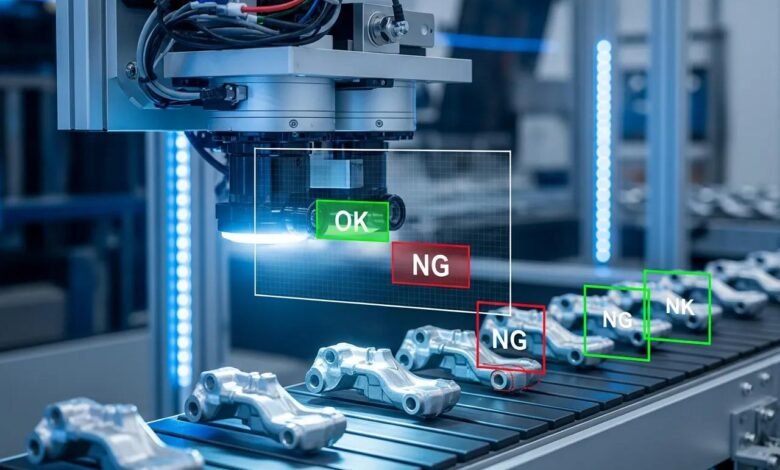
For example, an automotive parts manufacturer may use cameras to inspect metal components as they move along a conveyor. The AI system can highlight surface irregularities and direct questionable parts for closer examination.
This approach helps manufacturers identify quality issues earlier and reduce the risk of defective products reaching the next production stage.
2. Supporting Real-Time Inspection
In many factories, inspection must happen while products are moving through the production line. Checking every item manually can slow production or require additional workers at inspection stations.
AI vision systems can analyze images automatically and return results quickly enough for many real-time production applications. When integrated with manufacturing equipment, they can trigger alerts, mark defective items, or send products to a separate inspection area.
Consider a packaging facility producing thousands of containers every hour. An AI-based inspection system may check labels, cap placement, container shape, and visible damage as each unit passes the camera.
When a problem is detected, the system can notify the operator or activate a configured rejection mechanism. This allows quality checks to become part of the production process rather than a separate activity performed only at the end.
3. Reducing Waste and Rework
Defects discovered late in manufacturing can be expensive. A faulty component may already have been assembled into a larger product, packaged, or shipped to another facility before anyone notices the problem.
AI-powered inspection can help identify issues closer to the point where they occur. Earlier detection gives production teams an opportunity to investigate the cause, adjust equipment, and prevent additional defective items from being produced.
For example, if a machine begins creating components with inconsistent dimensions or surface marks, inspection data may reveal an increase in defects over time. Maintenance staff can then examine the equipment before the issue affects a larger batch.
The financial benefit depends on the production environment, but preventing unnecessary rework and material waste is an important reason manufacturers consider AI inspection.
4. Improving Inspection of Complex Products
Some products contain many small components or require highly precise assembly. Electronic circuit boards, medical devices, automotive electronics, and precision-engineered parts are good examples.
AI vision systems can examine multiple visual features within the same inspection process. Depending on the setup, they may check component placement, solder quality, surface conditions, missing parts, or assembly alignment.
This is particularly useful when a product has many inspection points and small errors can affect performance or reliability.
However, visual inspection cannot identify every possible fault. Electrical performance, internal structural weaknesses, and other hidden defects may require additional testing methods.
5. Making Quality Decisions More Data-Driven
Traditional inspection records may consist of pass-or-fail results, handwritten notes, or basic defect counts. AI vision systems can generate more detailed information about the types, locations, and frequency of visible defects.
Quality teams can use this information to identify recurring problems and investigate their causes.
For instance, an increase in surface scratches may be associated with a particular production line, material batch, machine setting, or handling process. By comparing inspection results with production records, manufacturers can investigate these relationships and determine what corrective action is needed.
Over time, this information can support better process control and more informed quality management decisions.
Real-World Applications of AI Vision in Manufacturing
AI-powered inspection can be adapted to different industries, depending on the product and the quality requirements.
Automotive Manufacturing
Automotive manufacturers can use AI vision to inspect body panels, metal components, weld appearances, paint finishes, and assembled parts. The technology can help identify visible defects and inconsistencies before components move to the next production stage.
Electronics Manufacturing
Electronic assembly requires precise component placement and careful inspection of small features. AI vision systems can support checks for missing components, alignment issues, solder-related visual defects, and other assembly problems.
Food and Beverage Production
Food manufacturers can apply computer vision to inspect packaging seals, label placement, product appearance, and visible contamination. Specialized systems may also help identify differences in size, shape, or color. Their performance depends on the product, imaging conditions, and inspection requirements.
Pharmaceutical and Medical Device Manufacturing
AI vision can support visual checks for packaging defects, incorrect labels, damaged containers, missing components, and certain product irregularities. Because these industries operate under strict quality requirements, AI inspection must be validated and used within appropriate quality management procedures.
Metal and Heavy Equipment Manufacturing
Manufacturers of metal parts and industrial equipment may use AI vision to identify surface imperfections, coating inconsistencies, and visible signs of damage. For internal cracks or defects that cannot be seen in an image, techniques such as ultrasonic testing or industrial radiography may still be necessary.
AI Vision Systems vs. Traditional Machine Vision
Traditional machine vision and AI vision share many of the same hardware components, including cameras, lenses, lighting, and image-processing equipment. The main difference often lies in how visual information is interpreted.
Traditional systems commonly use predefined rules, measurements, thresholds, or geometric comparisons. AI-based systems can learn visual patterns from training examples, which may make them more adaptable to complex or variable defects.
For example, a rule-based system may reject an item when a measured dimension exceeds a fixed limit. An AI vision model may instead analyze a product’s surface and recognize a complicated pattern associated with damage.
Neither approach is automatically better in every situation. Traditional machine vision may be simpler, more predictable, and easier to validate for stable inspection tasks. AI vision may be more useful when defects are visually complex or difficult to describe using fixed rules.
Many manufacturing environments benefit from combining both methods.
Challenges Manufacturers Should Consider
Despite its advantages, AI vision is not a plug-and-play solution for every factory. Successful implementation requires planning, testing, and ongoing monitoring.
Training data quality: AI models need representative images of acceptable products and relevant defects. Poor-quality or incomplete examples can lead to unreliable predictions.
Lighting and camera setup: Changes in illumination, reflections, camera angles, or product positioning can affect inspection results. A stable imaging environment is essential.
False positives and missed defects: A system may incorrectly flag acceptable products or fail to detect certain defects. Manufacturers must measure both types of error and set suitable acceptance criteria.
Integration with existing equipment: Cameras, inspection software, production systems, and rejection mechanisms must work together reliably. Older production lines may require additional hardware or integration work.
Maintenance and retraining: Product designs, materials, and manufacturing conditions can change. Models should be monitored and updated when performance declines or new defect types appear.
Human oversight: Quality engineers and trained operators remain important for reviewing uncertain results, investigating root causes, and handling unusual situations.
Manufacturers should evaluate AI vision systems against real production samples before relying on them for critical quality decisions.
How to Implement AI Vision in a Factory
A gradual implementation strategy can help businesses reduce risk and understand the technology’s practical value.
- Choose a specific inspection problem. Start with a recurring defect, a time-consuming visual check, or a production stage where quality issues are costly.
- Collect representative images. Include normal products, known defects, different product variations, and realistic operating conditions.
- Select suitable cameras and software. Consider image resolution, lighting, inspection speed, available AI models, and integration requirements.
- Test the system on real production samples. Compare its results with expert inspection and measure missed defects, false alarms, and processing time.
- Connect it to the production workflow. Decide how the system will notify operators, record inspection results, or route questionable products for additional checks.
- Monitor performance continuously. Review inspection accuracy, production impact, and changing defect patterns. Retrain or recalibrate the system when necessary.
Starting with a clearly defined use case makes it easier to assess whether the investment delivers measurable improvements.
The Future of AI-Powered Quality Inspection
AI vision systems are likely to become more closely connected with other smart manufacturing technologies. Integration with industrial sensors, production data platforms, robotics, and predictive maintenance systems can give manufacturers a broader view of equipment and product quality.
For example, inspection results may be combined with machine temperature, vibration, or operating-speed data to help engineers investigate why defects are increasing. Robotic systems may also use visual information to position components, handle products, or carry out additional inspections.
Advances in image analysis may make it easier to detect unfamiliar defect patterns, while improved edge computing can allow certain inspections to run directly on factory equipment with limited reliance on cloud processing.
Still, the future of AI inspection will depend on more than model accuracy. Reliability, explainability, data protection, integration costs, and compliance with industry requirements will remain important considerations.
Conclusion
AI vision systems are changing quality inspection by helping manufacturers identify visible defects, inspect products at production speed, and use quality data more effectively. They can reduce repetitive manual work, support earlier defect detection, and help production teams investigate recurring problems.
However, AI is not a complete replacement for traditional inspection, skilled workers, or specialized testing methods. Its success depends on good training data, suitable imaging equipment, careful validation, and continuous monitoring.
For manufacturers seeking more consistent quality control, AI-powered visual inspection offers a practical way to combine automation with informed human decision-making. When implemented around a clearly defined production need, it can become a valuable part of a modern, data-driven manufacturing process.
Frequently Asked Questions
1. What are AI vision systems in manufacturing?
AI vision systems use cameras, image processing, and artificial intelligence to inspect products, identify visible defects, and support automated quality control during manufacturing.
2. How do AI vision systems improve quality inspection?
They analyze product images to detect defects such as scratches, cracks, missing components, and surface irregularities. This helps manufacturers identify quality issues more consistently and reduce manual inspection work.
3. Can AI vision systems replace human inspectors?
AI vision systems can automate many repetitive visual inspection tasks, but human inspectors remain important for complex decisions, reviewing uncertain results, and investigating unusual defects.
4. Which industries use AI vision for quality inspection?
Automotive, electronics, food and beverage, pharmaceutical, medical device, and metal manufacturing industries can use AI vision systems to inspect products and identify visible defects.