Federated Learning: Training AI Without Sharing Sensitive Data

Artificial intelligence needs data to learn. Whether it is recognizing faces, detecting unusual banking transactions, or helping doctors identify diseases, AI systems depend on information to understand patterns and make predictions.
But collecting data is not always easy. Much of the information organizations work with is private, confidential, or legally protected. Hospitals cannot freely exchange patient records, banks must protect customer details, and smartphone users may not want their personal activities stored on external servers.
This creates an important challenge: How can artificial intelligence learn from different sources without requiring everyone to share their private information?
Federated learning offers a practical way to approach this problem.
Instead of bringing all the data together in one location, this technology allows multiple devices or organizations to train a shared AI model while keeping their original information where it already exists. Only selected model updates are exchanged during the training process.
This approach is attracting attention because it makes collaboration possible without depending on traditional centralized data collection. As organizations look for better ways to develop AI responsibly, federated learning is becoming an important part of the conversation around data privacy and machine learning.
What Is Federated Learning?
Federated learning is a machine learning approach in which multiple devices, servers, or organizations work together to improve a common AI model without directly exchanging their original training data.
To understand the difference, consider how traditional AI training works. An organization usually collects information from different sources and sends it to a central system. The system then processes that information to train a machine learning model.
Federated learning takes another route. Instead of moving the information to a central location, it sends the model to the locations where the data is stored.
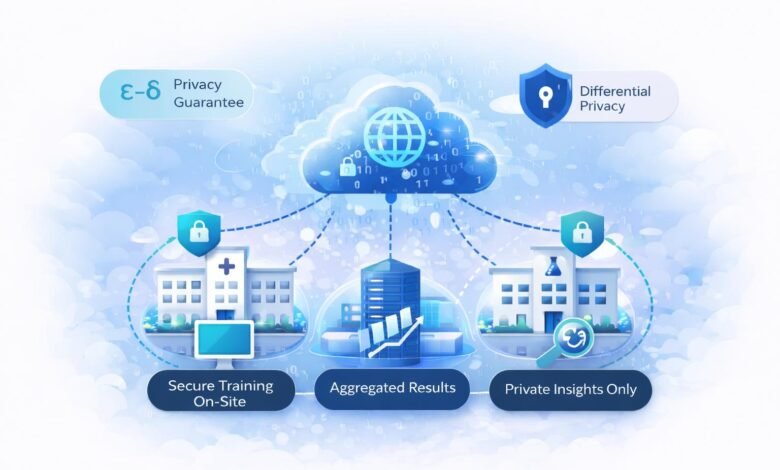
Each participant trains the model using its own local information. After training, the participant shares model updates with a central coordinator, which combines the contributions and improves the shared model.
For example, several hospitals may want to develop an AI system that helps identify signs of a particular disease. Rather than exchanging complete patient databases, each hospital can train the model using its own medical records and contribute learning updates.
The hospitals can therefore participate in a shared research effort while maintaining greater control over their patient information.
It is worth remembering that federated learning does not make a system completely private by itself. Model updates can sometimes expose information, so additional privacy and security protections are still important.
How Does Federated Learning Actually Work?
The process may sound complicated at first, but the basic idea is straightforward. Different participants train the same model using their own data, and their learning contributions are combined to improve the overall result.
1. A Shared AI Model Is Prepared
The process starts with an initial machine learning model. A central server or coordinating system prepares the model and sends a copy to the participating devices or organizations.
This model acts as the starting point for the training process.
2. Original Data Stays in Its Own Location
Each participant keeps its existing information within its own environment.
For example, a hospital continues storing patient records in its internal systems. Similarly, a smartphone keeps relevant personal information on the device.
There is no general requirement to transfer the original training records to the central server.
3. Each Participant Trains the Model Locally
The participating devices or organizations use their own datasets to train their local copies of the model.
During this stage, the model learns from the available information and adjusts its internal parameters.
Because participants may have different datasets, each local model can learn slightly different patterns.
4. Model Updates Are Sent to the Coordinator
Once local training is complete, participants send selected model updates to the central coordinator.
These updates represent changes made during training rather than the complete original datasets.
However, they should not automatically be considered harmless. Depending on the model and training setup, updates may reveal information about the underlying data.
5. The Updates Are Combined
The coordinator combines the updates received from participating devices.
One commonly used technique is Federated Averaging, also known as FedAvg. It combines local model parameters into an updated global model.
The updated model can then be distributed to participants for another training round.
6. The Training Process Continues
The same process is repeated over multiple rounds.
As participants continue contributing their local learning, the shared model can improve its ability to identify patterns across different datasets.
This is what makes federated learning useful: organizations can benefit from collective learning without routinely exchanging their complete original datasets.
Why Is Federated Learning Important for Data Privacy?
Data privacy is no longer just a technical concern. It has become an important responsibility for organizations that collect and process personal information.
Businesses handle customer details, financial records, medical histories, and other sensitive information. Moving these datasets between different systems can create additional security and compliance challenges.
Federated learning offers an alternative by reducing the need to move raw information.
Here are some reasons why this approach matters:
Less movement of sensitive information: Original training datasets remain with their respective owners, reducing the need to transfer them to centralized storage.
Better control over data: Organizations can maintain their existing data-management policies while participating in collaborative AI development.
Opportunities for collaboration: Different institutions can contribute to a common model even when sharing their original datasets is difficult or restricted.
Privacy-focused development: Federated learning can be combined with differential privacy and secure aggregation to strengthen protection during training.
Support for distributed environments: It works well with systems where information is naturally spread across different devices, locations, or organizations.
However, organizations still need to consider applicable privacy laws, security requirements, and the complete flow of information within their federated learning systems.
Real-World Applications of Federated Learning
Federated learning is particularly relevant in industries where information is valuable but difficult to share. Its applications extend beyond research laboratories and include several areas of everyday technology.
1. Healthcare and Medical Research
Healthcare is one of the clearest examples of where federated learning can make a difference.
Hospitals collect enormous amounts of medical information, including diagnostic images, laboratory results, treatment histories, and patient records. This information can help AI systems recognize patterns that may support medical research and clinical decision-making.
The problem is that patient information requires careful protection.
With federated learning, multiple hospitals can contribute to training a shared AI model while keeping their patient records within their own systems.
For example, hospitals in different cities could collaborate on a model that helps identify patterns associated with a particular disease. Each hospital trains the model using its local records and shares selected updates.
This approach could help researchers work with a broader range of medical information without requiring all participating institutions to exchange complete patient databases.
2. Smartphones and Personal Devices
Many smartphone features become more useful when they understand individual preferences.
Predictive keyboards, personalized recommendations, and voice-related features are examples of applications that can benefit from learning from user behavior.
Federated learning can support certain on-device AI training approaches. A smartphone may learn from local typing patterns and contribute model updates to a shared system without routinely uploading the user’s complete typing history.
This creates an opportunity to improve intelligent features while reducing unnecessary transfers of personal information.
3. Banking and Financial Services
Banks regularly analyze transaction information to identify unusual activity and protect customers against fraud.
However, financial records contain sensitive details, and institutions cannot freely exchange customer databases.
Federated learning can help participating financial institutions develop shared fraud-detection models using their respective datasets.
For instance, one bank may identify unusual transaction patterns that are also relevant to another institution. By contributing to a shared model, both institutions may benefit from broader learning without routinely exchanging complete customer records.
The approach still requires strong security controls and careful governance.
4. Manufacturing and Industrial Automation
Modern factories depend on connected equipment, industrial sensors, and automated monitoring systems.
These systems continuously generate information about machine performance, temperature, production conditions, and equipment behavior.
Different factories may experience similar machine problems, but their operational information often remains within separate environments.
Federated learning provides a way for manufacturing facilities to collaborate on predictive maintenance models.
For example, multiple factories could contribute to a shared model that identifies patterns associated with equipment failure. Each facility keeps its original production data locally while contributing to the model’s improvement.
This could help manufacturers identify maintenance requirements earlier and reduce unexpected equipment downtime.
5. Retail and E-Commerce
Retail businesses use AI to understand customer interests, recommend products, and forecast demand.
However, customer information is sensitive, and organizations need to manage it responsibly.
Federated learning may help retailers develop collaborative recommendation and demand-forecasting models without requiring all participating businesses to centralize their complete customer datasets.
It can also support research into personalized shopping experiences while reducing unnecessary movement of personal information.
Technologies That Make Federated Learning More Secure
Keeping original data in its local environment is a useful starting point, but it does not remove every security risk.
Additional technologies can help protect information during the training and aggregation process.
Differential Privacy
Differential privacy adds carefully controlled mathematical noise to information used during model training.
The purpose is to make it harder for someone to determine whether a particular individual’s information influenced the model.
It can provide additional protection against certain privacy attacks, although the amount of noise needs to be carefully balanced against model performance.
Secure Aggregation
Secure aggregation allows a coordinating server to combine model updates without directly accessing each participant’s individual contribution.
This is useful when participating organizations want to collaborate but do not want their individual training updates exposed.
Homomorphic Encryption
Homomorphic encryption allows certain mathematical operations to be performed on encrypted information.
In federated learning, this can help protect model updates during certain computation and aggregation processes.
However, the technique can require additional processing resources and may affect system performance.
Trusted Execution Environments
Trusted Execution Environments, commonly called TEEs, are protected areas within computer hardware that help isolate sensitive computations.
They can provide additional safeguards when model training or aggregation takes place.
Some implementations also support verification that approved code is running inside the protected environment.
Together, these technologies can strengthen federated learning systems, although the right combination depends on the application and its security requirements.
Recent Developments in Federated Learning
Federated learning continues to attract interest from technology companies, research institutions, and organizations working with sensitive datasets.
An important development in this area is the growing focus on making privacy protections measurable and verifiable rather than simply assuming that locally stored data is safe.
Research into differential privacy is helping developers understand how privacy protection affects model accuracy. Secure aggregation and encrypted computation are also receiving attention as ways to protect information exchanged during training.
Another important direction is the combination of federated learning with edge computing. This allows AI training activities to take place closer to where information is generated, including smartphones, connected devices, and industrial systems.
Healthcare research is also exploring ways to use federated learning across different institutions, particularly for medical imaging, genomic information, and electronic health records.
These developments show that the technology is evolving beyond the basic idea of distributed training. Researchers are increasingly focusing on reliability, security, performance, and practical deployment.
Challenges and Limitations of Federated Learning
Federated learning offers several advantages, but adopting it is not always simple. Organizations need to understand its limitations before using it in real-world applications.
Different Data Quality
Not every participant collects information in the same way.
For example, one hospital may have records from mostly older patients, while another may serve a younger population. The datasets may also differ in size, structure, and quality.
These differences can make it difficult for a shared model to learn consistently.
This problem is commonly associated with non-independent and identically distributed data, or non-IID data.
Communication Requirements
Federated learning involves repeated communication between participants and a central coordinator.
When thousands of devices are involved, sending model updates can consume network bandwidth and increase training time.
This can be challenging for devices with limited connectivity or computing resources.
Security Threats
Keeping original information locally does not eliminate every security risk.
Attackers may try to manipulate training data, introduce malicious model updates, or extract sensitive information from shared updates.
Organizations need suitable authentication, monitoring, secure aggregation, and privacy protections to reduce these threats.
Implementation Complexity
A federated learning system may involve multiple organizations, different hardware environments, and separate software platforms.
Making these systems work together requires coordination, technical expertise, and ongoing maintenance.
For smaller organizations, the infrastructure and implementation costs may also become a barrier.
Privacy and Accuracy Trade-Offs
Additional privacy protections can sometimes affect model performance.
For example, differential privacy introduces noise that may reduce prediction accuracy. Encryption and secure computation can also increase processing requirements.
Organizations must evaluate these trade-offs according to the sensitivity of their information and the requirements of their AI applications.
Federated Learning vs Traditional Machine Learning
Both approaches help develop intelligent systems, but they handle data differently.
| Comparison | Traditional Machine Learning | Federated Learning |
|---|---|---|
| Data location | Often centralized | Distributed across participants |
| Training | Uses centrally collected datasets | Uses local datasets |
| Raw data movement | Often required | Generally not required |
| Model updates | Usually handled centrally | Exchanged between participants |
| Privacy considerations | Centralized data exposure risks | Reduces raw-data movement but has other privacy risks |
| Infrastructure | Often easier to manage | Requires distributed coordination |
| Suitable applications | Centralized data environments | Collaborative and distributed data environments |
Traditional machine learning remains useful when data can be collected and processed centrally under appropriate safeguards. Federated learning is especially useful when different participants want to collaborate without routinely transferring their original datasets.
What Does the Future Hold for Federated Learning?
The future of federated learning will depend on how effectively organizations can combine distributed AI training with reliable privacy and security protections.
One promising direction is its connection with edge computing. As more devices become capable of processing information locally, AI models may be trained closer to the places where data is generated.
The relationship between federated learning and generative AI is another area attracting research interest. Developers are exploring ways to support collaborative model training and adaptation across distributed environments without depending entirely on centralized sensitive datasets.
Healthcare could also see wider experimentation with federated learning as hospitals and research institutions look for ways to collaborate on medical AI projects.
At the same time, improvements in secure aggregation, differential privacy, communication efficiency, and model verification will be important.
However, widespread adoption will require more than technical improvements. Organizations will need clear governance policies, suitable infrastructure, and a strong understanding of the risks involved.
Conclusion
Federated learning offers a different way to approach AI development. Instead of asking organizations to bring all their information into one central location, it allows them to contribute to a shared model while keeping their original datasets within their own environments.
This makes the approach particularly interesting for healthcare, financial services, manufacturing, smartphones, and other industries where information needs careful protection.
Of course, federated learning is not a complete solution to every privacy challenge. Model updates can still create security risks, and organizations need additional safeguards to protect the entire training process.
As privacy-enhancing technologies continue to develop, federated learning could become an important part of building more responsible AI systems.
The real value of this approach is that it creates new opportunities for collaboration. Organizations can learn from distributed information without making unnecessary data sharing a requirement.
In the future of artificial intelligence, better collaboration may not require sharing everything.
Frequently Asked Questions
1. What is federated learning in artificial intelligence?
Federated learning is a machine learning approach that allows multiple devices or organizations to train a shared AI model without transferring their original datasets to a central server. It supports collaborative AI development while keeping sensitive information in its original location.
2. How does federated learning protect sensitive data?
Federated learning keeps original training data on local devices or organizational servers. Instead of sharing complete datasets, participants send selected model updates to a central coordinator. Additional techniques such as differential privacy and secure aggregation can provide stronger protection.
3. What are the main applications of federated learning?
Federated learning can be used in healthcare, banking, smartphone applications, manufacturing, and retail. For example, hospitals can collaborate on medical AI models, while banks can develop shared fraud-detection systems without routinely exchanging complete customer records.
4. What are the biggest challenges of federated learning?
Some major challenges include differences in data quality, communication costs, security risks, implementation complexity, and maintaining model accuracy. Organizations also need suitable infrastructure and privacy safeguards to operate federated learning systems effectively.