AI Model Drift: Why Artificial Intelligence Systems Lose Accuracy Over Time

Artificial intelligence systems are becoming an important part of everyday business operations. Companies use AI to detect fraud, recommend products, forecast demand, analyze customer behavior, and support important decisions. However, even a well-trained AI model may not continue delivering the same level of accuracy forever.
This gradual decline in performance is known as AI model drift. It happens when the data, patterns, or real-world conditions an AI system encounters change over time. A model that once produced reliable predictions may begin making more mistakes if it is not monitored and maintained.
Understanding AI model drift is essential for businesses that depend on accurate and consistent AI-driven decisions. By recognizing early warning signs and taking corrective action, organizations can keep their systems useful, reliable, and aligned with changing requirements.
What Is AI Model Drift?
AI model drift refers to a change that causes a machine learning model’s predictions or performance to become less reliable over time. The model learns patterns from historical data during training, but those patterns may not always remain relevant.
For example, an online shopping platform might train an AI recommendation system using customers’ previous purchasing habits. If customer preferences change because of new trends, seasonal demand, or new competitors, the recommendations may become less relevant.
The AI system may continue operating normally, but its results no longer match current customer behavior.
Model drift can affect many applications, including fraud detection, medical data analysis, cybersecurity, financial forecasting, and automated customer support. The impact depends on how the model is used and how important prediction accuracy is to the task.
Why Do AI Models Lose Accuracy?
AI model drift does not have a single cause. It often develops when the environment surrounding a model changes or when the relationship between its inputs and expected outputs becomes different.
1. Changes in Input Data
Data drift occurs when the characteristics of incoming data change compared with the data used to train a model.
Consider a company that uses an AI system to predict customer demand. During training, the system learns from purchasing patterns collected throughout the year. If a new shopping trend suddenly changes what customers buy, the incoming data may look very different from the original dataset.
The model may struggle because it has not learned enough about these new patterns.
2. Changing Relationships Between Data and Outcomes
Concept drift occurs when the relationship between input data and the outcome a model predicts changes over time.
For instance, a bank may use an AI model to identify potentially fraudulent transactions. Fraudsters can develop new techniques, making older indicators less useful. Even if the incoming transaction data appears familiar, the patterns associated with fraud may have changed.
This can reduce the model’s ability to distinguish legitimate activity from suspicious behavior.
3. Outdated Training Data
AI models learn from the examples available during training. When those examples no longer represent current conditions, predictions can become less accurate.
A demand forecasting model trained several years ago may not fully reflect recent economic changes, customer expectations, or supply chain disruptions.
Training data does not automatically become useless with age. However, organizations need to determine whether it still represents the situations the model is expected to handle.
4. Changes in User Behavior
People change how they shop, search, communicate, and use digital services. These changes can affect the performance of AI systems that rely on behavioral data.
A search recommendation model, for example, may initially perform well because it understands popular search phrases. As users adopt new terminology or change their search habits, the model may return less relevant results.
Regularly examining these behavioral changes helps teams identify when a model needs attention.
5. Changes in Business Processes or Technology
Sometimes, the cause of model drift comes from the organization itself.
A company might change its data collection process, introduce a new application, update its website, or modify how transactions are recorded. These changes can affect the information supplied to an AI model.
Even small differences in data formatting, missing values, or measurement methods can influence predictions. This is why technical changes should be evaluated before they affect production AI systems.
Real-World Examples of AI Model Drift
AI model drift becomes easier to understand when viewed through everyday business situations.
Retail and e-commerce: A recommendation system may continue suggesting products that were popular last season, even though customers have moved toward different styles or brands.
Banking and fraud prevention: A fraud detection model may miss suspicious transactions when criminals adopt new payment methods or develop unfamiliar patterns.
Healthcare analytics: A predictive model may perform differently when used with a patient population that differs from the one represented in its training data. Healthcare teams must carefully validate models before relying on their predictions.
Cybersecurity: An AI system trained to recognize known attack patterns may become less effective as attackers change their techniques. Security teams need ongoing monitoring and updated threat information.
Business forecasting: A sales prediction model may become less dependable after major changes in customer demand, pricing, competition, or economic conditions.
These examples show why an AI model should not be treated as a system that can be trained once and left unchanged indefinitely.
How Can Organizations Detect AI Model Drift?
Detecting drift early helps prevent unreliable predictions from spreading into business decisions. Organizations can use several methods to monitor AI systems.
Monitor Model Performance
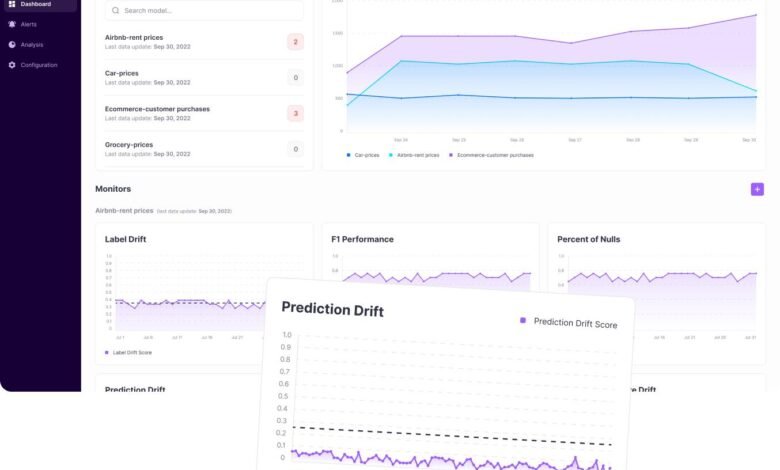
Teams should track relevant performance measures, such as accuracy, precision, recall, and error rates. The right measurements depend on the model’s purpose.
For example, a fraud detection system may need to monitor missed fraudulent transactions as well as false alarms. A forecasting model may need to measure the difference between predicted and actual demand.
When performance moves outside an acceptable range, the change should trigger an investigation.
Compare Current Data With Training Data
Organizations can compare new input data with the data used during model development. They may examine changes in averages, distributions, missing values, category frequencies, and other relevant characteristics.
These comparisons can reveal data drift before enough confirmed outcomes are available to calculate performance accurately.
However, a difference in data distribution does not automatically mean the model has become inaccurate. It is a warning sign that requires further investigation.
Set Up Automated Alerts
Automated monitoring tools can notify teams when data patterns, prediction distributions, or performance indicators cross predefined thresholds.
Alerts allow data scientists and engineering teams to investigate potential issues before they cause significant disruption. Thresholds should be selected carefully to avoid excessive false alarms.
Review Predictions Against Actual Outcomes
When real outcomes become available, teams should compare them with the model’s predictions. This provides direct evidence of whether the system is performing as expected.
For example, a forecasting model’s predictions can be compared with actual sales figures. If errors consistently increase, the organization can examine whether changing conditions or data quality issues are responsible.
How to Reduce the Impact of AI Model Drift
Detecting drift is only part of the process. Organizations also need a practical strategy for responding to it.
Retrain Models With Relevant Data
Retraining can help a model learn from more recent examples. However, adding new data without checking its quality may create additional problems.
Before retraining, teams should verify that the data is relevant, representative, and correctly labeled. They should also compare the updated model with the existing version to confirm that the change improves performance.
Validate Before Deployment
A newly trained model should be tested against suitable validation data and realistic scenarios before replacing the production model.
Organizations should check whether the updated model improves important performance measures without introducing unacceptable errors in other areas.
For high-impact applications, human oversight and formal approval procedures may also be necessary.
Improve Data Quality
Reliable AI predictions depend on reliable input data. Organizations should monitor missing information, duplicate records, inconsistent formats, incorrect labels, and changes in data collection.
Strong data quality practices reduce the risk of confusing data pipeline problems with genuine changes in real-world behavior.
Maintain Continuous Monitoring
AI model maintenance should be an ongoing responsibility rather than an occasional task.
A monitoring plan should identify which metrics to track, who receives alerts, how incidents are investigated, and when retraining or rollback may be appropriate.
The monitoring frequency should reflect the speed at which the model’s environment changes and the potential consequences of incorrect predictions.
Keep Human Experts Involved
Automated systems cannot always explain why their performance has changed. Data scientists, domain specialists, and operational teams can help determine whether an alert represents a genuine problem or an expected change.
Human oversight is especially valuable when AI predictions influence financial decisions, healthcare, security, or other sensitive activities.
AI Model Drift vs. Data Drift
The terms are related, but they are not identical.
Data drift describes changes in the distribution or characteristics of incoming data. AI model drift is often used more broadly to describe changes in model behavior or declining predictive performance. Concept drift specifically refers to changes in the relationship between input data and the outcome being predicted.
These issues can overlap. Data drift may occur without reducing accuracy, while concept drift can affect accuracy even when changes in the input data are not immediately obvious.
Understanding the distinction helps teams investigate the correct cause rather than automatically retraining a model whenever a change is detected.
The Future of AI Model Monitoring
As organizations adopt AI in more business-critical applications, monitoring will become an increasingly important part of the AI lifecycle.
Modern monitoring approaches can combine data-quality checks, statistical drift detection, performance evaluation, automated alerts, and model version tracking. Some systems can also support retraining workflows, although retraining should not happen blindly whenever an alert appears.
Organizations will increasingly need clear processes for deciding when a model should continue operating, when it needs updating, and when human intervention is required.
The goal is not to prevent every change in AI behavior. Real-world conditions naturally evolve. The goal is to identify meaningful changes quickly and ensure that AI systems remain appropriate for the tasks they perform.
Conclusion
AI model drift is a natural challenge for machine learning systems operating in changing environments. New customer behaviors, evolving cyber threats, outdated training data, and changes in business processes can all affect prediction quality.
Organizations can manage this risk by monitoring performance, comparing incoming data with historical patterns, improving data quality, validating updated models, and involving human experts when necessary.
AI accuracy is not something businesses can assume will remain constant. It requires regular measurement, responsible maintenance, and a clear understanding of how real-world conditions influence model performance.
By making model monitoring part of the AI lifecycle, organizations can build more dependable systems and make better-informed decisions as their data and operating environments evolve.
Frequently Asked Questions
1. What is AI model drift?
AI model drift occurs when changes in data or real-world conditions affect a machine learning model’s behavior or prediction accuracy over time.
2. What causes AI model drift?
Common causes include changing user behavior, outdated training data, evolving business conditions, data quality issues, and changes in the relationship between inputs and outcomes.
3. How can businesses detect AI model drift?
Businesses can detect potential drift by monitoring model performance, comparing new data with training data, tracking prediction errors, and setting up automated alerts.
4. How can AI model drift be prevented?
Although drift cannot always be prevented, its impact can be reduced through continuous monitoring, high-quality data, regular model validation, and retraining when necessary.