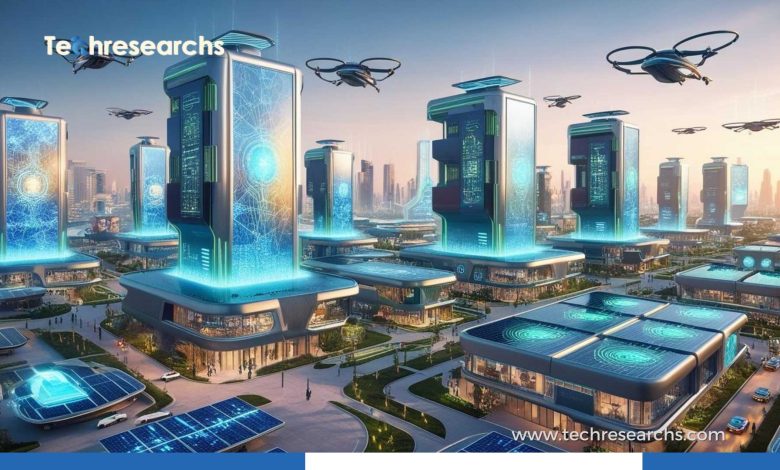
Technology is moving faster than ever. In 2026, innovation is no longer limited to better smartphones, faster computers, or smarter software. Artificial intelligence, robotics, biotechnology, quantum computing, advanced semiconductors, clean energy, and space technologies are increasingly working together to solve problems that once seemed far beyond reach.
The important change is not simply that new technologies are appearing. It is that many of them are moving from research labs into practical applications. The World Economic Forum’s 2026 emerging-technology report highlights technologies approaching real-world scale across computing, healthcare, energy, and materials.
So, what does the technology landscape of 2026 actually look like? Let’s explore the innovations that could have the biggest influence on businesses, industries, and everyday life.
1. AI Agents Are Moving Beyond Simple Automation
Artificial intelligence remains one of the biggest technology forces in 2026, but the conversation is shifting from chatbots to AI agents.
Instead of simply responding to a question, AI agents can be designed to plan tasks, use software tools, analyze information, and complete multi-step workflows with limited human intervention. IEEE’s 2026 technology predictions identify AI agents as an important development for business because they can take over repetitive and routine work.
Businesses are exploring agent-based AI for areas such as:
- Customer service
- Software development
- Research and analysis
- Marketing operations
- Financial workflows
- IT support
- Business process automation
The biggest opportunity is not replacing every human task. It is giving employees intelligent systems that can handle routine work while people focus on decisions, creativity, relationships, and strategy.
2. Physical AI and Smarter Robots
AI is increasingly leaving the screen and entering the physical world.
Robots are becoming more capable of understanding their surroundings, learning from data, and responding to changing conditions. This combination of AI, sensors, robotics, and advanced computing is often described as physical or embodied AI.
Factories are an obvious application, but the possibilities extend much further. Robots could assist with logistics, agriculture, healthcare, construction, inspection, disaster response, and household tasks.
The 2026 Stanford Emerging Technology Review identifies robotics as one of the frontier technology areas with major implications for society and industry.
The real breakthrough will come when robots become flexible enough to handle unfamiliar environments instead of performing only highly controlled repetitive tasks.
3. World Models Could Give AI a Better Understanding of Reality
One particularly interesting development is the rise of world models.
Traditional AI systems are often very good at recognizing patterns in data. World models aim to go a step further by building an internal representation of how parts of the physical world behave.
The World Economic Forum lists world models among its 2026 emerging technologies, noting their potential applications in areas such as robotics and climate modelling.
Imagine a robot being able to predict what might happen if it moves an object, drives around an obstacle, or encounters an unfamiliar environment. That type of capability could make autonomous machines significantly more adaptable.
4. AI-Powered Biotechnology Is Accelerating Discovery
The relationship between AI and biology is becoming increasingly important.
Researchers can use AI to analyze biological datasets, identify potential drug targets, study molecular interactions, and assist with the design of new therapies. The 2026 technology landscape increasingly treats AI and biotechnology as connected fields rather than separate disciplines.
AI-powered biotechnology could influence:
- Drug discovery
- Personalized medicine
- Gene and cell therapies
- Synthetic biology
- Agricultural biotechnology
- Disease research
- Laboratory automation
The goal is not to remove scientists from the process. Instead, AI can help researchers explore enormous amounts of biological information faster and identify promising directions for laboratory testing.
5. Quantum Computing Is Moving Closer to Practical Applications
Quantum computing continues to attract attention because it approaches computation in a fundamentally different way from conventional computers.
Although large-scale, fault-tolerant quantum computing remains challenging, organizations are already investigating potential applications. These include optimization, materials research, chemistry, financial modelling, and cybersecurity.
At the same time, quantum technology is creating a security challenge. Future quantum computers could threaten some existing encryption methods, which is why post-quantum cryptography is becoming increasingly important. The 2026 World Economic Forum report highlights lattice-based cryptography as one approach designed to withstand both conventional and future quantum attacks.
For businesses, preparing for the quantum era may be less about buying a quantum computer today and more about understanding where quantum computing could affect existing systems.
6. Advanced Semiconductors Will Power the Next Technology Wave
Behind almost every major technology trend is one essential component: the semiconductor.
AI models, robots, autonomous vehicles, edge devices, smartphones, data centers, and advanced scientific systems all depend on increasingly capable chips.
The semiconductor industry is therefore evolving toward specialized architectures designed for particular workloads. AI accelerators, energy-efficient processors, advanced packaging, and new materials are becoming increasingly important.
The 2026 technology landscape also reflects growing interest in integrated photonics and advanced materials for future computing systems.
In simple terms, the future of software increasingly depends on the future of hardware.
7. Edge AI Will Make Technology More Responsive
Not every intelligent system needs to send all of its data to the cloud.
Edge AI allows devices to process information closer to where it is generated. This can reduce latency, limit unnecessary data transfers, and improve responsiveness.
Consider a security camera that detects an unusual event locally, a vehicle processing sensor information while driving, or an industrial machine identifying a fault before sending only relevant information to a central system.
As AI becomes part of more physical devices, edge computing will become increasingly important for applications where speed, reliability, privacy, or connectivity matters.
8. Smarter Energy Systems Will Support a More Electrified World
Technology innovation is also changing the way electricity is generated, stored, distributed, and consumed.
One notable concept highlighted by the World Economic Forum in 2026 is “everything-to-grid” technology. Electric vehicles, batteries, and other distributed energy resources can potentially supply electricity back to the grid when demand is high.
AI can further improve energy systems by helping predict demand, optimize renewable generation, manage storage, and detect problems.
This matters because the expansion of data centers, electric vehicles, AI infrastructure, and connected devices is increasing the need for reliable and efficient energy systems.
9. Advanced Materials Could Change Manufacturing
Materials science may not receive as much public attention as AI, but it could have an enormous impact on the technologies people use every day.
Researchers are exploring materials with improved strength, conductivity, durability, thermal performance, and environmental characteristics.
AI is also becoming useful in materials discovery. Instead of testing every possible material combination manually, researchers can use computational models to identify promising candidates before laboratory validation.
This could accelerate progress in batteries, electronics, construction, clean energy, water treatment, and industrial manufacturing.
10. Brain-Computer Interfaces Are Becoming More Serious
Brain-computer interfaces, or BCIs, are another emerging area worth watching.
The basic idea is to create a communication pathway between neural activity and an external device. Research in this area could eventually support new approaches to assistive technology, rehabilitation, communication, and human-computer interaction.
BCIs are still developing and face major technical, medical, ethical, and regulatory challenges. However, their inclusion in national technology strategies demonstrates how seriously the field is being considered as a future technology area.
11. Space Technology Is Expanding Beyond Government Missions
Space technology is becoming increasingly commercial and strategically important.
Satellite communications, Earth observation, navigation, space-based data services, lunar exploration, and new launch technologies are creating opportunities beyond traditional government space programs.
Countries are also developing long-term plans around lunar missions, satellite networks, and space infrastructure. For example, South Korea announced a 2026 technology strategy covering lunar exploration, satellite communications, space data centers, and related aerospace capabilities.
The next phase of space technology could therefore involve not just reaching space, but building useful services and infrastructure around it.
12. Cybersecurity Must Evolve Alongside Innovation
Every new technology creates new opportunities—and new risks.
AI can improve cybersecurity by identifying unusual behavior and automating parts of threat detection. At the same time, attackers can use AI to create more convincing phishing campaigns, automate attacks, and discover vulnerabilities faster.
Quantum computing introduces another long-term concern because some current encryption methods may eventually become vulnerable.
This makes security a fundamental part of technology development rather than something added at the end.
Organizations should increasingly consider:
- Zero-trust security
- Strong identity management
- AI-assisted threat detection
- Post-quantum cryptography
- Secure software development
- Data protection
- Continuous monitoring
How These Technologies Will Work Together
The most important technology story of 2026 may not be any single invention.
It is convergence.
AI can improve robotics. Better chips can make AI faster and more efficient. Biotechnology can use AI to accelerate scientific discovery. Quantum technologies may eventually support new forms of computation and security. Advanced energy systems can provide the infrastructure required for increasingly power-hungry digital technologies.
Stanford’s 2026 technology review specifically emphasizes this convergence between fields such as AI, biotechnology, quantum technologies, robotics, semiconductors, energy, and space.
That means the next generation of innovation is likely to come from combinations of technologies rather than isolated breakthroughs.
What New Technology Means for Businesses
Businesses do not need to adopt every emerging technology simply because it is receiving attention.
A better approach is to identify where technology can solve a genuine business problem.
For example:
- AI agents can reduce repetitive administrative work.
- Edge AI can support faster decisions in connected environments.
- Robotics can improve productivity in physical operations.
- AI-driven analytics can improve forecasting.
- Cybersecurity technologies can strengthen digital defenses.
- Advanced energy systems can improve efficiency and resilience.
Companies that experiment early can build knowledge and capabilities before a technology becomes mainstream. At the same time, organizations should avoid investing heavily in technologies without a clear use case, measurable value, or appropriate risk controls.
Challenges That Could Slow Technology Adoption
The future of technology is exciting, but progress is not automatic.
Several challenges could influence how quickly these innovations become mainstream:
High Infrastructure Costs
Advanced AI, robotics, quantum systems, and biotechnology often require significant investment in hardware, computing, laboratories, and skilled professionals.
Energy Consumption
AI infrastructure and high-performance computing can require substantial amounts of electricity, increasing the importance of efficient chips and cleaner energy sources.
Cybersecurity Risks
More connected and intelligent systems create a larger attack surface.
Regulation
Governments are still developing rules for AI, biotechnology, autonomous systems, data protection, and other emerging technologies.
Skills Shortages
Technology adoption requires people who understand both the technology and the business problem it is intended to solve.
Trust and Responsible Development
Users need confidence that emerging systems are reliable, secure, transparent, and designed with appropriate safeguards.
What the Future Could Look Like
The future will probably not arrive as one dramatic technological moment.
Instead, it will emerge through thousands of smaller improvements that gradually change how people work, communicate, travel, manufacture products, receive healthcare, and manage energy.
AI may become less visible because it will increasingly operate inside everyday products and services. Robots may become more common in workplaces. Biotechnology could make treatments more personalized. Energy systems could become more intelligent and distributed. Quantum technologies may open new possibilities in specialized fields.
The biggest change may be that technology becomes less like a separate tool and more like an underlying layer of everyday life.
Final Thoughts
New Technology 2026 is not defined by one breakthrough. It is defined by convergence, acceleration, and practical adoption.
Artificial intelligence, robotics, biotechnology, quantum computing, advanced semiconductors, energy technologies, cybersecurity, and space systems are developing simultaneously. Their combination could create innovations that are difficult to predict today.
For businesses and individuals, the smartest response is not to chase every trend. It is to understand which technologies are becoming practical, identify where they can create genuine value, and prepare for the skills, security, and infrastructure they require.
The future of technology is already being built. The real question is how intelligently we choose to use it.
Frequently Asked Questions
1. What are the most important new technologies in 2026?
Some of the most significant technologies in 2026 include AI agents, physical AI and robotics, world models, AI-powered biotechnology, quantum computing, advanced semiconductors, edge AI, and smart energy systems.
2. How will AI agents change businesses in 2026?
AI agents can handle multi-step tasks such as research, customer support, data analysis, and workflow automation. This can help businesses reduce repetitive work while allowing employees to focus on strategic and creative activities.
3. Will quantum computing become widely used in 2026?
Quantum computing is still developing and is not expected to replace conventional computers for everyday tasks. However, research and early applications are progressing in areas such as optimization, materials science, chemistry, and cybersecurity.
4. Why is cybersecurity important for emerging technologies?
New technologies create new opportunities but can also introduce new security risks. Businesses need strong identity controls, secure software practices, continuous monitoring, AI-assisted threat detection, and preparation for future post-quantum security challenges.