Industrial biotechnology is entering a new phase in 2026. Advances in synthetic biology, metabolic engineering, artificial intelligence, automation, and bioprocessing are changing how companies develop and manufacture chemicals, materials, foods, fuels, enzymes, and pharmaceutical ingredients.
Instead of depending entirely on petroleum-based or resource-intensive manufacturing, industrial biotechnology uses biological systems—including microorganisms, enzymes, and engineered cells—to produce useful products from renewable or alternative feedstocks.
The most important change today is the growing connection between biology and digital technologies. AI-assisted strain design, automated laboratories, advanced fermentation systems, multi-omics, and digital twins are helping researchers move faster from biological discovery to scalable production. Recent research also emphasizes that scaling remains one of the industry’s biggest challenges.
What Is Industrial Biotechnology?
Industrial biotechnology, sometimes called white biotechnology, applies biological processes to industrial manufacturing.
Engineered microorganisms such as bacteria, yeast, fungi, and other biological systems can be programmed or optimized to produce specific compounds. Enzymes can also replace conventional chemical catalysts in selected manufacturing processes.
Applications include:
- Bio-based chemicals
- Industrial enzymes
- Sustainable materials
- Bioplastics
- Biofuels
- Food ingredients
- Alternative proteins
- Pharmaceutical ingredients
- Agricultural products
- Waste-to-value technologies
- Carbon utilization
The goal is not simply to make products biologically. Modern industrial biotechnology increasingly focuses on making them efficiently, economically, consistently, and at commercial scale.
1. AI Is Accelerating Biomanufacturing
Artificial intelligence is becoming an important tool across the industrial biotechnology pipeline.
Researchers can use machine learning to analyze biological datasets, predict metabolic behavior, identify promising genetic modifications, and optimize production conditions.
One particularly important development is the use of AI with design-build-test-learn (DBTL) workflows. Instead of relying entirely on slow experimental iteration, AI systems can help prioritize experiments and identify potentially productive biological designs.
Recent research published in 2026 describes how AI-driven digital twins and process simulations could help bridge the gap between laboratory experiments and industrial biomanufacturing.
AI can potentially assist with:
- Strain optimization
- Fermentation monitoring
- Process control
- Yield prediction
- Feedstock optimization
- Equipment maintenance
- Experimental design
- Quality control
However, AI does not eliminate the need for laboratory validation. Industrial biotechnology still depends on experimental data, biological understanding, process engineering, and safety controls.
2. Synthetic Biology Is Creating Programmable Microbial Factories
Synthetic biology is one of the foundations of modern industrial biotechnology.
Scientists can redesign microorganisms so they produce specific molecules or materials. By modifying metabolic pathways, researchers can redirect cellular resources toward a desired product.
Modern synthetic biology increasingly combines:
Genome engineering + metabolic engineering + automation + computational modeling + high-throughput screening
This creates what can be thought of as programmable microbial factories.
For example, microorganisms can potentially be engineered to produce specialty chemicals, enzymes, biomaterials, food ingredients, and pharmaceutical intermediates.
Research published in 2026 highlights continued progress in microbial cell factories through multi-omics, strain engineering, and improved bioprocessing strategies.
3. Metabolic Engineering Is Improving Production Efficiency
A major challenge in industrial biotechnology is getting cells to produce large quantities of a desired product without negatively affecting their growth.
Metabolic engineering addresses this challenge by modifying cellular pathways.
Researchers can identify metabolic bottlenecks and redirect carbon, energy, and other cellular resources toward production.
The focus is increasingly shifting toward improving three important performance measures:
- Titer: How much product is produced
- Rate: How quickly it is produced
- Yield: How efficiently resources are converted into the product
Combining metabolic engineering with genomic data, automation, and computational modeling can make microbial production systems more efficient and predictable.
4. Smart Fermentation Is Becoming More Data-Driven
Fermentation remains at the heart of many industrial biotechnology processes.
Modern fermentation systems are becoming increasingly connected and automated. Sensors can continuously monitor parameters such as temperature, pH, dissolved oxygen, pressure, and other process conditions.
Instead of making decisions only after a production batch has finished, manufacturers can increasingly use real-time data to identify deviations during production.
This supports the development of smart biomanufacturing, where biological processes are monitored and optimized through digital technologies.
Continuous fermentation is another area attracting attention. Research published in 2026 notes that continuous processing can improve productivity, resource efficiency, and consistency, although technical, economic, microbial, and regulatory barriers still limit widespread adoption in some sectors.
5. Digital Twins Could Transform Bioprocess Scale-Up
Moving from a laboratory-scale bioreactor to an industrial facility is one of biotechnology’s most difficult challenges.
Conditions that work in a small laboratory vessel do not always behave the same way in a large industrial reactor.
Digital twins offer one potential solution.
A digital twin is a computational representation of a physical process. In biomanufacturing, it can combine experimental data, process models, sensor information, and simulations to help researchers understand how a production system behaves.
Potential applications include:
- Predicting fermentation performance
- Testing process changes virtually
- Detecting process abnormalities
- Optimizing operating conditions
- Supporting scale-up decisions
- Reducing unnecessary physical experiments
The combination of mechanistic models and AI is emerging as an important direction for industrial bioprocess development.
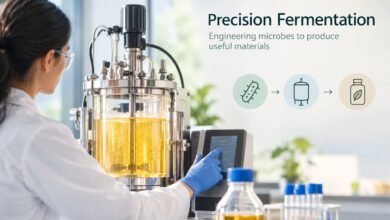
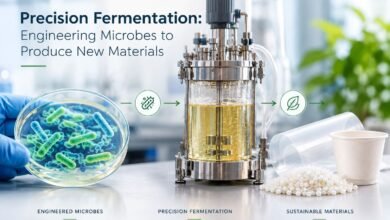
6. Precision Fermentation Is Expanding Bio-Based Production
Precision fermentation uses microorganisms to produce targeted compounds.
The technology has attracted considerable interest in food, nutrition, specialty ingredients, and other industrial applications.
Instead of obtaining a desired compound directly from animals, plants, or petroleum-derived chemistry, microorganisms can be designed to produce specific molecules through fermentation.
Potential applications include:
- Proteins
- Enzymes
- Food ingredients
- Nutritional compounds
- Specialty chemicals
- Functional ingredients
The broader opportunity is to create production systems that are more controlled and potentially less dependent on traditional raw-material supply chains.
However, commercial success depends on much more than biological performance. Cost of feedstocks, fermentation productivity, downstream processing, regulatory approval, and market demand all influence whether a technology can compete commercially.
7. Waste Is Becoming a Valuable Industrial Feedstock
Another important advance is the movement toward waste valorization.
Industrial biotechnology can convert agricultural residues, food-processing by-products, organic waste, and other underused resources into valuable products.
This creates a circular approach:
Waste → Biological conversion → Valuable product
Possible outputs include:
- Organic acids
- Biogas
- Enzymes
- Bio-based chemicals
- Microbial biomass
- Alternative proteins
- Bio-based materials
This approach can help reduce waste while creating additional value from resources that might otherwise be discarded.
The challenge is designing economically viable systems that account for collection, transportation, preprocessing, biological conversion, and downstream recovery.
8. Bio-Based Materials Are Advancing Beyond Traditional Plastics
Industrial biotechnology is also contributing to the development of alternative materials.
Microorganisms can be engineered to produce polymers and other useful biomaterials.
One important area is polyhydroxyalkanoates (PHAs), a family of biodegradable biopolymers produced biologically.
Recent research examining industrial-scale biomanufacturing identifies PHAs and succinic acid as examples of technologies approaching commercial maturity while also illustrating the remaining challenges involved in achieving competitive large-scale production.
The future of bio-based materials will depend on improving:
- Production costs
- Material performance
- Feedstock sustainability
- Processing efficiency
- Recycling or end-of-life pathways
- Manufacturing scale
9. Industrial Biotechnology Is Supporting the Circular Bioeconomy
The traditional manufacturing model often follows a linear path:
Raw materials → Manufacturing → Product → Waste
Industrial biotechnology can contribute to a more circular model:
Renewable resources → Biomanufacturing → Product → Recovery/Reuse → New production
Biological processes can potentially connect agriculture, food production, waste management, chemicals, materials, and energy systems.
This is particularly important as industries search for ways to reduce resource consumption and greenhouse-gas emissions.
However, a biological process is not automatically sustainable. Energy use, water consumption, feedstock sourcing, transportation, purification, and facility infrastructure must all be considered when evaluating environmental performance.
10. India Is Building Its Biomanufacturing Ecosystem
India is also placing greater emphasis on advanced biomanufacturing.
The country’s BioE3 Policy—Biotechnology for Economy, Environment and Employment focuses on advanced technologies including genome editing, synthetic biology, metabolic engineering, bioprocess engineering, data science, and AI/ML.
The policy identifies areas such as bio-based chemicals and biopolymers, smart proteins and functional foods, precision biotherapeutics, climate-resilient agriculture, carbon capture and utilization, and marine and space research. It also supports shared infrastructure such as Bio-AI hubs, biofoundries, and biomanufacturing hubs.
This could strengthen India’s ability to move biotechnology innovations from research laboratories toward commercial manufacturing.
11. Automation Is Changing the Biotech Laboratory
Automation is becoming increasingly important because industrial biotechnology requires large numbers of experiments.
Automated platforms can help researchers:
- Prepare samples
- Conduct experiments
- Collect measurements
- Screen microbial variants
- Analyze results
- Repeat successful experiments
When connected with AI and laboratory information systems, automation can create faster experimental feedback loops.
However, recent research on smart biomanufacturing also points out that digitalization introduces challenges involving data standards, cybersecurity, infrastructure, safety oversight, and governance.
Therefore, automation should complement scientific expertise rather than replace human oversight.
12. Biomanufacturing Still Faces Major Scale-Up Challenges
Despite impressive technological progress, industrial biotechnology has a significant commercialization challenge.
A process that works in a laboratory may not be economically competitive at industrial scale.
Some of the biggest challenges include:
High production costs
Biological production can require expensive feedstocks, equipment, energy, and downstream purification.
Scale-up complexity
Microbial behavior can change as reactor size increases.
Downstream processing
Recovering and purifying the final product can represent a substantial portion of total manufacturing costs.
Feedstock availability
A sustainable process needs reliable and economically viable raw materials.
Regulatory requirements
Products involving engineered organisms, food ingredients, pharmaceuticals, and environmental applications may face complex regulatory requirements.
Data limitations
AI-based systems require reliable and representative data, while industrial bioprocess datasets can be difficult and expensive to generate.
Recent research emphasizes that the laboratory-to-industry gap remains one of the central barriers to commercial biomanufacturing.
The Future of Industrial Biotechnology
The next stage of industrial biotechnology will likely be defined by convergence.
Synthetic biology provides biological programmability. Metabolic engineering improves cellular production. AI helps analyze and optimize complex systems. Automation accelerates experimentation. Advanced fermentation enables manufacturing. Digital twins support scale-up.
Together, these technologies could create a more flexible manufacturing model.
Future industrial facilities may increasingly operate as data-driven biological production systems, where biological organisms, sensors, AI models, robotics, and process engineers work together.
The most successful companies will not necessarily be those with the most sophisticated biological technology. They will be the organizations capable of combining biological performance with cost efficiency, reliable scale-up, regulatory compliance, sustainability, and market demand.
Conclusion
Industrial biotechnology is moving beyond traditional fermentation toward a digitally enabled era of biomanufacturing.
The latest advances in AI-assisted strain engineering, synthetic biology, metabolic engineering, precision fermentation, continuous processing, digital twins, automation, waste valorization, and bio-based materials are expanding what biological manufacturing can achieve.
At the same time, the industry must overcome important challenges in scale-up, economics, infrastructure, data availability, regulation, safety, and sustainability.
The central opportunity is clear: biology is increasingly becoming a manufacturing platform.
As researchers and companies learn to combine biological systems with AI, automation, and advanced engineering, industrial biotechnology could play a significant role in building more adaptable and resource-efficient manufacturing systems over the coming decade.
Frequently Asked Questions
1. What is industrial biotechnology?
Industrial biotechnology uses biological organisms, cells, enzymes, and biological processes to manufacture products such as chemicals, materials, food ingredients, fuels, and pharmaceutical components.
2. What are the latest advances in industrial biotechnology?
Major advances include AI-assisted biomanufacturing, synthetic biology, metabolic engineering, precision fermentation, automated laboratories, digital twins, continuous fermentation, and waste-to-value technologies.
3. How is AI used in industrial biotechnology?
AI can help analyze biological data, optimize microbial strains, predict process performance, select experiments, monitor fermentation, and support bioprocess optimization.
4. Why is synthetic biology important for industrial biotechnology?
Synthetic biology allows scientists to redesign biological systems for specific purposes, creating microorganisms that can produce targeted chemicals, proteins, materials, and other valuable compounds.