Model Context Protocol (MCP) Explained: Everything You Need to Know

Artificial intelligence is rapidly changing the way businesses, developers, and individuals interact with technology. From AI chatbots and coding assistants to intelligent business automation, AI systems are becoming increasingly capable. However, one major challenge remains: enabling AI models to securely connect with external tools, databases, applications, and enterprise systems.
Traditionally, developers had to create custom integrations for every AI application and every external service. This process was time-consuming, expensive, and difficult to maintain. As AI adoption accelerated, the need for a universal integration standard became increasingly clear.
This is where the Model Context Protocol (MCP) comes into the picture.
Model Context Protocol is an open standard designed to simplify communication between AI models and external systems. Instead of creating separate integrations for every application, MCP provides a standardised way for AI assistants to discover, access, and interact with tools, APIs, databases, documents, and business software. It enables AI applications to become more powerful, reliable, and context-aware while reducing development complexity.
In this article, we’ll explore what MCP is, how it works, its architecture, benefits, real-world applications, challenges, and why it is shaping the future of AI integration.
What Is Model Context Protocol (MCP)?
Model Context Protocol (MCP) is an open protocol that standardises how AI applications communicate with external resources. It acts as a bridge between an AI model and the tools or services it needs to perform useful tasks.
Instead of giving an AI direct access to every database or application through custom code, developers can connect those resources using MCP servers. AI clients can then securely discover available tools and use them when appropriate.
Think of MCP as similar to how USB became a universal connector for hardware devices. Rather than creating different connectors for every device, USB established one standard. MCP aims to do the same for AI integrations.
Why Does MCP Matter?
Modern AI systems rarely work in isolation. They often need access to:
- Company documents
- Knowledge bases
- Cloud storage
- Business software
- Customer databases
- APIs
- Development environments
- Productivity applications
Without a standard protocol, each AI assistant requires custom integrations for every platform. This increases development costs and creates ongoing maintenance challenges.
MCP addresses these issues by introducing a consistent communication layer that works across different AI applications and services.
Key advantages include:
- Faster integration
- Reduced development effort
- Better scalability
- Improved security
- Easier maintenance
- Consistent user experience
How Model Context Protocol Works
The MCP ecosystem generally consists of three main components.
1. MCP Client
The client is the AI application that wants to use external resources.
Examples include:
- AI coding assistants
- Enterprise AI chatbots
- Productivity assistants
- Research assistants
- Customer support AI
The client sends requests whenever it needs additional information or external functionality.
2. MCP Server
The MCP server acts as a gateway between AI applications and external systems.
It exposes available tools and resources in a standard format, allowing AI models to understand what capabilities are available without requiring custom integration logic.
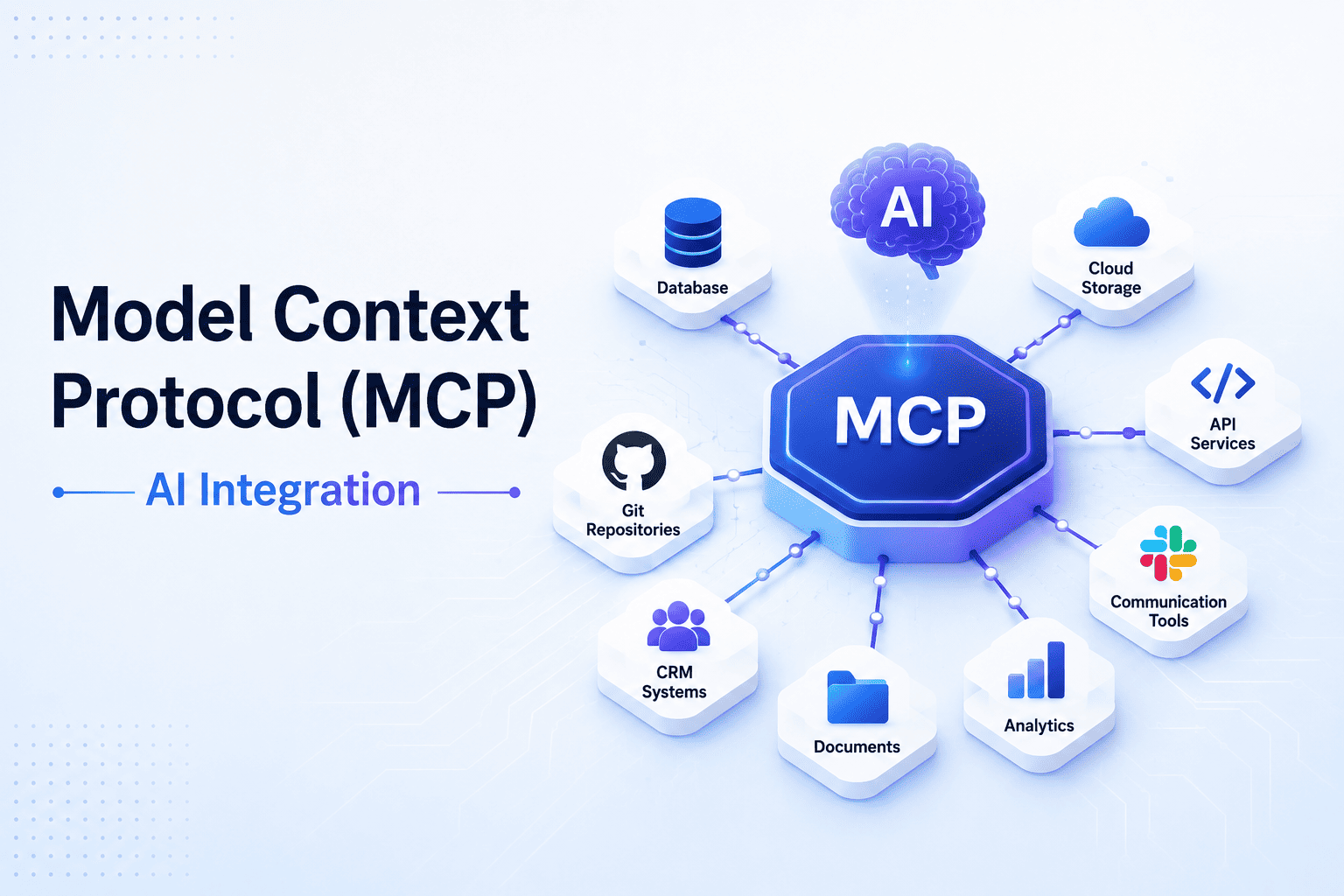
The server can connect to:
- SQL databases
- CRM platforms
- Cloud storage
- Local files
- Git repositories
- APIs
- Internal company systems
3. External Resources
These include the systems that actually contain data or perform actions.
Examples include:
- PostgreSQL
- MySQL
- GitHub
- Google Drive
- Slack
- Jira
- Notion
- Enterprise databases
- Document repositories
- Cloud platforms
MCP Architecture
A simplified workflow looks like this:
- A user asks an AI assistant a question.
- The AI determines that external information is required.
- The AI communicates with an MCP server.
- The server identifies the appropriate tool.
- The external service processes the request.
- The results are returned through the MCP server.
- The AI combines this information into a helpful response.
This architecture separates AI reasoning from external system integration, making applications more modular and easier to maintain.
Key Features of MCP
Standardised Communication
MCP establishes a common language between AI applications and external systems, eliminating the need for custom integration methods.
Tool Discovery
AI applications can automatically discover available tools without requiring hardcoded configurations.
Secure Access
Authentication and permission controls help ensure AI systems only access authorised resources.
Context Sharing
MCP enables AI assistants to retrieve relevant information from multiple sources while maintaining context throughout conversations.
Extensibility
Developers can introduce new tools and services without redesigning the AI application.
Benefits of Model Context Protocol
Faster Development
Developers spend less time building integrations and more time improving AI functionality.
Better Interoperability
Different AI models can work with the same MCP-enabled tools.
Improved Scalability
Adding new services becomes much simpler because they follow a common protocol.
Lower Maintenance Costs
Instead of updating dozens of custom integrations, developers maintain a single standard interface.
Enhanced User Experience
Users receive more accurate, context-aware responses because AI assistants can access live business information.
Real-World Applications
Enterprise Knowledge Assistants
Employees can ask questions about company policies, documentation, HR information, or technical manuals.
Software Development
AI coding assistants can search repositories, analyse projects, review pull requests, and generate documentation.
Customer Support
Support agents can retrieve customer records, product documentation, and ticket histories within a single AI conversation.
Healthcare
Medical professionals can securely access authorised patient information and clinical knowledge systems while following organisational policies.
Financial Services
Financial organisations can connect AI assistants to internal reporting systems, compliance documentation, and customer databases.
Research
Researchers can search multiple academic databases, analyse datasets, and summarise findings more efficiently.
MCP vs Traditional API Integration
| Feature | Traditional APIs | Model Context Protocol |
|---|---|---|
| Custom Integration | Required | Standardised |
| Tool Discovery | Manual | Automatic |
| Scalability | Moderate | High |
| Maintenance | High | Lower |
| AI Optimisation | Limited | Designed for AI |
| Reusability | Low | High |
Security Considerations
Security is one of the most important aspects of MCP implementation.
Best practices include:
- Strong authentication
- Role-based access control
- Encrypted communication
- Detailed audit logging
- Permission validation
- Data privacy compliance
- Secure credential management
These practices help protect sensitive information while allowing AI systems to access only authorised resources.
Challenges of MCP
Although MCP offers significant advantages, organisations should also consider several challenges:
- Initial implementation effort
- Infrastructure planning
- Security management
- Tool compatibility
- Governance requirements
- Performance optimisation
- User permission management
Proper planning helps organisations maximise the benefits of MCP while reducing operational risks.
The Future of Model Context Protocol
As AI continues to evolve, interoperability will become increasingly important. Businesses are adopting multiple AI models, cloud platforms, and enterprise applications, creating a growing need for standardised communication.
Future developments may include:
- Wider enterprise adoption
- Improved security frameworks
- Enhanced developer tooling
- Better multi-agent collaboration
- Increased cloud-native support
- Broader ecosystem integrations
- Standard governance practices
MCP is well positioned to become a foundational technology for enterprise AI integration.
Best Practices for Implementing MCP
To successfully deploy MCP:
- Clearly define business requirements.
- Follow the principle of least privilege.
- Regularly monitor tool usage.
- Keep MCP servers updated.
- Document integrations thoroughly.
- Test security controls regularly.
- Monitor performance metrics.
- Train development teams on MCP architecture.
Conclusion
Model Context Protocol (MCP) represents a significant step towards standardising how AI systems interact with external tools, services, and business applications. By replacing complex custom integrations with a common communication framework, MCP simplifies AI development while improving scalability, security, and interoperability.
As organisations increasingly rely on AI for automation, analytics, software development, customer service, and decision-making, protocols like MCP will play a crucial role in building reliable, connected, and context-aware AI ecosystems. Businesses that adopt open standards today will be better positioned to develop flexible and future-ready AI solutions.
Frequently Asked Questions (FAQs)
What is Model Context Protocol (MCP)?
MCP is an open standard that enables AI models to securely communicate with external tools, databases, APIs, and business applications through a standardised protocol.
Why is MCP important?
It reduces integration complexity, improves scalability, enhances security, and allows AI systems to access real-time information from external resources.
Is MCP only for developers?
No. While developers implement MCP, businesses benefit through more capable AI assistants, improved automation, and better access to enterprise information.
Can MCP improve enterprise AI?
Yes. MCP enables AI assistants to work with company systems, making them more useful for customer support, research, software development, analytics, and business operations.