The global shortage of donor organs has remained one of the biggest challenges in modern healthcare. Every year, millions of patients wait for life-saving organ transplants, but only a small percentage receive one in time. This gap has driven scientists to explore innovative alternatives, and one of the most promising solutions is lab-grown organs.
Using advanced technologies such as stem cell engineering, 3D bioprinting, tissue engineering, and regenerative medicine, researchers are developing functional human tissues and organs that could one day replace damaged or failing organs. Although the field is still evolving, recent breakthroughs indicate that lab-grown organs may transform healthcare by reducing transplant waiting lists, lowering the risk of organ rejection, and enabling personalized treatments.
In this article, we’ll explore how lab-grown organs work, the technologies behind them, their benefits, challenges, current applications, and what the future holds for regenerative medicine.
What Are Lab-Grown Organs?
Lab-grown organs are biological organs or tissues created in laboratory environments using living human cells. Instead of relying on donated organs, scientists grow new tissues by combining stem cells, biomaterials, and tissue engineering techniques.
The primary goal is to produce organs that closely mimic natural human organs in structure and function. Because these organs can potentially be created from a patient’s own cells, they significantly reduce the risk of immune rejection.
Examples of organs currently under research include:
- Skin
- Cartilage
- Blood vessels
- Corneas
- Heart tissue
- Liver tissue
- Kidney tissue
- Lung tissue
- Pancreatic tissue
While complete functional organs are still undergoing research, several engineered tissues are already being used in medical treatments.
Why Are Lab-Grown Organs Important?
Organ transplantation saves thousands of lives every year, but donor shortages remain a global problem.
Major challenges include:
- Long transplant waiting lists
- Organ rejection after surgery
- Lifelong immunosuppressant medications
- Limited donor availability
- High healthcare costs
Lab-grown organs aim to eliminate many of these issues by providing customized organs designed specifically for each patient.
Technologies Behind Lab-Grown Organs
1. Stem Cell Technology
Stem cells are unique because they can develop into many different cell types.
Scientists often use induced pluripotent stem cells (iPSCs), which are adult cells reprogrammed into stem cells. These cells can then be guided to become heart cells, liver cells, kidney cells, or other specialized tissues.
This approach supports personalized regenerative medicine while reducing ethical concerns associated with embryonic stem cells.
2. Tissue Engineering
Tissue engineering combines living cells with biodegradable scaffolds that act as a framework for new tissue growth.
As cells multiply and mature, the scaffold gradually dissolves, leaving behind functional biological tissue.
This technique has already been successfully applied to engineered skin, cartilage, and blood vessels.
3. 3D Bioprinting
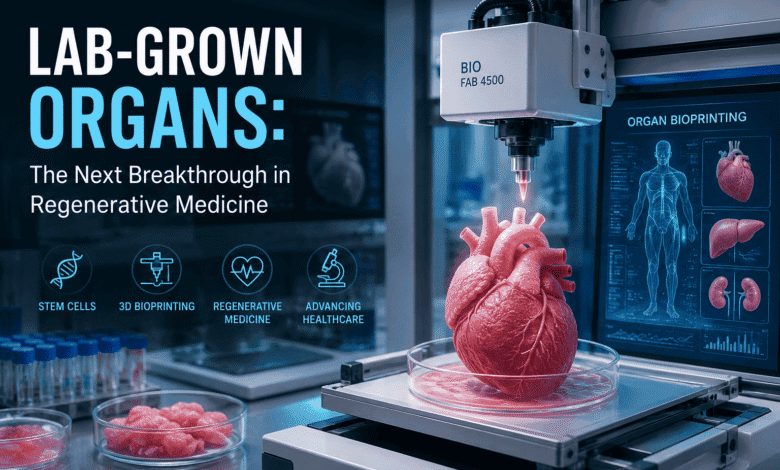
3D bioprinting is one of the most exciting developments in regenerative medicine.
Specialized bioprinters layer living cells mixed with bioinks to create complex tissue structures.
Researchers are currently developing printed versions of:
- Heart tissue
- Liver tissue
- Kidney tissue
- Bone tissue
- Blood vessels
Although printing fully functional organs remains challenging, rapid progress continues worldwide.
4. Organoids
Organoids are miniature versions of human organs grown from stem cells.
These tiny structures imitate many characteristics of real organs and are widely used in:
- Drug testing
- Disease research
- Cancer studies
- Personalized medicine
Organoids help reduce dependence on animal testing while improving research accuracy.
Benefits of Lab-Grown Organs
Reduced Organ Shortage
Millions of patients could receive organs without waiting for donor availability.
Lower Risk of Rejection
Organs developed using the patient’s own cells are more likely to be accepted by the immune system.
Personalized Medicine
Doctors can create customized treatments tailored to each patient’s biology.
Better Drug Testing
Scientists can test new medicines on lab-grown tissues before clinical trials, improving safety and reducing development costs.
Fewer Animal Experiments
Human tissue models provide more accurate data while decreasing reliance on animal testing.
Improved Quality of Life
Patients may experience faster recovery, fewer complications, and better long-term outcomes.
Current Applications of Lab-Grown Tissues
Although complete organ replacement is still under development, several lab-grown tissues are already making a difference.
Artificial Skin
Engineered skin is widely used for treating severe burns and chronic wounds.
Corneal Tissue
Researchers are developing lab-grown corneas to restore vision in patients with corneal diseases.
Cartilage Repair
Engineered cartilage helps repair joint injuries and sports-related damage.
Bladder Reconstruction
Bioengineered bladder tissues have shown promising clinical results in selected patients.
Bone Regeneration
Scientists use biomaterials and stem cells to regenerate damaged bone tissue.
Challenges Facing Lab-Grown Organs
Despite remarkable progress, several obstacles remain.
Complex Organ Structures
Organs such as the heart, liver, and kidneys contain intricate networks of blood vessels and specialized cells that are difficult to recreate.
Blood Supply
Growing functional blood vessels inside engineered organs remains one of the biggest scientific challenges.
Regulatory Approval
Every new therapy must undergo extensive clinical testing to ensure safety and effectiveness.
Manufacturing Costs
Advanced laboratory equipment and specialized expertise make production expensive.
Long-Term Performance
Researchers continue studying how engineered organs function over many years after transplantation.
Ethical and Regulatory Considerations
As regenerative medicine advances, ethical and legal frameworks are evolving alongside scientific innovation.
Key considerations include:
- Patient safety
- Stem cell sourcing
- Clinical trial transparency
- Long-term monitoring
- Equitable access to treatments
- International regulatory standards
Strong oversight will help ensure these technologies are developed responsibly and made accessible to patients who need them.
The Future of Regenerative Medicine
The next decade is expected to bring significant progress in organ engineering.
Future developments may include:
- Fully transplantable bioengineered kidneys
- Lab-grown livers for patients with liver failure
- Printed heart tissues for cardiac repair
- Artificial pancreas tissue for diabetes treatment
- Personalized organs created from patient-specific stem cells
- AI-assisted organ design and tissue optimization
- Automated bioprinting systems for faster production
As research continues, these innovations could reshape transplantation and reduce dependence on donor organs.
How Artificial Intelligence Supports Lab-Grown Organ Research
Artificial intelligence is increasingly contributing to regenerative medicine by:
- Analyzing complex biological datasets
- Optimizing stem cell differentiation
- Improving 3D bioprinting precision
- Predicting tissue growth outcomes
- Accelerating drug discovery
- Supporting personalized treatment planning
The integration of AI with biotechnology is expected to speed up research and improve clinical outcomes.
Conclusion
Lab-grown organs represent one of the most exciting frontiers in regenerative medicine. By combining stem cell science, tissue engineering, 3D bioprinting, and artificial intelligence, researchers are moving closer to creating functional organs that could transform healthcare.
Although significant scientific and regulatory challenges remain, current progress demonstrates that regenerative medicine is rapidly evolving from experimental research into real-world clinical applications. As technology advances, lab-grown organs have the potential to reduce organ shortages, improve transplant success rates, and deliver personalized treatments that improve the quality of life for millions of patients worldwide.
Frequently Asked Questions (FAQs)
1. What are lab-grown organs?
Lab-grown organs are biological tissues or organs developed in laboratories using human cells, stem cells, biomaterials, and tissue engineering techniques to replace damaged or failing organs.
2. Are lab-grown organs currently available for transplantation?
Some engineered tissues, such as skin and cartilage, are already used clinically. Fully functional organs like hearts and kidneys are still in advanced research and development.
3. How does 3D bioprinting help create organs?
3D bioprinting deposits living cells layer by layer using specialized bioinks to build tissue structures that resemble natural organs.
4. What are the biggest challenges in developing lab-grown organs?
Key challenges include creating complex blood vessel networks, ensuring long-term functionality, reducing production costs, and obtaining regulatory approval.