Cell-Free Biomanufacturing: Producing Biological Materials Without Living Cells

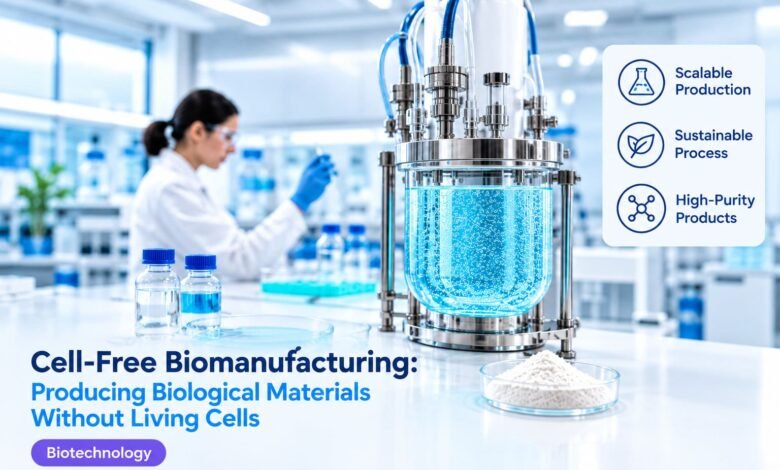
What if scientists could produce important biological materials without keeping living cells alive throughout the manufacturing process? This is the idea behind cell-free biomanufacturing, an emerging biotechnology approach that uses the machinery of cells to produce useful biological products outside intact living cells.
Traditional biomanufacturing often relies on microorganisms, yeast, or mammalian cells to produce proteins, enzymes, and other valuable compounds. These cells need suitable nutrients, temperature, oxygen levels, and other carefully controlled conditions. Cell-free systems offer another way to carry out selected biological processes by using the molecular components responsible for making these products.
The approach is attracting interest in biotechnology research, pharmaceutical development, synthetic biology, and industrial production. Although it still faces technical and economic challenges, cell-free biomanufacturing could provide manufacturers with greater control over certain production processes.
What Is Cell-Free Biomanufacturing?
Cell-free biomanufacturing is a process that uses biological machinery extracted from cells to produce specific materials without relying on intact, living cells during the production reaction.
These extracts can contain ribosomes, enzymes, transfer RNA, and other components required for biological reactions. When researchers supply the appropriate genetic instructions, energy sources, amino acids, and other ingredients, the system can produce a target molecule.
One important application is cell-free protein synthesis, also known as CFPS. In this process, the molecular machinery responsible for reading genetic instructions and assembling proteins works in a controlled environment outside an intact cell.
The key difference is that researchers do not need to maintain a growing population of cells during the actual production reaction. Instead, they can focus on controlling the biochemical environment needed to make the desired product.
How Does Cell-Free Biomanufacturing Work?
The process begins with preparing a biological system capable of carrying out the required reaction. The exact method depends on the target material and the technology being used.
1. Preparing the Cellular Machinery
Researchers obtain biological material from a suitable source, such as bacteria or another organism. The cells are broken open, and the resulting extract is prepared to retain the molecular components needed for the reaction.
The quality and composition of this extract can strongly influence the final production results.
2. Providing Genetic Instructions
The system receives genetic instructions, usually in the form of DNA or messenger RNA, that specify which protein should be produced.
These instructions guide the biological machinery toward assembling the required molecule rather than producing it as part of a growing cell.
3. Supplying Essential Ingredients
The reaction mixture contains the necessary building blocks, energy sources, salts, and other components. Researchers adjust the conditions to support the desired biochemical activity.
Because the system is open rather than enclosed within an intact cell, scientists can often modify its ingredients more directly.
4. Producing the Target Material
The biological machinery carries out the required reactions. In protein synthesis, ribosomes read the genetic instructions and join amino acids together to form a protein.
Researchers then assess the quantity, quality, and functionality of the resulting product. Depending on its intended use, additional purification and testing may be necessary.
Why Are Scientists Exploring Cell-Free Production?
Living cells are remarkably efficient biological factories, but they also have their own needs. They use energy to grow, repair themselves, and maintain essential functions. These activities can compete with the production of a particular industrial or pharmaceutical compound.
Cell-free systems allow researchers to concentrate on a selected reaction without maintaining an intact, growing cell population.
Several potential advantages make this approach worth exploring:
- Greater control: Researchers can directly adjust reaction ingredients and conditions.
- Faster experimentation: Different production conditions can be tested without always developing and growing new cell cultures.
- Flexible design: Reaction mixtures can be adapted for different proteins and biochemical pathways.
- Access to challenging products: Some proteins or molecules may be difficult to produce efficiently inside living cells.
- Potential portability: Certain cell-free reagents can be freeze-dried for storage and later use, depending on the formulation.
These advantages do not guarantee higher yields or lower costs in every situation. Performance depends on the product, the biological extract, the reaction design, and the intended production scale.
Applications of Cell-Free Biomanufacturing
1. Pharmaceutical Research and Protein Production
The pharmaceutical industry relies on proteins and other biological molecules for research, diagnostic development, and therapeutic applications. Cell-free systems provide an alternative platform for producing and studying selected proteins.
Researchers can use these systems to test protein designs, investigate biological functions, and explore production methods. However, proteins intended for medical use must meet strict requirements for purity, consistency, safety, and biological activity.
2. Enzyme Manufacturing
Enzymes are used in numerous industries, including food processing, chemical manufacturing, biotechnology, and environmental applications.
Cell-free production can help researchers investigate enzymes that may be difficult to express in living organisms. It also allows direct adjustment of reaction conditions, making it useful for studying how different ingredients influence enzyme production.
Whether the method is commercially attractive depends on production yield, enzyme stability, processing requirements, and overall cost.
3. Synthetic Biology
Synthetic biology involves designing and engineering biological systems for specific purposes. Cell-free platforms are useful in this field because scientists can assemble and test biochemical reactions in a controlled environment.
For example, researchers can compare different genetic instructions, evaluate engineered proteins, and test combinations of biological components. This can help identify promising designs before moving to more complex experiments involving living cells.
4. Diagnostics and Biosensors
Cell-free biological systems can also support the development of diagnostic tools and biosensors. Researchers can design reactions that respond to selected biological or chemical signals.
In some approaches, the presence of a target substance triggers a measurable response, such as a change in colour or another detectable signal. Freeze-dried cell-free systems are being investigated for applications where conventional laboratory equipment may be difficult to access.
Their practical use depends on sensitivity, reliability, storage stability, and the ability to distinguish genuine signals from interference.
5. Sustainable Chemical Production
Biotechnology is increasingly being explored as a way to manufacture useful chemicals through biological reactions. Cell-free metabolic systems allow researchers to combine enzymes and other biochemical components to convert starting materials into desired products.
Potential applications include the production of selected industrial chemicals and other value-added compounds. However, the sustainability of a process depends on factors such as the source of its raw materials, energy consumption, reaction efficiency, and waste generation.
Cell-Free Biomanufacturing vs. Traditional Biomanufacturing
Both approaches use biological processes, but they differ in how those processes are organized.
| Feature | Cell-Free Biomanufacturing | Traditional Cell-Based Biomanufacturing |
|---|---|---|
| Production system | Biological machinery outside intact cells | Living cells or microorganisms |
| Growth requirements | No cell growth during the reaction | Cells generally require suitable growth conditions |
| Process control | Reaction ingredients can often be adjusted directly | Conditions must support both cells and product formation |
| Development | Can simplify selected early-stage experiments | May require cell cultivation and strain development |
| Production costs | Reagents and extracts can be expensive | Costs depend on cultivation, feedstocks, and downstream processing |
| Industrial readiness | Expanding, but product-dependent | Established for many commercial products |
Neither approach is universally better. Traditional cell-based manufacturing remains highly effective for many products, particularly where established processes deliver consistent yields at scale. Cell-free systems may be more attractive when flexibility, rapid testing, or specific biochemical capabilities are priorities.
Challenges That Need to Be Addressed
Despite its potential, cell-free biomanufacturing still has several limitations.
High Production Costs
Preparing biological extracts and supplying the ingredients needed for a reaction can be expensive. In some applications, conventional fermentation offers a more economical route to large quantities of a product.
Maintaining Consistent Results
The composition of biological extracts can vary, affecting reaction performance. Manufacturers need reliable preparation methods and standardized quality controls to obtain reproducible results.
Scaling Up Production
A reaction that performs well in a small laboratory experiment may not deliver the same results at industrial scale. Larger production systems require careful control of mixing, energy supply, reaction conditions, and product recovery.
Producing Complex Proteins
Some proteins require specialized folding processes or post-translational modifications, such as glycosylation. Not every cell-free platform can perform these modifications efficiently, so the production system must be matched to the intended product.
Purification and Quality Control
Producing a target molecule is only one part of manufacturing. Removing unwanted components and demonstrating product quality remain essential, particularly for pharmaceutical applications.
Addressing these limitations will be important if cell-free technologies are to become more widely adopted in commercial production.
What Is the Future of Cell-Free Biomanufacturing?
The future of cell-free biomanufacturing will likely depend on improvements in reaction efficiency, reagent cost, automation, and process consistency.
Researchers are exploring new biological extracts, improved energy-generation systems, and methods for extending the duration of biochemical reactions. Advances in synthetic biology and automated experimentation may also help scientists identify better combinations of components.
Another area of interest is decentralized production. Certain cell-free systems could eventually support the preparation of selected biological products closer to where they are needed. Freeze-dried formulations may be especially useful when transporting and storing conventional laboratory materials is difficult.
However, broader adoption will require evidence that these systems can meet practical manufacturing requirements. Reliable performance, affordable production, suitable purification methods, and regulatory compliance will remain important considerations.
Rather than replacing traditional biomanufacturing entirely, cell-free production is more likely to complement established approaches in applications where its particular advantages justify its cost.
Conclusion
Cell-free biomanufacturing offers a different way to use biology for producing valuable materials. By separating selected biochemical processes from intact living cells, researchers gain greater flexibility in how they design and control certain production reactions.
The technology has potential applications in protein synthesis, enzyme production, synthetic biology, diagnostics, and industrial biotechnology. At the same time, cost, consistency, scalability, and product quality remain significant challenges.
As research continues, improvements in biological extracts, reaction design, and manufacturing methods could make cell-free systems more practical for specific commercial uses. Its long-term importance will depend not simply on what scientists can produce in a laboratory, but on whether they can produce it reliably, safely, and economically at the scale required.
Frequently Asked Questions
1. What is cell-free biomanufacturing?
Cell-free biomanufacturing uses biological components extracted from cells to produce useful materials without intact living cells during the reaction.
2. What is cell-free protein synthesis?
It is a process that uses cellular machinery, such as ribosomes and enzymes, to produce proteins from genetic instructions outside intact cells.
3. What are the applications of cell-free biomanufacturing?
Applications include protein production, enzyme research, synthetic biology, diagnostic development, and selected industrial biotechnology processes.
4. What are the main challenges of cell-free production?
Key challenges include production costs, reaction consistency, industrial scale-up, protein quality, and purification requirements.