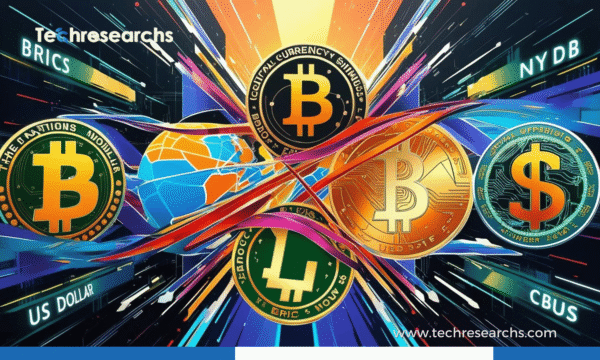
The global financial system is changing. For decades, the U.S. dollar has played the leading role in international trade, investment, and central-bank reserves. But as emerging economies look for more flexibility in global finance, the BRICS group has become an important part of the conversation.
The idea of a BRICS currency has attracted significant attention. Could countries such as Brazil, Russia, India, China, and South Africa eventually create a shared currency or another financial system that reduces their dependence on the U.S. dollar?
The answer is not straightforward. A common BRICS currency is still a possibility rather than an established reality. However, efforts to increase the use of local currencies, strengthen cross-border payment systems, and reduce reliance on the dollar could gradually influence the global financial landscape.
What Is BRICS?
BRICS is a group of emerging economies that originally brought together Brazil, Russia, India, China, and South Africa. The group has expanded its membership, increasing its economic and geopolitical significance.
One of its broader goals is to encourage greater cooperation among member countries. Financial cooperation has become an increasingly important part of that discussion.
Rather than depending entirely on the dollar for international transactions, BRICS members have shown growing interest in using their own national currencies for trade and exploring alternative payment mechanisms.
Is There a BRICS Currency Right Now?
No. There is currently no officially launched common BRICS currency that businesses or consumers can use like the U.S. dollar, euro, or Indian rupee.
This distinction is important because discussions about a “BRICS currency” sometimes make it sound as though a new currency is already ready to enter global markets.
The reality is more complicated.
BRICS countries have discussed different approaches to financial cooperation, including local-currency trade, payment infrastructure, and potential digital financial systems. A fully shared currency would require much deeper economic coordination and agreement among countries with very different monetary policies, financial systems, and economic priorities.
Why Are BRICS Countries Interested in Reducing Dollar Dependence?
The U.S. dollar provides major advantages for international commerce, but relying heavily on one currency can also create financial and geopolitical concerns.
For BRICS economies, increasing the use of local currencies could potentially reduce some currency-conversion costs and provide greater flexibility in bilateral trade.
For example, two countries trading directly with each other may prefer to settle part of their transaction in their own currencies rather than converting everything through the dollar.
Another motivation is financial resilience. Countries may want payment options that are less vulnerable to disruptions caused by sanctions, geopolitical disputes, or changes in international financial policy.
How Could a BRICS Currency Affect the US Dollar?
If BRICS countries eventually created a widely accepted common currency, the impact on the dollar could be significant. However, the size of that impact would depend on how widely the currency was adopted.
1. Reduced Demand for the Dollar
If businesses and governments increasingly used a BRICS-related currency for international transactions, some demand for dollars could decline.
The effect would probably be gradual rather than immediate. The dollar’s role is supported by deep financial markets, strong global liquidity, and decades of established trade relationships.
2. Changes in Global Trade Settlement
One of the most realistic areas of change is international trade.
If more BRICS members settle transactions directly in their national currencies, fewer transactions may need to pass through the dollar.
This would not necessarily eliminate the dollar from global trade. Instead, it could create a more diversified system in which several currencies play larger roles.
3. Possible Pressure on Dollar Dominance
The dollar’s global position depends partly on network effects. Businesses use dollars because other businesses, banks, investors, and governments already use dollars.
Breaking that network is difficult.
However, if alternative payment systems become easier and more countries participate in them, the dollar could face greater competition over time.
4. Possible Changes in Foreign-Exchange Markets
A successful BRICS financial system could increase demand for currencies associated with BRICS trade.
That could influence currency markets, especially if large volumes of commodities and manufactured goods were priced or settled without the dollar.
The impact would depend on liquidity, convertibility, market confidence, and the stability of the alternative currency system.
Why Replacing the US Dollar Would Be Difficult
Creating an alternative to the dollar is much harder than announcing a new currency.
The U.S. dollar benefits from a highly developed financial ecosystem. Global investors can access large capital markets, international banks, government securities, and financial instruments denominated in dollars.
A potential BRICS currency would need to compete across many of these areas.
There are also differences among BRICS economies. Countries may have different inflation rates, interest-rate policies, exchange-rate systems, capital controls, and economic priorities.
Managing those differences under one currency would be a major challenge.
Could a Digital BRICS Payment System Be More Realistic?
Possibly.
A shared currency is only one way to reduce dependence on the dollar. Another approach is to make cross-border payments easier using existing national currencies or digital financial infrastructure.
Digital payment systems could allow participating countries to transfer value more efficiently without requiring every transaction to be settled through a traditional dollar-based system.
This could be particularly important for emerging markets because faster and cheaper international payments can support trade and investment.
What Would It Mean for India?
India could have an important role in the discussion because it has strong trade relationships with both BRICS partners and Western economies.
India has also supported greater use of the rupee in international transactions while maintaining extensive connections with the dollar-based global financial system.
For India, the issue is therefore not necessarily about choosing one currency over another.
A more diversified payment environment could give Indian businesses additional options for international trade while allowing the country to maintain relationships across different economic blocs.
What About Other BRICS Economies?
The potential benefits and challenges would vary from country to country.
China: China’s large economy and international trade network could give it a major role in any alternative payment framework.
Russia: Russia has strong incentives to develop payment channels that are less dependent on Western financial infrastructure.
India: India may benefit from greater use of the rupee in international commerce while continuing to participate in the existing global financial system.
Brazil: As a major commodity exporter, Brazil could benefit from more flexible settlement mechanisms for international trade.
South Africa: South Africa can provide an important link between BRICS financial cooperation and the broader African economy.
The interests of these countries are not identical, which makes a single common currency difficult to design.
Will the BRICS Currency Replace the US Dollar?
A complete replacement is unlikely in the near term.
The more realistic possibility is a gradual shift toward a more multipolar international monetary system.
In such a system, the dollar would remain extremely important, but other currencies and payment networks could gain a larger role.
Think of it less as one currency suddenly replacing another and more as global finance becoming increasingly diversified.
What Could Investors Watch?
Anyone following the BRICS currency debate should focus on actual developments rather than headlines.
Important indicators include:
- Growth in trade settled using local currencies
- Development of BRICS cross-border payment systems
- Central-bank agreements involving participating countries
- Changes in foreign-exchange reserves
- Digital-currency and payment infrastructure projects
- Commodity transactions conducted outside the dollar
- Changes in international demand for U.S. Treasury securities
These factors can provide a better picture of whether de-dollarization is becoming a meaningful financial trend.
The Bigger Picture
The BRICS currency discussion is ultimately about more than creating a new banknote.
It reflects a broader debate about how international finance should work in a world where economic power is becoming more distributed.
The dollar is unlikely to disappear from global finance simply because BRICS countries explore alternatives. At the same time, continued development of local-currency trade and alternative payment systems could gradually reduce the dollar’s dominance in certain areas.
The most likely outcome may not be a world without the dollar. Instead, global finance could move toward a system where the dollar remains the leading currency while other currencies and payment networks become more influential.
Conclusion
A potential BRICS currency could become an important development in global finance, but it is important to separate speculation from reality.
There is no established common BRICS currency replacing the dollar today. The more immediate development is the group’s broader push toward local-currency trade, alternative payment mechanisms, and greater financial cooperation.
If these initiatives continue to expand, the U.S. dollar could face more competition in selected areas of international finance. However, replacing the dollar would require overcoming significant challenges involving liquidity, trust, financial-market depth, monetary coordination, and global adoption.
For now, the BRICS story is better understood as a gradual attempt to diversify the global financial system rather than an immediate attempt to eliminate the U.S. dollar.
Frequently Asked Questions
Is there an official BRICS currency in 2026?
No. BRICS does not currently have a single official currency that replaces national currencies or the U.S. dollar. Discussions have focused more broadly on local-currency trade and alternative cross-border payment systems.
Could a BRICS currency replace the U.S. dollar?
A complete replacement is unlikely in the near term. The U.S. dollar has deep financial markets, strong international liquidity, and widespread use in global trade. A BRICS currency could potentially increase competition without immediately replacing the dollar.
How could BRICS reduce dependence on the U.S. dollar?
BRICS countries can reduce dollar dependence by increasing trade in local currencies, developing alternative payment infrastructure, and expanding financial cooperation between member economies.
What could a BRICS currency mean for the global economy?
If widely adopted, it could contribute to a more diversified international monetary system. However, its impact would depend on factors such as economic stability, market liquidity, international trust, and how many countries actually use it.