Robotics and artificial intelligence are changing faster than most people expected. What once seemed like technology limited to factories and research laboratories is now becoming part of healthcare, logistics, agriculture, transportation, retail, and even everyday life.
The interesting part is not just that robots are becoming smarter. AI is helping robots understand their surroundings, learn from information, recognize objects, make decisions, and perform tasks with greater flexibility.
As these two technologies continue to develop together, they could reshape the way people work and interact with machines. So, what should we expect next?
Let’s explore the major robotics and AI trends that are likely to shape the coming years.
What Is Changing in Robotics and AI?
Older robots were generally built to perform a limited number of predefined tasks. If something unexpected happened, the robot often needed human intervention.
AI is changing that approach.
Modern robots can combine cameras, sensors, machine learning, computer vision, language models, and advanced control systems. This gives them a better understanding of what is happening around them.
Instead of simply following instructions, future robots could increasingly determine what needs to be done, how to do it, and how to respond when circumstances change.
This is one reason the combination of robotics and AI has attracted so much attention.
1. Humanoid Robots Will Continue to Develop
Humanoid robots are probably one of the most visible areas of robotics right now.
These machines are designed with human-like features such as arms, hands, legs, and a torso. The idea is fairly practical: many workplaces and public environments are already designed for humans.
A humanoid robot could potentially use existing doors, shelves, tools, workstations, and other infrastructure without requiring major changes to the environment.
However, humanoid robots still have plenty of challenges to overcome. Walking is only one part of the problem. Robots also need to become better at handling objects, understanding their surroundings, managing energy consumption, and working safely around people.
Over time, improvements in AI and hardware could make humanoid robots more useful for warehouses, manufacturing, inspection, and other repetitive tasks.
2. Physical AI Will Bring Intelligence Into the Real World
AI has become very good at working with digital information. Robotics adds another dimension: physical interaction.
This is where the idea of physical AI becomes important.
Physical AI refers to intelligent systems that can perceive and respond to the physical world. A robot may use cameras and sensors to understand its surroundings, an AI model to interpret what it sees, and robotic controls to perform an action.
For example, imagine telling a robot:
“Please move these packages to the empty shelf.”
A more advanced robot could identify the packages, locate the shelf, plan a safe route, pick up the objects, and adjust its behavior if someone walks into its path.
That kind of flexibility could become a major part of future automation.
3. AI-Powered Robots Will Understand Natural Language
Programming a robot manually for every task can be complicated and time-consuming.
AI could make interaction much simpler.
Instead of using complex commands, people may increasingly communicate with robots using ordinary language.
For example, a worker could say:
“Take these items to the packing area and organize them by size.”
The robot could interpret the instruction and translate it into a sequence of physical actions.
This development could make robotics more accessible to businesses that do not have large teams of robotics engineers.
4. Robots Will Learn From Simulations and Demonstrations
Teaching a robot in the real world can take a lot of time. It can also be expensive and risky.
Simulation provides a useful alternative.
Developers can create virtual environments where robots practice tasks such as navigation, object handling, and movement. A robot can repeat the same task thousands of times without damaging equipment or putting people at risk.
Robots can also learn by watching humans perform tasks.
For example, instead of programming every movement required to pick up an object, a robot could observe a person performing the task and learn the general process.
Combining simulation, demonstrations, and real-world experience could make robot training faster and more practical.
5. Edge AI Will Help Robots Make Faster Decisions
Robots often need to respond immediately.
A machine working in a warehouse cannot always wait for information to travel to a distant cloud server and come back. A delay of even a fraction of a second can matter when the robot is moving around people or machinery.
That is where edge AI becomes useful.
With edge computing, some AI processing can happen directly on the robot or on nearby hardware.
This can reduce latency, improve responsiveness, and allow robots to continue performing important functions even when internet connectivity is limited.
As AI chips become smaller, faster, and more energy efficient, edge AI is expected to become increasingly important in robotics.
6. Humans and Robots Will Work More Closely Together
The future of robotics does not have to mean humans being replaced by machines.
In many situations, the better approach is collaboration.
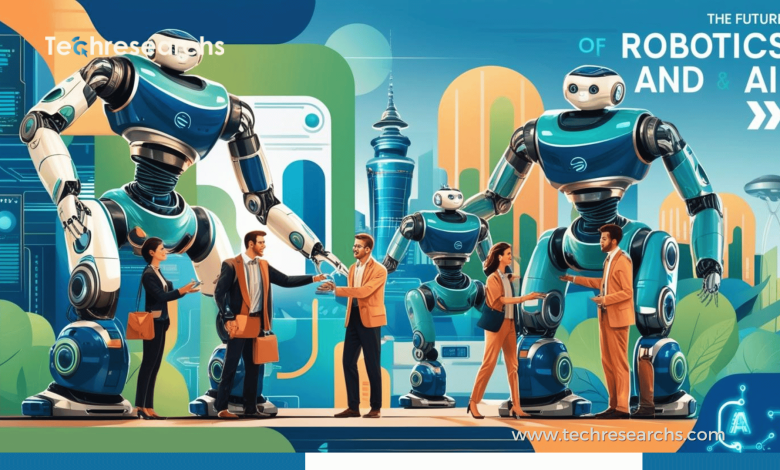
Robots can take care of repetitive, physically demanding, or potentially dangerous work. People can focus on areas where human judgment, communication, creativity, and decision-making are more valuable.
For example, a robot might transport materials around a factory while workers handle quality checks and complex decisions.
This type of human-robot collaboration could improve productivity without removing people from the process entirely.
7. Robotics Will Move Into More Industries
Robots are already common in manufacturing, but their use is expanding.
Healthcare
Robotic technology can support surgery, rehabilitation, patient assistance, and hospital logistics.
Agriculture
Farm robots can help with crop monitoring, harvesting, field inspection, and other agricultural activities.
Warehousing
Autonomous robots can move products, organize inventory, and support order fulfillment.
Construction
Robots could assist with surveying, inspection, material handling, and repetitive construction tasks.
Transportation
Autonomous systems are being developed for vehicles, delivery platforms, drones, and other forms of transportation.
The important shift is that robotics is no longer limited to one industry. As machines become more adaptable, businesses across different sectors can find ways to use them.
8. Swarm Robotics Could Create Smarter Robotic Teams
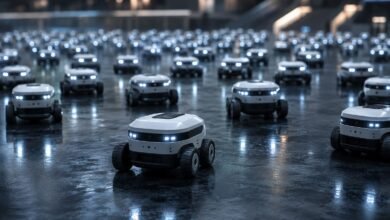
One powerful idea in robotics is that a group of simple robots can sometimes accomplish more than one extremely complex machine.
This concept is known as swarm robotics.
Instead of relying on one robot to handle an entire operation, several machines can communicate and divide the work between themselves.
Imagine dozens of small robots inspecting a large area after a natural disaster. Each robot could cover a different section while sharing information with the others.
Swarm robotics could eventually be useful for agriculture, environmental monitoring, warehouse operations, infrastructure inspection, and emergency response.
9. Better Sensors Will Give Robots a Sense of Touch
Robots have become increasingly good at seeing objects, but vision is not always enough.
Think about picking up a fragile glass object. A person naturally adjusts their grip based on how the object feels.
Robots need similar capabilities.
Researchers are developing tactile sensors that can detect pressure, force, contact, and other physical information. These technologies could help robots handle fragile or irregular objects more carefully.
Better tactile sensing could be particularly useful in manufacturing, healthcare, food handling, and household robotics.
10. Robotics Cybersecurity Will Become More Important
As robots become connected to networks and cloud services, cybersecurity cannot be ignored.
A modern robot may communicate with other machines, store information, receive software updates, and interact with business systems. That creates new security risks.
Companies will need to protect robotic systems against unauthorized access, malicious software, data theft, and other threats.
Security will become especially important when robots are used in factories, hospitals, warehouses, and other environments where a technical failure could have physical consequences.
11. Robots Will Become More Flexible
Traditional industrial robots are excellent at repeating the same task again and again.
The next generation is expected to become more flexible.
Instead of building one robot for one specific activity, companies may increasingly look for systems that can perform several tasks and adapt to changing requirements.
For example, the same robot could potentially move products in the morning, assist with sorting in the afternoon, and support another workflow later in the day.
This flexibility could make robotics more attractive to businesses that need to respond quickly to changing demand.
12. Robotics Will Become More Focused on Real Business Value
There is a lot of excitement surrounding robotics and AI, but impressive demonstrations are not enough.
Businesses ultimately want to know one thing:
Does the technology solve a real problem?
Companies will evaluate robots based on factors such as:
- Cost
- Reliability
- Productivity
- Safety
- Maintenance
- Energy consumption
- Ease of deployment
- Return on investment
This means the robotics industry is likely to become more focused on practical applications rather than technology demonstrations alone.
The robots that succeed commercially will be the ones that can perform useful tasks consistently and provide measurable value.
Challenges the Robotics Industry Still Needs to Solve
Despite rapid progress, robotics and AI still have significant limitations.
High Development Costs
Advanced robots require sophisticated hardware, sensors, processors, software, and maintenance.
Safety Concerns
Robots working around people must be able to react safely to unexpected situations.
Limited Battery Life
Mobile robots need enough energy to operate for useful periods without frequent charging.
Reliability
A robot may work well in a controlled demonstration but struggle when conditions change.
Data Requirements
AI-powered robots need high-quality data to learn how to operate effectively in the real world.
Ethical and Regulatory Questions
As autonomous machines become more common, governments and organizations will need to address questions around safety, privacy, responsibility, and employment.
Solving these problems will be just as important as improving the technology itself.
What Can We Expect From Robotics and AI in the Future?
Over the next several years, we are likely to see robotics become more connected with everyday business operations.
Some of the developments worth watching include:
- More capable humanoid robots
- Smarter warehouse automation
- AI-powered industrial robots
- Improved autonomous vehicles and drones
- Better robot vision and touch
- Natural-language robot control
- Greater use of edge AI
- More human-robot collaboration
- Growth in healthcare robotics
- Wider adoption of autonomous machines
- Stronger robotics cybersecurity
- More flexible general-purpose robots
Not every prediction will happen at the same speed. Some technologies may take years to become commercially practical, while others could advance much faster.
How Robotics and AI Could Change the Workplace
The impact of robotics will not simply be about machines doing more work.
Jobs themselves may change.
Employees may spend less time performing repetitive manual tasks and more time supervising automated systems, analyzing information, solving problems, maintaining robots, or managing AI-powered workflows.
This creates a growing need for new skills.
People working with robotics may need knowledge of areas such as:
- Artificial intelligence
- Data analysis
- Robotics programming
- Automation
- Computer vision
- Cybersecurity
- System maintenance
- Human-machine interaction
Businesses that invest in employee training alongside automation may be better prepared for this transition.
Final Thoughts
The future of robotics and AI is not just about building machines that look impressive.
The real breakthrough will come when robots can understand their surroundings, respond to changing situations, learn from experience, and work safely alongside people.
Humanoid robots may capture the public’s attention, but the broader transformation will happen across factories, warehouses, hospitals, farms, transportation systems, and many other environments.
AI gives robots a form of intelligence. Robotics gives AI the ability to act in the physical world.
Together, they are creating a new generation of machines that can see, understand, decide, and act.
The technology is still evolving, and there will undoubtedly be setbacks along the way. But one thing is becoming increasingly clear: robotics and AI are moving from the laboratory into the real world, and their influence is only beginning to grow.
Frequently Asked Questions
1. What is the future of robotics and AI?
The future of robotics and AI is focused on creating smarter machines that can understand their surroundings, learn from data, make decisions, and perform tasks with less human intervention.
2. What are the major trends in robotics and AI?
Major trends include humanoid robots, physical AI, edge AI, autonomous robots, human-robot collaboration, advanced sensors, robot learning, and AI-powered automation.
3. Will AI and robotics replace human jobs?
AI and robotics may automate some repetitive and dangerous tasks, but they can also create new roles. In many industries, humans and robots are expected to work together rather than robots completely replacing people.
4. Why is AI important for modern robots?
AI helps robots understand their environment, recognize objects, process sensor information, plan actions, and respond to changing situations. This makes modern robots more flexible than traditional programmed machines.