
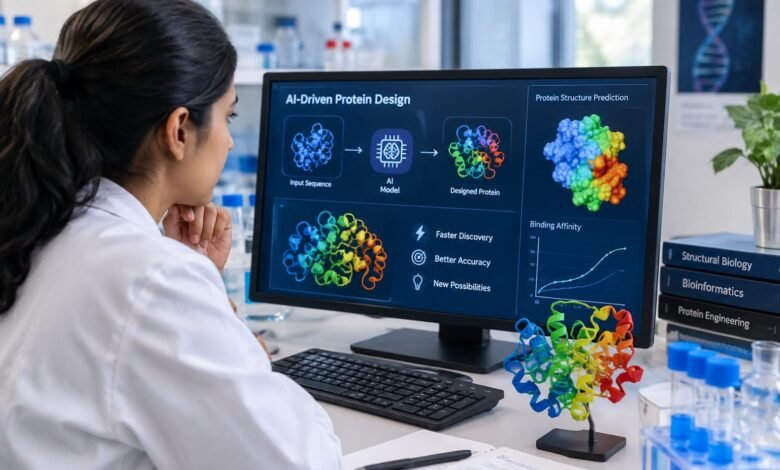
Protein research has always involved a mix of biology, chemistry, experimentation, and a fair amount of patience. Scientists often spend considerable time studying how proteins are structured, how they behave, and what happens when their amino acid sequences change.
Artificial intelligence is adding a new tool to this process.
Instead of relying only on laboratory experiments, researchers can now use AI algorithms to examine huge amounts of biological data, identify patterns, predict protein structures, and explore potential protein designs. This does not mean computers have replaced laboratory science. Rather, AI can help scientists decide where to look and which possibilities are worth testing.
What Is AI-Powered Protein Design?
AI-powered protein design refers to the use of artificial intelligence and machine learning techniques to study existing proteins and explore new protein sequences or structures.
Proteins are made from chains of amino acids. These chains fold into specific three-dimensional shapes, and that shape often influences what the protein can do. A small change in its sequence can sometimes have a significant effect on its stability or function.
The difficulty is the enormous number of possible protein sequences. Researchers cannot realistically test every possible combination in a laboratory.
AI provides a way to search this large space more efficiently.
Depending on the research objective, AI models can help scientists analyze protein sequences, predict structures, identify potentially useful mutations, and generate candidates for further investigation.
Why Protein Design Is Challenging
Designing a protein is not as simple as choosing a sequence that looks promising.
A successful protein needs to fold properly and maintain the characteristics required for its intended purpose. It may also need to interact with another molecule, remain stable under particular conditions, or perform a specific chemical reaction.
Traditional protein engineering often involves repeated cycles of designing, producing, and testing candidates.
This experimental process is extremely valuable, but it can also take considerable time and resources. AI can help narrow down the possibilities before researchers commit to laboratory testing.
How AI Helps With Protein Research
AI models can analyze information from protein databases, structural studies, experiments, and other biological sources.
When a model finds relationships within this data, researchers can use those patterns to make predictions about proteins that have not been studied as extensively.
For example, an AI system may identify sequence patterns associated with particular structural characteristics. A researcher can then use that information to select a group of protein candidates for additional analysis.
The advantage is not simply speed. AI can also help researchers explore possibilities that would be difficult to evaluate manually.
Predicting Protein Structures
One of the most visible applications of AI in protein research is structure prediction.
Knowing the three-dimensional structure of a protein can help researchers understand how it may interact with other molecules and why particular changes to its sequence affect its behavior.
Modern computational models have made significant progress in predicting protein structures from amino acid sequences. These predictions can provide researchers with useful starting points when experimental structures are unavailable.
However, a predicted structure is still a prediction. Depending on the research question, scientists may need additional computational analysis or experimental methods to confirm the result.
Designing New Protein Sequences
AI can also be used to explore proteins that do not simply copy naturally occurring sequences.
Generative models can produce potential protein sequences based on patterns learned from biological data. Researchers can then evaluate these candidates according to their specific goals.
For example, a research team might be interested in a protein that is more stable, binds to a particular target, or performs a specific enzymatic function.
The general process can look like this:
- Set the research goal – Define the desired protein characteristics.
- Gather relevant data – Use available protein sequences, structures, and experimental information.
- Apply AI models – Analyze biological patterns and generate predictions.
- Select candidates – Identify sequences that appear promising.
- Run computational checks – Examine predicted structures and other characteristics.
- Perform laboratory experiments – Produce and test selected proteins.
- Learn from the results – Use experimental findings to improve future designs.
This combination of computation and experimentation can make protein engineering more targeted.
AI in Drug Discovery
Protein research is closely connected to drug discovery because many medicines work by interacting with proteins.
Researchers need to understand how potential drug molecules interact with biological targets. AI can assist by helping analyze protein structures, identify possible interactions, and prioritize candidates for additional research.
AI-generated or AI-optimized proteins may also become useful in therapeutic research. However, moving from a computational design to a safe and effective biological application requires extensive experimental testing.
This is one reason AI should be considered an accelerator for research rather than a substitute for it.
AI and Enzyme Engineering
Enzymes are another important area where AI-assisted protein design can be useful.
Scientists engineer enzymes for applications ranging from biotechnology and industrial chemistry to medicine and environmental research. Changing individual amino acids can sometimes alter an enzyme’s performance, but there may be many possible mutations to investigate.
AI can help researchers prioritize mutations that are worth testing.
Instead of approaching every possibility equally, scientists can use computational predictions to create a smaller and more focused experimental set. Laboratory results can then show whether those predictions were accurate.
Why Biological Data Matters
AI is only as useful as the information it learns from.
Protein databases contain enormous amounts of valuable biological information, but not every protein is equally well studied. Some datasets may contain incomplete information or have a strong focus on particular types of proteins.
This means researchers need to think carefully about:
- The quality of the training data
- The diversity of proteins represented
- Experimental accuracy
- Model limitations
- Biological context
- Independent validation
A model can identify patterns in data, but researchers still need scientific judgment to determine whether those patterns make biological sense.
AI Does Not Replace Laboratory Science
It is easy to assume that increasingly capable AI models could eliminate the need for laboratory experiments. In protein research, that is not the case.
A computer-generated protein sequence may look promising but still fail when it is produced in a laboratory. Its real-world behavior can depend on factors that are difficult to capture completely in a computational model.
Laboratory experiments provide the evidence needed to determine whether a prediction actually works.
The most useful workflow therefore combines both approaches:
AI predicts → researchers select → laboratories test → results improve future predictions.
This feedback loop can make protein research more efficient without removing the experimental foundation of biological science.
Challenges Researchers Still Face
AI-powered protein design is developing quickly, but several challenges remain.
Prediction Accuracy
A strong computational prediction does not automatically mean that a protein will have the desired biological function.
Complex Biological Environments
Proteins do not operate in isolation. Temperature, pH, other molecules, cellular conditions, and many additional factors can influence their behavior.
Limited Training Data
Some proteins and biological functions have much more experimental data available than others. Models may therefore perform differently across different research problems.
Experimental Validation
Even an impressive computational result ultimately needs to be tested when researchers are making biological claims or developing practical applications.
These challenges are important because they show why human expertise remains central to AI-assisted protein research.
What Could Come Next?
The future of protein research may involve much tighter integration between AI systems and laboratory technology.
Researchers could increasingly connect sequence generation, structure prediction, molecular modeling, automated experiments, and data analysis into a single research workflow.
As these technologies improve, scientists may be able to investigate a much broader range of protein possibilities before selecting candidates for laboratory testing.
This could have implications for drug discovery, enzyme engineering, biotechnology, agriculture, and other areas of biological research.
Conclusion
AI-powered protein design is changing how researchers approach one of biology’s most complicated problems: understanding and designing proteins.
AI can examine large datasets, identify useful patterns, predict structures, and generate potential protein candidates. But the technology works best when it is combined with laboratory science rather than treated as a replacement for it.
The real opportunity lies in bringing computational predictions and experimental evidence together. By allowing researchers to explore more possibilities before beginning extensive laboratory testing, AI can make protein research more focused and open new directions for biological discovery.
As AI and biological science continue to develop together, protein design is likely to become an increasingly data-driven field while human researchers remain responsible for asking the right questions, interpreting the results, and proving what actually works.
Frequently Asked Questions
What is AI-powered protein design?
AI-powered protein design uses algorithms to study protein sequences, predict structures, and explore new protein possibilities.
How does AI help protein research?
AI analyzes biological data and helps researchers identify promising protein candidates for further testing.
Can AI predict protein function?
AI can predict protein structures and characteristics, but laboratory testing is needed to confirm the results.
Does AI replace laboratory experiments?
No. AI supports researchers by narrowing down possibilities, while laboratory experiments validate the results.
