Artificial intelligence is becoming better at understanding language, recognizing patterns, generating content, and supporting business decisions. But even powerful AI systems can struggle when the information they need is scattered across databases, documents, applications, and disconnected systems.
The problem is often not a lack of data. It is a lack of context and connections.
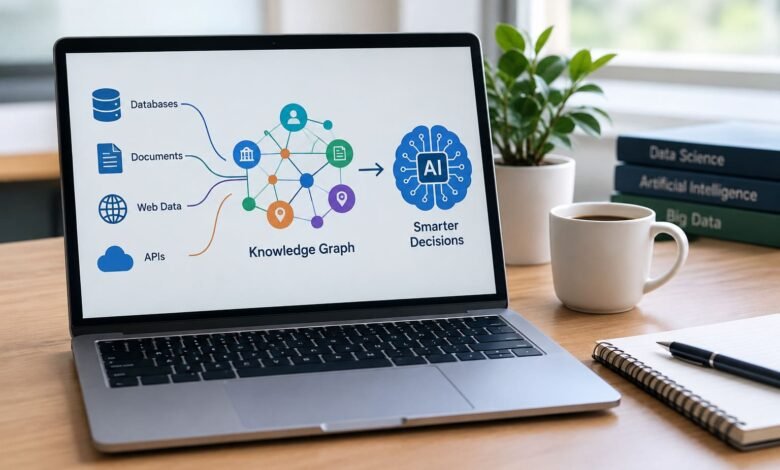
This is where knowledge graphs are becoming increasingly important. A knowledge graph connects people, products, organizations, events, documents, and other entities through meaningful relationships. When combined with AI, these connections can help systems understand not only individual pieces of information but also how those pieces relate to one another.
In 2026, knowledge graphs are gaining attention as organizations look for more reliable ways to provide AI systems with structured, contextual information. Current enterprise AI approaches increasingly combine knowledge graphs with semantic models, retrieval systems, and AI agents to improve context and reasoning.
What Is a Knowledge Graph?
A knowledge graph is a structured way of representing information as connected entities and relationships.
For example, consider a simple technology company database. Instead of storing information only as separate records, a knowledge graph could connect:
- A customer to the company they work for
- A company to its products
- A product to its suppliers
- A supplier to its contracts
- A contract to specific requirements
- A requirement to relevant regulations
These connections create a network of information that AI systems can explore.
A traditional database can answer a direct question such as “Who purchased this product?” A knowledge graph can support more relationship-based questions, such as “Which customers could be affected if this supplier has a disruption?”
The difference is context.
Why AI Needs Connected Data
Modern AI models can process enormous amounts of information, but they do not automatically understand every relationship inside an organization’s data.
Enterprise information is usually distributed across multiple systems. Customer information may exist in a CRM, product information in another database, support conversations in a ticketing system, and company policies in documents.
This fragmentation creates a challenge for AI.
An AI application may retrieve individual pieces of information without fully understanding how those pieces connect. Knowledge graphs provide an additional structure that explicitly represents these relationships.
Current enterprise AI research and implementations increasingly focus on this contextual layer because reliable AI depends on more than simply giving a model access to large amounts of data.
How Knowledge Graphs Work With AI
The relationship between AI and a knowledge graph can be understood through a simple process.
1. Data Is Collected
Information can come from databases, applications, documents, APIs, websites, customer records, and other sources.
2. Important Entities Are Identified
The system identifies important objects such as customers, products, employees, locations, organizations, technologies, and events.
3. Relationships Are Created
The system then establishes relationships between those entities.
For example:
Customer → purchased → Product
Product → manufactured by → Company
Company → located in → Country
Product → depends on → Component
4. AI Uses the Connected Information
An AI system can then retrieve or traverse these relationships when answering questions, generating insights, or supporting automated workflows.
This gives AI a richer representation of the information it is working with.
Knowledge Graphs and Generative AI
Generative AI has increased interest in knowledge graphs because large language models can sometimes produce convincing answers without having complete business context.
Knowledge graphs can provide structured information that helps ground AI responses.
One important architecture is GraphRAG, where graph-based information is combined with retrieval-augmented generation. Instead of relying only on similarity-based document retrieval, the system can use relationships between entities to retrieve relevant context.
For example, imagine an employee asking:
“Which products could be affected by the supplier issue reported this week?”
A basic search system may find documents mentioning the supplier.
A graph-based system can follow relationships such as:
Supplier → Components → Products → Customers
That connected path can provide a broader context for the AI system.
Current enterprise AI architectures increasingly view vector retrieval and knowledge graphs as complementary rather than mutually exclusive technologies.
Knowledge Graphs vs. Traditional Databases
Knowledge graphs do not necessarily replace traditional databases.
Instead, they solve a different problem.
A relational database is excellent for structured records, transactions, reporting, and predefined queries. Knowledge graphs are particularly useful when relationships between entities are central to the question.
For example:
| Traditional Database | Knowledge Graph |
|---|---|
| Stores structured records | Represents entities and relationships |
| Strong for transactions | Strong for connected information |
| Uses tables and joins | Uses graph relationships |
| Works well with predefined structures | Useful for relationship-oriented exploration |
| Excellent for operational data | Useful for contextual AI applications |
In many modern architectures, organizations can use databases, data warehouses, vector databases, and knowledge graphs together rather than choosing only one.
Key Benefits of Knowledge Graphs for AI
Better Context
Knowledge graphs show AI how information is connected. This can make retrieved information more meaningful.
Improved Data Discovery
Connected relationships can help users and AI systems discover information that may not be obvious from individual documents or records.
Relationship-Based Reasoning
Some business questions require multiple steps of reasoning. Graph structures are naturally suited to navigating those connections.
Greater Explainability
When information is connected to identifiable entities and sources, organizations can build clearer paths for understanding where an AI response came from.
More Consistent Enterprise Knowledge
A shared representation of business concepts can help different teams and systems use common definitions.
Support for AI Agents
AI agents increasingly need access to business context before taking actions. Knowledge graphs can provide information about entities, relationships, rules, and dependencies that agents may need during a workflow. Gartner’s September 2026 Data & Analytics Summit session specifically highlights knowledge graphs, ontologies, and semantics as components for building context-aware AI agents.
Real-World Applications of Knowledge Graphs and AI
Knowledge graphs can support a wide range of technology applications.
Customer Experience
Businesses can connect customer profiles, interactions, purchases, products, support requests, and preferences.
AI can use these relationships to provide more contextual customer support and recommendations.
Fraud Detection
Financial organizations can connect accounts, transactions, devices, locations, and individuals.
Unusual relationships or transaction patterns can then become easier to identify.
Healthcare
Knowledge graphs can connect patients, conditions, treatments, medications, medical research, and healthcare providers.
AI applications can use these connections to organize complex medical information, although healthcare deployments require appropriate privacy, security, validation, and governance.
Cybersecurity
Security teams can connect users, devices, applications, vulnerabilities, alerts, and incidents.
This can help analysts investigate how different security events are related.
Supply Chain Management
Companies can map suppliers, components, warehouses, products, transportation routes, and customers.
If one component becomes unavailable, connected data can help identify potentially affected products and operations.
Enterprise Search
Knowledge graphs can make enterprise search more context-aware by connecting people, content, organizational information, and relationships. Google Cloud, for example, documents knowledge graph capabilities for improving entity recognition, context understanding, personalization, and search results across enterprise information.
Knowledge Graphs and AI Agents
The growth of AI agents makes connected information even more important.
An AI agent may need to perform several steps instead of simply answering a question. It might retrieve information, evaluate conditions, select an action, and interact with another system.
To do this reliably, the agent needs context.
For example, an AI procurement agent could need to understand:
Supplier → Contract → Product → Delivery Schedule → Customer Order
Without those connections, the agent may see individual records but struggle to understand the larger situation.
A knowledge graph can provide a structured representation of these relationships, while other AI components can handle language understanding, retrieval, planning, and execution.
This combination is one reason knowledge graphs are increasingly being discussed alongside agentic AI architectures.
The Role of Ontologies and Semantic Layers
A knowledge graph becomes more useful when organizations have a clear understanding of what their data means.
This is where ontologies and semantic layers become important.
An ontology defines concepts and relationships within a particular domain. For example, a technology company might define:
- Customer
- Product
- Subscription
- Employee
- Supplier
- Contract
It can also define how these concepts relate to each other.
A semantic layer provides consistent meaning across different data sources.
Together, these structures can help AI systems interpret enterprise information more consistently rather than treating every database field or document as isolated data.
KPMG’s 2026 discussion of knowledge engineering similarly emphasizes consistent definitions, machine-readable context, relationships, and governance as important foundations for scalable AI.
Challenges of Building a Knowledge Graph
Knowledge graphs offer significant potential, but they are not a shortcut to better AI.
Data Quality
Incorrect source data can create incorrect relationships. Poor-quality graph data can therefore affect downstream AI results.
Entity Resolution
The same entity may appear under different names across systems.
For example:
IBM
International Business Machines
A graph system may need to determine that these references represent the same organization.
Integration Complexity
Organizations often have information distributed across legacy applications, cloud platforms, databases, documents, and APIs.
Connecting these sources can require substantial engineering work.
Governance
Organizations need to understand who owns the data, where it came from, how it can be used, and how changes are tracked.
Maintenance
A knowledge graph is not a one-time project. Business relationships, products, policies, customers, and technologies change over time.
The graph therefore needs processes for updating and validating information.
How Businesses Can Start With Knowledge Graphs
Organizations do not necessarily need to build a massive enterprise graph from day one.
A practical approach is to begin with one well-defined business problem.
Step 1: Select a Specific Use Case
Choose a problem where relationships matter.
Examples include:
- Enterprise search
- Customer 360
- Fraud investigation
- Supply chain analysis
- IT dependency mapping
- Product recommendations
- AI assistants
Step 2: Identify Important Data Sources
Determine which databases, applications, documents, and APIs contain the required information.
Step 3: Define Core Entities
Decide which objects need to exist in the graph.
Step 4: Map Relationships
Document how those entities are connected.
Step 5: Add Governance
Define ownership, permissions, data quality rules, and update processes.
Step 6: Connect AI
Once the graph provides useful structured context, it can be connected to search systems, RAG pipelines, LLM applications, or AI agents.
This incremental approach can make a knowledge graph project easier to test and improve.
The Future of Knowledge Graphs and AI
AI is moving beyond simple question answering toward systems that can understand context, coordinate tasks, and support complex workflows.
That shift increases the importance of connected information.
Knowledge graphs are unlikely to be the only technology used in future AI architectures. Instead, they are likely to work alongside relational databases, data warehouses, vector databases, semantic layers, APIs, and AI models.
The important change is the way organizations think about data.
Instead of asking only:
“Where is the information?”
AI systems increasingly need to answer:
“What does this information mean, how is it connected, and why does that relationship matter?”
Knowledge graphs provide one way to represent that context.
As AI becomes more deeply integrated into business operations, connected and governed data can become an important foundation for building systems that are more contextual, traceable, and useful.
Conclusion
Knowledge graphs bring structure and relationships to information that might otherwise remain fragmented across multiple systems.
When combined with AI, they can help applications move beyond retrieving isolated facts toward understanding connected context. This can support enterprise search, recommendations, cybersecurity, supply chain analysis, customer experiences, AI agents, and other data-intensive applications.
The real value of a knowledge graph is not simply the graph itself. It is the ability to turn disconnected information into a connected representation of knowledge.
For organizations building smarter AI systems, that connection between data, context, relationships, and intelligence is becoming increasingly important.
Frequently Asked Questions
What is a knowledge graph in AI?
A knowledge graph connects data entities and their relationships, helping AI systems understand information with greater context.
How do knowledge graphs improve AI systems?
Knowledge graphs provide connected and structured information that can help AI systems retrieve relevant data, understand relationships, and generate more contextual results.
What is the difference between a knowledge graph and a database?
A database mainly stores structured records, while a knowledge graph focuses on the connections and relationships between different entities and pieces of information.
What is GraphRAG?
GraphRAG combines knowledge graphs with retrieval-augmented generation to help AI systems use connected information and broader context when producing responses.