Robotic Swarms: How Hundreds of Simple Machines Could Work as One

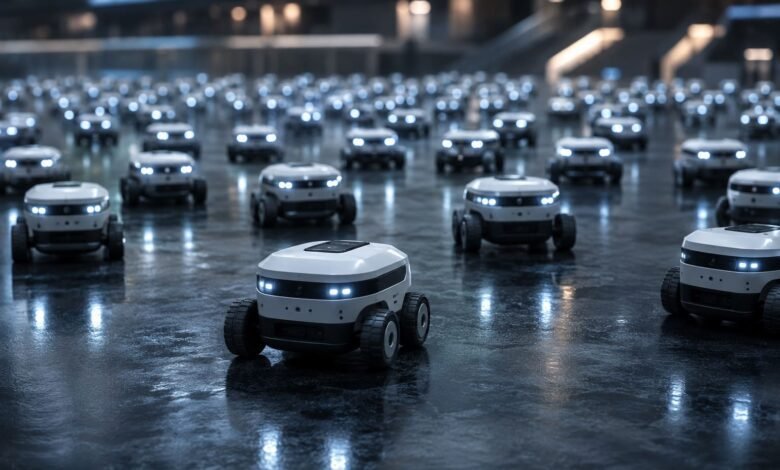
Imagine hundreds of small robots entering an environment where no single machine knows the entire situation. Instead of waiting for one central computer to tell every robot what to do, the machines communicate locally, respond to their surroundings, divide tasks, and continuously adjust their behavior.
Individually, each robot may have limited capabilities. Together, however, they can behave like a coordinated system.
This is the central idea behind swarm robotics.
Swarm robotics combines autonomous machines, distributed computing, sensing, communication, and collective decision-making. Rather than building one extremely sophisticated robot, engineers can create groups of simpler machines that cooperate to accomplish a larger objective.
The concept is inspired by natural systems such as ants searching for food, bees coordinating around a hive, and fish moving collectively to avoid threats. In robotic systems, similar principles can be translated into algorithms that allow machines to coordinate without depending entirely on a central controller.
The technology is moving from laboratory experiments toward increasingly sophisticated applications in exploration, inspection, logistics, environmental monitoring, and space missions.
What Is Swarm Robotics?
Swarm robotics is a field of robotics in which multiple autonomous robots work together to accomplish a shared objective.
The important difference between a robotic swarm and a collection of ordinary robots is how the machines coordinate.
A conventional multi-robot system may rely heavily on a central controller that knows the position and status of every machine. A swarm can instead use decentralized coordination, where individual robots make decisions based on local information and interactions with nearby robots.
This approach creates a system in which there may be no single robot acting as the permanent leader.
If one robot fails, the remaining robots can potentially continue the mission.
That makes swarm robotics particularly attractive for environments where failure is expected, communication is difficult, or the operating area is too large for one machine.
How Can Simple Robots Work Together?
A swarm does not require every robot to understand the entire mission.
Instead, robots can follow relatively simple rules.
For example, an individual robot might be programmed to:
- Avoid collisions
- Maintain a safe distance from neighbors
- Move toward a detected target
- Share information with nearby robots
- Follow a formation
- Search an unexplored area
- Return information to the group
- Take another robot’s place when necessary
When hundreds of robots follow these rules simultaneously, complex collective behavior can emerge.
This is known as emergent behavior.
The surprising part is that sophisticated group behavior does not necessarily require every individual machine to be sophisticated.
Centralized Robots vs Robotic Swarms
The difference becomes easier to understand through a simple comparison.
A centralized robotic system might work like this:
Central computer → assigns task → Robot 1, Robot 2, Robot 3 → report back
A decentralized swarm can work more like this:
Robot ↔ Robot ↔ Robot ↔ Robot
Each machine exchanges relevant information with nearby members and adjusts its actions.
This distributed approach can provide several advantages.
If communication with a central controller is interrupted, the swarm may still retain some ability to operate.
If one robot stops working, other robots can potentially continue.
If the environment changes, the group can redistribute its activities.
IEEE describes swarm robotics as a field built around groups of relatively simple robots that collectively perform tasks that may be too complex or geographically distributed for one machine.
The Intelligence Is in the Interaction
One of the most interesting aspects of swarm robotics is that intelligence does not have to exist entirely inside one robot.
It can emerge from interaction between robots.
Consider a search mission.
A single robot entering a large unknown area has limited coverage. Hundreds of robots can spread out, explore different regions, share discoveries, and adjust their positions based on what the group learns.
One robot finding something important can influence the behavior of nearby robots.
The group therefore becomes a distributed information-processing system.
This changes the way engineers think about robotics.
Instead of asking:
“How intelligent can we make one robot?”
the question becomes:
“How effectively can many robots cooperate?”
Communication Is the Foundation of a Swarm
Robots need some method of exchanging information.
Depending on the environment, communication may involve:
- Radio
- Wi-Fi
- Bluetooth
- Mesh networks
- Optical communication
- Short-range peer-to-peer links
- Specialized wireless protocols
The goal is not necessarily for every robot to communicate directly with every other robot.
That would become increasingly difficult as the swarm grows.
Instead, robots can communicate with nearby members and allow information to propagate through the group.
This creates a distributed network where local interactions can eventually produce global coordination.
Task Allocation Without a Permanent Leader
A major challenge is deciding which robot should perform which task.
Suppose a swarm is inspecting a damaged industrial facility.
Hundreds of robots may need to examine:
- Pipes
- Walls
- Machines
- Electrical systems
- Structural components
A centralized system could assign each robot a fixed location.
A swarm can potentially distribute tasks dynamically.
If one area requires more inspection, additional robots can move there.
If a robot fails, another can take over.
If a section has already been inspected, robots can move toward unexplored areas.
This creates a system capable of dynamic task allocation.
Why Hundreds of Small Robots Can Be Useful
A large robot can carry sophisticated sensors and powerful computing hardware, but it can also be expensive and difficult to replace.
A swarm takes a different approach.
Instead of putting every capability into every robot, engineers can build many relatively simple units.
The advantages can include:
Scalability
Additional robots can potentially be added to increase coverage or capacity.
Redundancy
The failure of one robot does not necessarily end the mission.
Distributed Coverage
Large areas can be explored simultaneously.
Flexibility
Robots can reorganize when environmental conditions change.
Lower Individual Cost
A simple robot may be cheaper to manufacture than one highly complex autonomous machine.
However, the overall swarm is not automatically inexpensive. Communication infrastructure, coordination software, testing, maintenance, and fleet management can become significant costs.
Swarm Robotics in Space Exploration
Space exploration is one of the most compelling applications for robotic swarms.
Sending one extremely capable robot to another world creates a single point of failure.
A group of smaller robots could potentially distribute exploration, mapping, sensing, and inspection tasks across a larger area.
NASA’s research provides several examples of this direction.
NASA’s Starling mission uses four CubeSats to test technologies for cooperative spacecraft operating as a synchronized group without continuous ground resources.
NASA has also been developing distributed spacecraft autonomy, where multiple spacecraft can make decisions collaboratively rather than relying entirely on individual ground commands. Tests have explored swarm scalability and autonomous coordination for future lunar applications.
This matters because communication delays become increasingly important as spacecraft travel farther from Earth.
A swarm that can make appropriate local decisions could reduce the need for constant human intervention.
Lunar Exploration With Multiple Robots
NASA’s JPL has also worked on CADRE, a concept involving multiple small autonomous lunar rovers.
The robots are designed to communicate, navigate, perceive their surroundings, and make cooperative decisions while exploring the lunar surface.
Instead of sending one rover to perform every task, multiple machines can work together to generate maps and conduct distributed measurements.
The broader idea is powerful:
future exploration missions may send teams of robots instead of relying on a single robotic explorer.
Swarms Could Also Build Things in Space
Swarm robotics is not limited to exploration.
NASA has been investigating autonomous robot swarms for lunar-orbit servicing and space-asset assembly. The concept includes small robots working together for inspection, assembly, maintenance, and potentially in-space manufacturing.
This opens an interesting possibility.
Instead of launching a fully assembled structure from Earth, future missions could potentially transport smaller components and use autonomous robotic systems to assemble or maintain them in space.
That would change how large space infrastructure is designed.
Microrobotic Swarms
Swarm robotics is also moving toward extremely small machines.
Research published in Nature Machine Intelligence in June 2026 examined autonomous navigation of intelligent microrobotic swarms in unknown environments. The work demonstrates how collective and reconfigurable behavior can support navigation and targeted tasks at very small scales.
At this scale, the concept becomes especially interesting for applications where individual robots are too small to carry sophisticated equipment.
Instead, the swarm itself becomes the useful system.
Potential areas include:
- Targeted delivery research
- Microscopic inspection
- Environmental sensing
- Biomedical research
- Complex-space exploration
These applications remain an active research area, and many are not yet ready for routine real-world deployment.
Agriculture Could Benefit From Robot Swarms
Agriculture contains large areas that are difficult to monitor continuously.
Instead of relying entirely on large agricultural machines, future systems could use fleets of small autonomous robots to inspect crops.
Different robots could monitor:
- Plant health
- Soil conditions
- Moisture
- Crop growth
- Weed presence
- Pest activity
The swarm could create a distributed picture of field conditions.
A farmer would then receive information about where attention is actually needed rather than treating an entire field uniformly.
This could support more targeted use of water, fertilizer, and crop-protection resources.
Search and Rescue
Natural disasters create environments that are dangerous and unpredictable for humans.
After an earthquake or structural collapse, sending one large robot into unstable areas may not provide sufficient coverage.
Small robots could potentially enter different sections of a damaged environment simultaneously.
A swarm could search for:
- Survivors
- Heat signatures
- Structural hazards
- Accessible routes
- Gas leaks
- Damaged infrastructure
If some robots become trapped or fail, others could continue operating.
NASA’s earlier swarm robotics research also identified search-and-rescue and infrastructure inspection as possible terrestrial applications for small cooperative robots.
Industrial Inspection
Large industrial facilities can contain kilometers of pipes, cables, tanks, tunnels, and machinery.
Inspecting every component manually is time-consuming.
A swarm could distribute inspection tasks among many machines.
For example:
Robot 1–20: inspect pipelines
Robot 21–40: inspect structural surfaces
Robot 41–60: monitor temperature
Robot 61–80: investigate detected anomalies
The important benefit is not simply having more robots.
It is the ability to adapt the distribution of robots according to what they discover.
Underwater Robotic Swarms
Oceans are another environment where swarm robotics could be valuable.
Underwater robots can be used for:
- Mapping
- Environmental monitoring
- Infrastructure inspection
- Marine research
- Pollution detection
- Seabed surveys
Communication underwater is difficult compared with ordinary wireless environments, making decentralized coordination particularly interesting.
A swarm that can maintain useful behavior with limited communication could operate more effectively than a system that constantly depends on a central controller.
What Happens When a Robot Fails?
This is one of the strongest arguments for swarm architectures.
Imagine a fleet of 500 robots.
If one robot stops working, the entire system does not necessarily stop.
The remaining robots can potentially adjust their formation, redistribute tasks, or continue with reduced capacity.
This property is known as fault tolerance.
It does not mean swarms are immune to failures.
A damaged communication network, software bug, power problem, or common hardware defect can affect many robots simultaneously.
Therefore, swarm resilience depends on the system’s ability to avoid common points of failure.
The Biggest Challenge: Coordination at Scale
Building ten robots that cooperate is one problem.
Building ten thousand robots that cooperate reliably is a much harder one.
As swarm size increases, engineers must deal with:
- Communication congestion
- Collision avoidance
- Conflicting decisions
- Limited battery life
- Sensor uncertainty
- Network failures
- Computational limitations
- Hardware differences
- Security threats
- Complex testing requirements
A coordination strategy that works for 20 robots may not work efficiently for 2,000.
Scalability is therefore one of the central research challenges in swarm robotics.
What If the Robots Make the Same Mistake?
Decentralization creates resilience, but it can also create new risks.
If every robot receives the same incorrect information or follows a flawed algorithm, the entire swarm could make the same mistake.
This is why swarm systems need mechanisms for:
- Local verification
- Anomaly detection
- Fault isolation
- Redundant sensing
- Safe behavior
- Recovery procedures
The objective is not merely to make robots autonomous.
It is to make them reliably autonomous.
Security Becomes a Swarm-Level Problem
A single compromised robot is a security problem.
A compromised robot inside a swarm could become something much more serious.
An attacker might attempt to:
- Inject false information
- Disrupt communication
- Manipulate task allocation
- Impersonate another robot
- Cause unsafe movement
- Spread malicious software
Because robots influence one another, a cyberattack could potentially propagate through the network.
Future swarm systems will therefore require strong identity management, secure communication, authenticated software updates, and mechanisms for isolating suspicious agents.
The Role of Artificial Intelligence
AI can make swarm robotics considerably more adaptive.
Machine-learning systems can potentially help robots:
- Recognize objects
- Understand environments
- Predict obstacles
- Optimize routes
- Learn from previous missions
- Detect unusual behavior
- Improve task allocation
However, AI does not replace swarm coordination.
The most effective systems may combine AI with traditional distributed algorithms.
For example, an AI model could identify an object while a distributed coordination algorithm determines which robot should investigate it.
This combination creates a system where individual intelligence and collective intelligence complement each other.
From Fixed Rules to Adaptive Swarms
Early swarm concepts often depended heavily on predefined rules.
Modern research is increasingly exploring learning-based approaches.
Nature’s 2026 collection on intelligent swarm robotics highlights the growing intersection of swarm robotics, machine learning, and intelligent adaptive systems.
This could lead to robots that do more than follow fixed instructions.
They may learn how to:
- Navigate unfamiliar environments
- Adapt their formations
- Improve collaboration
- Respond to changing conditions
- Optimize resource usage
The challenge is ensuring that learning systems remain predictable and safe when deployed in physical environments.
Are Robotic Swarms Ready for Everyday Use?
Not completely.
Many impressive swarm demonstrations remain research projects or controlled experiments.
Real-world deployment requires much more than demonstrating that robots can move together.
Engineers must prove that systems can operate reliably despite:
- Weather
- Hardware failures
- Communication loss
- Unexpected obstacles
- Battery limitations
- Cyberattacks
- Manufacturing differences
- Sensor errors
The gap between a successful laboratory demonstration and a dependable commercial swarm can therefore be substantial.
What the Future Could Look Like
The long-term potential of swarm robotics is not simply about putting more robots into the same environment.
It is about changing the architecture of autonomous systems.
Instead of:
One powerful robot → One mission
we could increasingly see:
Many specialized robots → One collective mission
This model could support exploration of difficult environments, continuous infrastructure monitoring, precision agriculture, disaster response, space construction, and microscopic medical technologies.
The most important shift is conceptual.
A swarm does not need every robot to be highly intelligent.
It needs the overall system to be capable of intelligent behavior.
Conclusion
Robotic swarms represent a fundamentally different approach to automation.
Rather than concentrating intelligence, sensing, and physical capability into one expensive machine, swarm systems distribute these capabilities across many smaller agents.
When coordination works effectively, simple robots can collectively perform tasks that would be difficult, expensive, or risky for a single machine.
NASA’s spacecraft and lunar robotics research demonstrates that distributed autonomy is becoming increasingly relevant to future space missions, while recent microrobotics research shows that swarm principles are also being explored at extremely small scales.
The biggest opportunity may therefore not be building the world’s smartest robot.
It may be building systems in which hundreds or thousands of ordinary robots can cooperate intelligently.
That is the real promise of swarm robotics: not one machine doing everything, but many machines accomplishing something together that none of them could achieve alone.
Frequently Asked Questions
What are robotic swarms?
Robotic swarms are groups of autonomous robots that cooperate to accomplish a shared objective. Instead of depending on one central machine to control every action, individual robots can use local information, communication, sensors, and predefined or learned behaviors to coordinate with nearby robots. Together, the group can perform tasks that may be difficult for a single robot.
How do robotic swarms work together?
Robotic swarms typically work through decentralized coordination. Each robot observes its surroundings, communicates relevant information, and adjusts its behavior according to the situation and the actions of nearby robots. When many robots follow these coordination rules simultaneously, collective behavior can emerge without requiring one robot to control the entire group.
What is the main advantage of swarm robotics?
The major advantage of swarm robotics is that a mission can be distributed across many machines instead of depending on a single complex robot. This can provide scalability, redundancy, wider area coverage, and greater resilience to individual failures. If one robot stops working, the rest of the swarm may be able to continue the mission or redistribute its tasks.
Do robotic swarms need a central controller?
Not necessarily. One of the defining characteristics of swarm robotics is decentralized decision-making, where robots can coordinate through local interactions. Some practical systems may still use centralized infrastructure for supervision, mission planning, or data collection, but the robots themselves can retain a degree of autonomous coordination.