Artificial intelligence is often associated with enormous data centers, powerful GPUs, and cloud-based models that process requests remotely. But a different direction is rapidly gaining momentum: smaller AI models running directly on phones, laptops, industrial devices, vehicles, sensors, and other edge hardware.
This approach is commonly described as on-device AI or Edge AI. Instead of sending every request to a remote server, an application can perform selected AI tasks locally, reducing dependence on continuous cloud connectivity.
The change is important because AI is moving closer to where data is created.
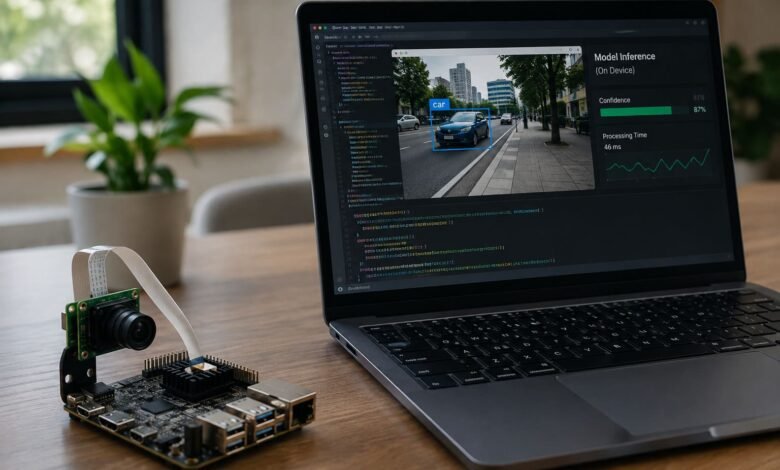
A camera can analyze an image locally. A laptop can summarize text without sending the document to a remote service. A sensor can detect an abnormal machine condition without waiting for a cloud response. A browser can use a small language model for writing assistance directly on the user’s computer.
The result is a new model of computing: intelligence does not always need to live in the cloud.
What Are Small AI Models?
Small AI models are machine-learning models designed to perform useful tasks with significantly fewer computational and memory requirements than large general-purpose models.
In language applications, they are often called Small Language Models (SLMs).
Instead of attempting to perform every possible AI task, a small model can be optimized for a particular purpose, such as:
- Text classification
- Summarization
- Writing assistance
- Sentiment analysis
- Speech processing
- Image recognition
- Object detection
- Recommendation
- Device control
- Document analysis
- Simple reasoning
- Local automation
The important idea is not simply making an AI model smaller.
The real objective is to achieve an appropriate balance between accuracy, latency, memory consumption, energy usage, and hardware requirements.
A model that is slightly less capable than a massive cloud model may be a better engineering choice if it can respond instantly, work offline, protect sensitive information, and operate on inexpensive hardware.
Why Move AI From the Cloud to the Edge?
Cloud AI remains extremely useful, particularly for complex workloads. However, sending every AI request to a remote server introduces practical limitations.
1. Lower Latency
When an AI request travels to a remote data center, the application must wait for communication, processing, and response transmission.
Local inference removes much of that network dependency.
This can be particularly valuable for applications where milliseconds matter, including:
- Industrial monitoring
- Robotics
- Driver-assistance systems
- Smart cameras
- Interactive devices
- Real-time speech processing
For these applications, local processing can provide a more predictable response.
2. Better Privacy
One of the strongest arguments for on-device AI is data control.
If sensitive information can be processed locally, it does not necessarily need to leave the device.
For example, local AI could process:
- Personal documents
- Voice commands
- Private messages
- Images
- Business information
- Device telemetry
- Internal application data
Microsoft’s current Edge developer work demonstrates this direction. Its experimental on-device APIs use small models locally, with Microsoft highlighting privacy, offline operation, and reduced network dependence as benefits.
Local processing does not automatically make an AI application secure, but it can reduce the amount of sensitive information that needs to be transmitted externally.
3. Offline Intelligence
A cloud-dependent application can become less useful when connectivity is unavailable.
On-device models can continue performing supported tasks without an active internet connection.
This is particularly valuable in:
- Remote locations
- Transportation
- Manufacturing facilities
- Field operations
- Emergency environments
- Airplane or underground environments
- Areas with unreliable connectivity
The AI does not necessarily need to stop simply because the network does.
4. Reduced Cloud Dependency
Running frequently used AI functions locally can reduce the number of requests sent to cloud inference services.
That can potentially lower:
- API consumption
- Network traffic
- Cloud inference costs
- Backend infrastructure requirements
However, local AI is not automatically cheaper in every situation. Organizations still need to consider device upgrades, model distribution, maintenance, testing, energy consumption, and hardware acceleration.
How Do Small Models Become Small Enough?
Modern AI models can be compressed and optimized using several techniques.
Quantization
Quantization reduces the numerical precision used to represent model parameters.
For example, a model may move from higher-precision representations toward formats such as INT8 or lower-bit representations.
The objective is to reduce:
- Memory requirements
- Storage requirements
- Computational workload
- Energy consumption
without causing unacceptable degradation in output quality.
Quantization is particularly important when a model must operate on hardware with limited memory.
Knowledge Distillation
Knowledge distillation allows a smaller model, often called the student, to learn from a larger and more capable teacher model.
Instead of trying to reproduce the entire architecture of the larger model, the smaller model learns useful patterns from it.
This creates an interesting possibility:
A large model can act as a teacher while a compact model performs the actual task on the edge.
Pruning
Pruning removes parameters or structures that contribute relatively little to a model’s performance.
A carefully optimized model can therefore require fewer computational resources while maintaining acceptable accuracy.
Architecture Optimization
Developers can also design models specifically for resource-constrained environments.
Rather than taking a massive model and simply shrinking it, engineers can build architectures optimized for:
- Mobile processors
- NPUs
- GPUs
- CPUs
- Microcontrollers
- Edge accelerators
This distinction is important because efficient AI is increasingly becoming a model-design problem as much as a hardware problem.
The Hardware Behind Edge AI
Small AI models still require computing resources.
Modern devices increasingly include hardware designed to accelerate machine-learning workloads.
Examples include:
- Mobile NPUs
- Integrated AI accelerators
- Edge GPUs
- AI-enabled CPUs
- Embedded processors
- Microcontrollers
- Dedicated inference accelerators
The hardware landscape is also expanding beyond smartphones and computers.
Researchers and developers are exploring ways to execute increasingly capable models on highly constrained devices. In one recent example, a developer demonstrated a very small language model running locally on an ESP32-S3 microcontroller, showing how aggressively optimized models can push AI toward extremely low-cost hardware. The experiment remains limited in capability, but it illustrates how far on-device inference can potentially extend.
Small Models Are Not Just Smaller Versions of Large Models
It is tempting to think of an SLM as simply a weaker LLM.
That is not always the right way to evaluate it.
A small model can actually be better suited to a specific application.
Consider a factory sensor that needs to determine whether a machine is behaving normally.
It does not need an AI system capable of writing essays, generating software, or solving complex mathematical problems.
It needs to answer one question reliably:
Is the machine operating normally?
A specialized model designed for that task may be faster, cheaper, and easier to deploy than a general-purpose model.
This creates a broader principle:
The best AI model is not necessarily the largest model. It is the model that fits the job.
On-Device AI Is Becoming More Capable
The technology is moving beyond simple classification.
Google AI Edge has demonstrated on-device small language models supporting capabilities such as multimodal input, retrieval-augmented generation and function calling. Its 2026 work also demonstrates local agentic workflows using Gemma models on laptops.
This means edge AI is gradually moving toward applications that can:
- Understand information
- Retrieve relevant local information
- Generate responses
- Interpret multiple types of input
- Perform selected actions
The important development is not that every edge device will suddenly run a huge AI model.
Instead, more AI capabilities are being decomposed into smaller workloads that can be executed close to the user or data source.
Edge AI and the Hybrid Model
The future is unlikely to be completely cloud-based or completely device-based.
A more realistic architecture is hybrid AI.
In this approach:
Device → Small Model → Local Decision
and, when necessary:
Device → Cloud → Large Model → Advanced Response
For example, a smartphone could first use a local model to determine whether a request is simple.
If it can solve the task locally, the request never leaves the device.
If the task requires more advanced reasoning, the application can send it to a larger cloud model.
This creates a model-routing architecture in which different models handle different levels of complexity.
A Simple Example
Imagine an AI assistant on a laptop.
Task 1: Fix a spelling mistake
→ Local model
Task 2: Summarize a short document
→ Local model
Task 3: Search local files and answer a question
→ Local model + local retrieval
Task 4: Perform complex research across multiple external sources
→ Cloud model
This approach can reduce unnecessary cloud calls while preserving access to powerful models when they are genuinely needed.
New Challenges Created by Small AI Models
On-device AI is promising, but it introduces its own engineering problems.
Limited Hardware
Edge devices have less memory and computing capacity than large AI data centers.
Developers must carefully optimize:
- Model size
- Inference speed
- Memory usage
- Storage
- Battery consumption
Accuracy vs Efficiency
Compression can reduce model size, but excessive optimization can affect quality.
The goal is therefore not:
“Make the model as small as possible.”
The goal is:
“Make the model as small as possible while maintaining the required quality.”
Device Fragmentation
Cloud applications can often run on standardized server infrastructure.
Edge applications must deal with thousands of hardware configurations.
Different devices may have different:
- CPUs
- GPUs
- NPUs
- Memory capacities
- Operating systems
- Power constraints
Testing therefore becomes considerably more complicated.
Model Updates
A cloud model can be updated centrally.
An on-device model may need to be distributed across millions of devices.
Organizations must consider:
- Version management
- Secure model delivery
- Rollbacks
- Compatibility
- Update frequency
- Storage requirements
This makes AI model lifecycle management an important part of edge deployment.
Security Considerations
Keeping AI local can improve privacy, but it does not eliminate security risks.
An attacker who gains access to a device could potentially inspect, modify, or replace local model files.
Organizations therefore need to consider:
- Secure model storage
- Hardware-backed security
- Signed model updates
- Device authentication
- Runtime integrity
- Access controls
- Model tampering detection
There is also a new question:
What happens when the AI itself becomes part of the device’s control system?
For example, if a local AI model controls an industrial machine, a wrong prediction could have physical consequences.
This makes testing and safety more important than simply measuring benchmark accuracy.
Where Small AI Models Could Have the Biggest Impact
Smartphones
Local AI can support writing, translation, image processing, voice features and personal assistance without sending every interaction to the cloud.
Personal Computers
Browsers and desktop applications can use local models for writing assistance, summarization, search and productivity.
Microsoft is already experimenting with built-in small language models in Edge, including models intended to operate on devices with more limited GPU capabilities.
Industrial Systems
Factories can use local AI for anomaly detection, quality inspection and predictive monitoring.
Healthcare Devices
Local processing could be useful when latency and privacy are important, although medical applications require rigorous validation and regulatory controls.
Vehicles
Vehicles can process selected sensor information locally, reducing dependence on remote connectivity for time-sensitive functions.
Smart Cameras
Instead of continuously sending video to a remote server, cameras can identify relevant events locally and transmit only selected information.
IoT Devices
TinyML and other lightweight AI approaches can bring intelligence to sensors and embedded systems with very limited computational resources.
What This Means for AI Developers
The rise of small models changes how developers think about AI applications.
Instead of beginning with:
“Which giant AI model should we call?”
developers increasingly need to ask:
“Which part of this workload actually needs a large model?”
That question can lead to a more efficient architecture.
A developer might use:
- A tiny model for classification
- An SLM for text processing
- A local retrieval system for private documents
- A cloud model for complex reasoning
- Traditional software for deterministic operations
The result is not one AI model doing everything.
It is an AI system composed of specialized components.
The Future: Intelligence Everywhere
The most important development in edge AI is not simply that models are getting smaller.
It is that intelligence is becoming distributed.
AI can increasingly exist:
- Inside browsers
- Inside smartphones
- Inside laptops
- Inside vehicles
- Inside cameras
- Inside industrial equipment
- Inside sensors
- Inside embedded systems
This could fundamentally change the architecture of AI applications.
Instead of sending all data to a centralized AI service, future systems may divide intelligence between devices, edge servers and cloud infrastructure.
The cloud will remain essential for large-scale training and demanding inference.
But it may no longer be the only place where useful AI happens.
Final Thoughts
Small AI models represent an important shift in the evolution of artificial intelligence.
The question is no longer simply how large an AI model can become. It is increasingly about how much useful intelligence can be delivered within the limitations of a real device.
Better quantization, distillation, specialized architectures, AI accelerators and local inference runtimes are making this possible.
At the same time, developments from Google, Microsoft and the broader AI ecosystem show that on-device models are moving beyond basic recognition toward language, multimodal processing, retrieval and selected agentic capabilities.
The likely future is therefore not “cloud AI versus edge AI.”
It is cloud + edge + device AI working together.
And as models become more efficient, the boundary between an ordinary device and an intelligent computing system may become increasingly difficult to see.
Frequently Asked Questions
1. What are small AI models at the edge?
Small AI models at the edge are compact artificial intelligence models designed to run directly on devices such as smartphones, laptops, cameras, sensors, vehicles, and industrial machines. Instead of sending every request to a remote cloud server, these models can process specific AI tasks locally, making applications faster, more private, and less dependent on internet connectivity.
2. Can small AI models work without cloud connectivity?
Yes, many small AI models can operate without a continuous internet connection when the model and required runtime are installed on the device. This allows applications to perform supported tasks in offline or low-connectivity environments. However, some features may still require cloud services when an application needs external information, large-scale processing, or a more powerful AI model.
3. What is the main advantage of running AI on an edge device?
The biggest advantage is that AI processing can happen closer to where the data is generated. Local inference can reduce network latency, limit unnecessary data transfers, support offline functionality, and potentially reduce dependence on cloud inference services. These benefits are particularly useful for applications that require quick responses or handle sensitive information.
4. Are small AI models less accurate than large AI models?
Small AI models can have fewer capabilities than large general-purpose models, but smaller size does not automatically mean poor performance. A model designed and optimized for a specific task can perform extremely well within its intended environment. The right comparison should therefore consider task accuracy, response time, memory requirements, energy consumption, and hardware limitations rather than model size alone.