The way businesses work has changed dramatically. Employees can work from almost anywhere, important files are stored online, and many companies rely on cloud applications for everyday operations. While this flexibility makes business faster and more convenient, it also creates new security challenges.
For years, companies mainly relied on traditional security methods such as firewalls, antivirus software, VPNs, and protected office networks. These tools are still useful, but today’s digital environment requires a broader approach.
This is where cloud web security comes into the picture.
But how is cloud web security different from traditional security? And does moving to the cloud mean businesses should abandon their existing security systems?
Let’s take a closer look.
What Is Traditional Security?
Traditional security is built around the idea of protecting a company’s internal network and physical infrastructure.
In a typical traditional setup, a business may have its own servers, computers, networking equipment, firewall, and data center. Security teams create a boundary around these resources and control what enters and leaves the network.
Some common traditional security tools include:
- Firewalls
- Antivirus and anti-malware software
- VPNs
- Network monitoring
- Physical security controls
- Endpoint protection
- Intrusion detection systems
- Network segmentation
This model worked particularly well when employees mainly worked from company offices and most business applications were hosted on internal servers.
The problem is that modern businesses don’t always work that way anymore.
What Is Cloud Web Security?
Cloud web security is designed to protect websites, web applications, cloud services, users, and data that operate through internet-connected environments.
Instead of depending entirely on a company’s physical network, cloud security uses technologies that can protect resources regardless of where users or applications are located.
Depending on the organization, this may include:
- Web application firewalls
- Secure web gateways
- Identity and access management
- Multi-factor authentication
- Zero Trust security
- Cloud workload protection
- API security
- Data loss prevention
- Cloud security monitoring
The focus is not simply on whether someone is connected to the company network. Security policies can also consider the user’s identity, device, location, application, permissions, and behavior.
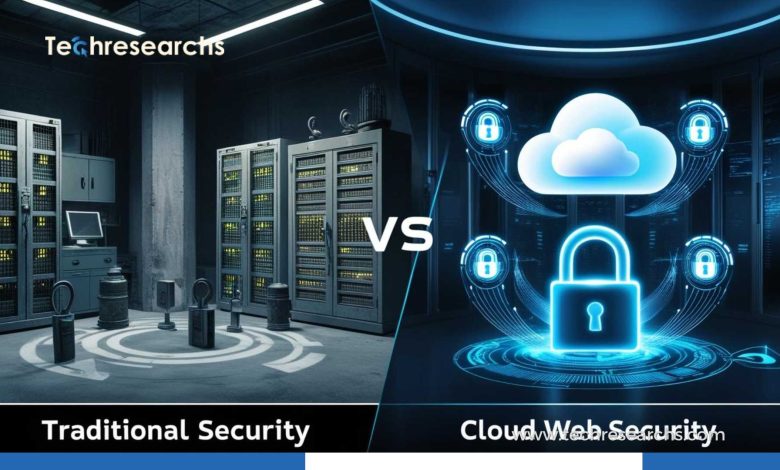
Cloud Web Security vs. Traditional Security
The biggest difference between the two approaches is how they define trust.
Traditional security often places significant emphasis on the network perimeter. Cloud web security takes a more distributed approach and puts greater emphasis on identity, access, applications, and data.
| Area | Traditional Security | Cloud Web Security |
|---|---|---|
| Main focus | Internal networks and infrastructure | Cloud, web applications, users, and data |
| Security boundary | Corporate network | Identity, applications, devices, and policies |
| Infrastructure | Mainly on-premises | Cloud, hybrid, and distributed |
| Remote workers | Often VPN-dependent | Identity and application-based access |
| Scaling | May require additional hardware | Generally more flexible |
| Access control | Network and user-based | Identity, context, and policy-based |
| Management | Often locally managed | Frequently centralized through cloud services |
| Monitoring | Primarily internal infrastructure | Cloud, web, identity, endpoint, and application activity |
Neither approach is automatically better in every situation. The right choice depends on the company’s infrastructure, applications, employees, compliance requirements, and security risks.
Why Traditional Security Still Matters
It can be tempting to assume that traditional security is outdated because businesses are moving to the cloud. That’s not really the case.
Firewalls, endpoint protection, network segmentation, and other traditional controls still play an important role.
For example, a manufacturing company may have industrial systems that cannot simply be moved to the cloud. A business may also have older applications that depend on local servers.
In these situations, traditional security can provide an important layer of protection.
The real challenge is making those traditional controls work alongside newer cloud technologies.
Why Cloud Web Security Has Become Important
Cloud services have changed the way organizations store information and run applications.
An employee might start the day using a cloud-based CRM, access a company document from a browser, join a video meeting, and later use another SaaS application—all without connecting to a traditional corporate network.
That creates a very different security environment.
Cloud web security helps organizations protect these activities without depending entirely on one physical location.
Remote Work
Remote employees are one of the biggest reasons companies are reconsidering traditional security models.
When workers connect from different locations and devices, creating a secure perimeter around the office network becomes less practical.
Modern security approaches can verify users and devices before allowing access to specific resources.
Cloud Applications
Businesses increasingly depend on services hosted by cloud providers.
Security teams therefore need visibility into cloud applications, accounts, permissions, data transfers, and unusual activity.
Internet-Facing Applications
Websites and online applications are exposed to threats that can originate from anywhere on the internet.
Web application firewalls and other security technologies can help organizations detect and block suspicious traffic.
The Role of Zero Trust
One of the most important ideas in modern cloud security is Zero Trust.
The basic concept is straightforward: don’t automatically trust a user or device simply because it has successfully connected to a network.
Instead, access should be evaluated using factors such as:
- Who the user is
- What resource they are requesting
- Whether the device is trusted
- What permissions they have
- Whether the activity looks unusual
- What security policies apply
This approach is particularly useful when employees, applications, and data are spread across multiple environments.
Cloud Security Is Not Completely Automatic
Moving information to the cloud doesn’t automatically make it secure.
In fact, cloud environments can introduce their own risks.
Common problems include:
- Incorrect cloud configurations
- Excessive permissions
- Stolen login credentials
- Weak passwords
- Unprotected APIs
- Outdated software
- Poor monitoring
- Inadequate backup strategies
- Third-party security issues
This is why organizations need clear security policies and trained security teams.
Cloud providers typically protect the underlying infrastructure they operate, but customers still have responsibilities for their own accounts, applications, data, permissions, and configurations. The exact responsibilities depend on the service being used.
Which Approach Is More Secure?
There isn’t a simple answer.
Traditional security can be extremely effective when an organization has controlled infrastructure and strong network boundaries.
Cloud web security can be more suitable for businesses that depend heavily on cloud applications, remote workers, web services, and distributed infrastructure.
In practice, many companies don’t choose one or the other.
They use both.
Why a Hybrid Security Strategy Makes Sense
A hybrid approach combines traditional security controls with modern cloud technologies.
For example, a company might use:
- Firewalls for internal networks
- Endpoint protection for employee devices
- Network segmentation for sensitive systems
- Multi-factor authentication for accounts
- Identity management for cloud applications
- Web application firewalls for public websites
- Cloud monitoring for hosted workloads
- Data protection tools for sensitive information
This approach allows businesses to protect older infrastructure while also adapting to newer technologies.
How to Improve Cloud Web Security
Businesses don’t need to implement every security product available. A better approach is to start with the basics and build from there.
Use Multi-Factor Authentication
Passwords can be stolen through phishing, malware, data breaches, or social engineering. Multi-factor authentication adds another verification step and can significantly strengthen account security.
Follow the Principle of Least Privilege
Employees shouldn’t automatically have access to every system.
Give users only the permissions they need to perform their jobs, and review those permissions regularly.
Keep Systems Updated
Security vulnerabilities can remain open when software and applications aren’t patched. Regular updates should therefore be part of normal security operations.
Monitor User Activity
Unusual login locations, unexpected downloads, strange API requests, or sudden permission changes can sometimes indicate an attack.
Monitoring helps security teams investigate these warning signs.
Protect APIs
APIs connect applications, services, and data. If an API is poorly secured, attackers may find a way to access information or functionality they shouldn’t have.
API authentication, authorization, rate limiting, and monitoring should therefore be considered part of a broader cloud security strategy.
Maintain Reliable Backups
Even strong security controls cannot guarantee that an incident will never happen.
Regular and properly protected backups can make recovery much easier after ransomware, accidental deletion, system failures, or other incidents.
What Should Businesses Choose?
The answer depends on how the business operates.
A company that relies heavily on physical servers and an internal office network may still need strong traditional security controls.
A company built around SaaS applications, cloud infrastructure, remote employees, and public-facing websites may need a stronger cloud-focused security strategy.
For many modern businesses, however, the most practical solution is a combination of both.
The goal isn’t to choose the newest technology simply because it’s new. The goal is to build security around the actual risks the organization faces.
The Future of Cloud and Web Security
The traditional idea of a secure company network surrounded by a single protective wall is becoming less realistic.
Employees may work remotely. Applications may run across multiple cloud platforms. Customers may access services through public websites and APIs. Data may move between several systems within seconds.
Security therefore needs to follow the users, applications, devices, and data.
This is why areas such as Zero Trust, identity security, cloud monitoring, endpoint protection, API security, and automated threat detection are becoming increasingly important.
Artificial intelligence is also changing cybersecurity. Security teams can use AI-assisted technologies to analyze large amounts of activity and identify suspicious patterns more quickly. At the same time, attackers are using automation and AI to create more sophisticated threats, so organizations need to keep improving their defenses.
Final Thoughts
Cloud web security and traditional security are not competing ideas where one must completely replace the other.
Traditional security remains valuable for protecting networks, endpoints, servers, and physical infrastructure. Cloud web security extends protection into environments where applications, users, and data are no longer tied to one location.
For many businesses, the strongest strategy is a layered one: combine established security controls with cloud protection, strong identity management, multi-factor authentication, least-privilege access, continuous monitoring, and Zero Trust principles.
As technology continues to change, the most effective security strategy will be one that can adapt with it.
Frequently Asked Questions
1. What is the difference between cloud web security and traditional security?
Traditional security mainly protects on-premises networks, servers, and devices, while cloud web security focuses on protecting cloud applications, websites, users, APIs, and data across internet-connected environments.
2. Is cloud web security better than traditional security?
Not necessarily. Both approaches have their strengths. Cloud web security is well suited to remote work and cloud-based applications, while traditional security remains useful for on-premises systems. Many businesses benefit from combining both.
3. What are the main benefits of cloud web security?
Cloud web security can provide flexible protection for remote users, cloud applications, websites, and data. It can also support identity-based access controls, centralized monitoring, multi-factor authentication, and scalable security services.
4. Can businesses use cloud and traditional security together?
Yes. A hybrid security strategy allows businesses to protect on-premises infrastructure with traditional controls while using cloud-based security tools for applications, remote users, APIs, and cloud workloads.