Technology is changing quickly, and artificial intelligence (AI) has become one of the biggest forces behind that change. From customer service and marketing to finance and software development, businesses are finding new ways to use AI to get work done faster.
But that does not mean traditional software has become outdated.
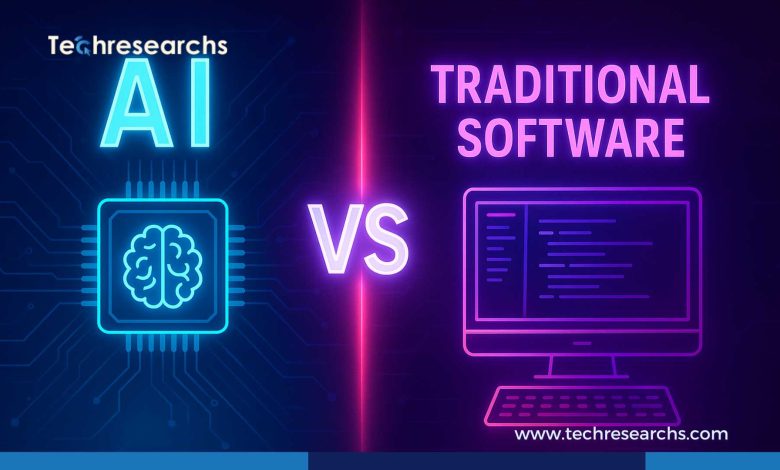
For decades, conventional software has powered everything from banking systems to inventory management. AI is now adding a new layer of intelligence to many of those systems. So, when it comes to business performance, AI vs traditional software is not necessarily a battle with one clear winner.
The better question is: Which technology is right for the job?
What Is Traditional Software?
Traditional software is built around predefined instructions. Developers create rules and workflows, and the application follows them whenever a user performs a particular action.
Think about an online billing system. If a customer purchases three products, the software calculates the price, adds the applicable tax, applies a discount if necessary, and generates an invoice. It does not need to “learn” how to calculate the total.
This approach works extremely well when the process is structured and predictable.
Common examples include:
- Accounting applications
- Payroll systems
- Inventory software
- Banking applications
- Word-processing programs
- Enterprise resource planning (ERP) systems
- Customer relationship management (CRM) platforms
Traditional software is still the backbone of many organizations because it is dependable, predictable, and relatively easy to control.
What Makes AI Software Different?
AI-powered software takes a different approach. Instead of relying only on fixed instructions, AI systems can analyze information, recognize patterns, generate content, make predictions, and respond to changing inputs.
For example, a traditional customer-support system might send a customer to a specific page when they select a particular option. An AI-powered assistant can understand a customer’s question, interpret its meaning, and provide a response based on available information.
AI can be particularly useful when the information being processed is complicated or doesn’t follow a predictable structure.
Examples include:
- AI assistants and chatbots
- Recommendation systems
- Predictive analytics
- Image and speech recognition
- Fraud detection
- AI writing tools
- Automated data analysis
- Intelligent search
AI vs Traditional Software: What Is the Main Difference?
The biggest difference comes down to how the software handles information and decisions.
Traditional software generally follows rules created by developers. AI software can identify patterns and produce outputs based on data and trained models.
Imagine a retail company trying to predict which products customers might purchase next.
A traditional system could use a set of predefined rules, such as recommending products that were frequently purchased together.
An AI system could analyze purchasing behavior, browsing activity, product interactions, seasonal trends, and other available data to identify more complicated patterns.
Neither approach is automatically better. The difference is in the type of problem each one is designed to solve.
Where Traditional Software Still Has the Advantage
AI receives a lot of attention, but traditional software continues to have major advantages.
Predictable Performance
When a business needs the same calculation or process to happen consistently, traditional software is often the safer choice.
A payroll application, for example, needs to calculate salaries according to defined rules. Businesses generally don’t want a system experimenting with the calculation.
Easier Control
Traditional applications typically operate according to clearly defined logic. Developers and administrators can determine exactly how specific workflows should behave.
This can be particularly useful for processes involving strict business rules.
Lower Complexity for Simple Jobs
Not every problem requires AI.
If a company simply needs software to calculate invoices or organize records, adding an AI system may create unnecessary complexity.
Sometimes the simplest technology is the most effective solution.
Easier Troubleshooting
When traditional software produces an incorrect result, developers can usually trace the problem back to a specific rule, function, or piece of code.
That level of predictability can make troubleshooting easier.
Where AI Has the Upper Hand
AI becomes more attractive when the problem is difficult to solve with fixed rules.
Processing Large Amounts of Data
Modern organizations generate huge amounts of information. AI can help analyze large datasets and identify patterns that might otherwise go unnoticed.
For example, an AI system could examine customer behavior to identify signs that a customer may stop using a service.
Understanding Natural Language
Traditional software generally requires structured commands or inputs.
AI can understand everyday language, making it possible for users to interact with software through conversational questions.
Instead of searching through multiple menus, an employee could ask:
“Which products performed best last quarter, and why?”
An AI-powered system could potentially analyze the available information and provide a useful summary.
Personalization
AI can help businesses create more personalized experiences.
Online retailers, streaming platforms, and digital services can use customer behavior and preferences to recommend products, content, or services that are more relevant to individual users.
Automation of Complex Tasks
Traditional automation works best when the steps are clearly defined.
AI can expand automation into tasks involving text classification, document analysis, summarization, prediction, and other activities that previously required more human involvement.
Which Technology Is More Cost-Effective?
Cost is one of the biggest factors businesses consider when adopting new technology.
Traditional software can have predictable development and maintenance costs. AI systems may introduce additional expenses related to data preparation, model usage, computing resources, integration, monitoring, and security.
However, AI can also reduce costs by automating repetitive work and helping employees complete certain tasks more quickly.
The important thing is to measure the business value, rather than assuming that AI will always be cheaper.
For a simple task, traditional software may provide better value.
For a complex process that requires hours of manual analysis, AI could potentially deliver a much stronger return.
What About Accuracy?
Accuracy is another area where the two approaches differ.
Traditional software can be extremely precise when the rules are correctly designed and the inputs are known.
AI systems can be highly capable, but their outputs can sometimes be incorrect or inconsistent. This is particularly important with generative AI, where systems may produce convincing information that still needs verification.
For that reason, businesses should not treat AI output as automatically correct.
Human review, testing, monitoring, and appropriate safeguards remain important, especially when AI is used for financial, legal, medical, security, or other high-impact decisions.
Security and Privacy Should Not Be Ignored
Both traditional and AI-based applications need strong security.
Traditional software can face risks such as unauthorized access, malware, software vulnerabilities, and data breaches.
AI systems introduce additional considerations, including the handling of training data, sensitive information, model access, prompt-based attacks, and potentially incorrect outputs.
Organizations should therefore evaluate:
- What information the system can access
- Where data is stored
- Who can use the system
- How information is protected
- How outputs are monitored
- What happens when the system makes a mistake
Choosing AI simply because it is newer is not a good security strategy.
Why the Best Answer May Be Both
One of the biggest misconceptions about AI is that businesses must replace their existing software to benefit from it.
In reality, AI can work alongside traditional applications.
For example, a company could continue using its existing CRM system to store customer information while adding an AI layer that summarizes customer conversations, identifies sales opportunities, or helps employees find relevant information.
In this setup, traditional software provides the reliable foundation, while AI adds intelligence and automation.
This hybrid approach can be especially practical for organizations that already have significant investments in existing technology.
When Should a Business Choose Traditional Software?
Traditional software may be the better option when:
- The process follows clear rules.
- Predictability is essential.
- The task requires precise calculations.
- Data is structured.
- AI would add unnecessary complexity.
- The workflow rarely changes.
For these situations, a conventional application can often deliver excellent results without the additional requirements of an AI system.
When Should a Business Consider AI?
AI may be worth considering when:
- Large datasets need to be analyzed.
- The task involves unstructured information.
- Predictions or recommendations are required.
- Employees spend significant time on repetitive knowledge work.
- Customers need conversational support.
- Personalization is important.
- The business needs to process text, images, audio, or other complex data.
The key is to start with the business problem rather than the technology.
The Future of Software Is Likely to Be Hybrid
AI is transforming software, but traditional applications are not disappearing.
Instead, the two technologies are increasingly being combined.
Traditional software can manage structured operations, databases, transactions, permissions, and business rules. AI can add capabilities such as prediction, natural-language interaction, intelligent search, recommendations, and content generation.
This combination can give businesses the best of both worlds: the reliability of conventional software and the adaptability of AI.
Final Verdict: AI or Traditional Software?
So, which drives better results?
There is no universal answer.
Traditional software is usually the stronger choice for predictable, rule-based, and highly controlled processes. AI is more valuable when businesses need pattern recognition, prediction, personalization, or intelligent automation.
Instead of asking which technology is better overall, businesses should ask which technology can solve a specific problem most effectively.
In many cases, the answer will be both.
The companies that get the most value from AI will not necessarily be the ones that replace everything with AI. They will be the ones that understand where AI genuinely adds value – and combine it with dependable software where traditional approaches still work best.
Frequently Asked Questions
1. What is the difference between AI and traditional software?
Traditional software follows predefined rules and instructions, while AI-powered software can analyze data, recognize patterns, generate responses, and handle changing inputs.
2. Is AI better than traditional software?
AI is not always better. Traditional software is often more effective for predictable, rule-based tasks, while AI is useful for complex analysis, prediction, personalization, and automation.
3. When should a business use AI instead of traditional software?
Businesses can consider AI when they need to analyze large datasets, identify patterns, make predictions, understand natural language, or automate complex tasks.
4. Can AI and traditional software work together?
Yes. Businesses can combine both technologies. Traditional software can manage structured processes and business rules, while AI can add intelligent analysis, recommendations, and automation.