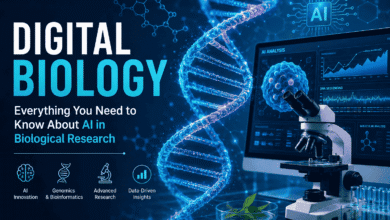
Artificial intelligence (AI) is rapidly transforming biotechnology by helping researchers analyze complex biological data, accelerate discoveries, and develop more precise solutions across healthcare, agriculture, pharmaceuticals, and industrial biotechnology. By combining machine learning, advanced data analysis, automation, and biological science, AI is opening new possibilities that were difficult or impossible to achieve using traditional approaches alone.
What Is AI in Biotechnology?
AI in biotechnology refers to the use of artificial intelligence technologies to understand biological systems, analyze large datasets, predict outcomes, and support research and development.
Biological research produces enormous amounts of information from areas such as genomics, proteomics, medical imaging, clinical studies, and molecular research. AI can process these datasets much faster than traditional manual methods and identify patterns that may not be obvious to researchers.
Machine learning models can be trained to recognize relationships between biological characteristics and outcomes, helping scientists make better-informed decisions.
How AI Is Transforming Biotechnology
1. Drug Discovery and Development
Drug discovery traditionally requires years of research, testing, and validation. AI can help shorten parts of this process by analyzing molecular structures, predicting how compounds may interact with biological targets, and identifying promising candidates.
AI-based systems can assist researchers with:
- Identifying potential drug candidates
- Predicting molecular interactions
- Screening large compound libraries
- Estimating potential toxicity
- Optimizing molecular structures
This can help researchers prioritize the most promising candidates before moving to laboratory testing.
2. Genomics and Personalized Medicine
Genomic datasets are extremely complex and contain information that can help researchers understand diseases and biological traits. AI can analyze genomic sequences and identify patterns associated with specific conditions.
In personalized medicine, AI can potentially help researchers determine how individuals may respond differently to particular treatments. This could support more targeted approaches to diagnosis, treatment selection, and disease management.
3. Protein Structure and Protein Engineering
Understanding protein structures is essential for areas such as drug development, enzyme engineering, and disease research.
AI models can predict protein structures and analyze relationships between protein sequences and their functions. These capabilities can help scientists investigate biological mechanisms and design proteins with desired characteristics.
The result could be faster progress in areas such as therapeutic protein development, industrial enzymes, and biotechnology research.
4. Medical Imaging and Diagnostics
AI-powered image analysis is becoming increasingly important in biotechnology and healthcare research.
Machine learning models can analyze medical images and identify patterns that may help researchers and clinicians detect abnormalities. Applications include the analysis of tissue samples, radiological images, microscopy images, and other biological data.
AI does not eliminate the need for expert review, but it can provide additional analytical support and help process large numbers of images efficiently.
5. Agricultural Biotechnology
AI is also creating opportunities beyond healthcare. In agricultural biotechnology, AI can analyze crop data, environmental conditions, genetic information, and plant characteristics.
Potential applications include:
- Crop disease detection
- Plant breeding
- Yield prediction
- Precision agriculture
- Soil and environmental analysis
- Development of climate-resilient crops
Combining AI with biotechnology could support more efficient and sustainable agricultural production.
6. Synthetic Biology
Synthetic biology involves designing or modifying biological systems for useful purposes. AI can assist scientists in designing biological sequences, predicting biological behavior, and selecting promising designs for laboratory testing.
This combination of AI and synthetic biology could contribute to advances in areas such as bio-based materials, engineered microorganisms, sustainable chemicals, and therapeutic development.
Benefits of AI in Biotechnology
AI can provide several important advantages to biotechnology organizations and research teams.
Faster Research
AI can analyze massive datasets quickly, allowing researchers to move from data collection to potential discoveries more efficiently.
Improved Accuracy
Well-designed AI systems can identify complex patterns and reduce certain forms of manual analytical error.
Lower Research Costs
By helping researchers prioritize promising experiments and candidates, AI may reduce unnecessary laboratory work and resource consumption.
Better Predictions
AI models can help predict molecular behavior, biological interactions, disease-related patterns, and other outcomes before experimental validation.
Automation
AI can work alongside laboratory automation systems to support repetitive research tasks and improve experimental workflows.
Challenges of Using AI in Biotechnology
Despite its potential, AI-powered biotechnology also presents important challenges.
Data Quality
AI systems depend heavily on the quality and diversity of their training data. Incomplete, biased, or inconsistent biological datasets can lead to unreliable results.
Interpretability
Some advanced AI models operate as complex systems that can be difficult to interpret. Researchers need to understand why a model produces a particular prediction, especially when the result influences scientific or medical decisions.
Privacy and Security
Genomic and health-related datasets can contain highly sensitive information. Organizations must use appropriate security, governance, and privacy practices when collecting and processing such data.
Experimental Validation
An AI prediction is not automatically a scientific discovery. Laboratory experiments and other forms of validation remain essential for confirming whether an AI-generated hypothesis is biologically accurate.
Ethical Considerations
AI-driven biotechnology raises questions about responsible data use, genetic information, ownership of biological discoveries, and the appropriate limits of automated decision-making.
The Future of AI in Biotechnology
The relationship between AI and biotechnology is likely to become increasingly important as biological datasets grow and computational technologies improve.
Future developments could include AI-assisted drug design, automated laboratories, more sophisticated protein engineering, faster genomic analysis, and increasingly personalized biological therapies.
The most valuable progress will likely come from collaboration between AI specialists, biologists, chemists, medical researchers, data scientists, and regulatory experts. AI is not a replacement for biological experimentation; instead, it can serve as a powerful tool for helping researchers determine what to investigate and how to investigate it more efficiently.
Conclusion
Artificial intelligence is unlocking new possibilities across biotechnology by improving data analysis, accelerating research, supporting drug discovery, advancing genomics, and enabling new approaches to biological design.
As AI models become more capable and biotechnology generates increasingly complex datasets, the integration of these fields could reshape how scientists understand biology and develop new products and therapies. However, responsible data management, scientific validation, transparency, and ethical oversight will remain essential for turning AI’s potential into reliable real-world outcomes.
Frequently Asked Questions (FAQ)
1. What is artificial intelligence in biotechnology?
Artificial intelligence in biotechnology refers to using AI and machine learning to analyze biological data, predict outcomes, accelerate research, and support applications such as drug discovery, genomics, and protein engineering.
2. How is AI used in biotechnology?
AI is used for drug discovery, genomic analysis, protein structure prediction, medical imaging, disease research, agricultural biotechnology, synthetic biology, and laboratory automation.
3. How does AI improve drug discovery?
AI can analyze large chemical and biological datasets, identify promising drug candidates, predict molecular interactions, and help researchers prioritize compounds for laboratory testing.
4. Can AI help with personalized medicine?
Yes. AI can analyze genomic, clinical, and other biological information to identify patterns that may help researchers develop more personalized approaches to diagnosis and treatment.