Artificial intelligence has changed incredibly quickly over the past few years. What once felt like futuristic technology is now part of everyday life. We use AI to write emails, analyze information, create images, develop software, automate business tasks, and even support scientific research.
But 2026 is bringing a different kind of change.
AI is gradually moving beyond simple chatbots and question-and-answer tools. New systems are becoming better at understanding different types of information, completing tasks, working with software, and making decisions based on a user’s goals.
For businesses, developers, researchers, and everyday users, this could make 2026 one of the most interesting years in the development of artificial intelligence.
Let’s look at the AI developments that are worth watching.
AI Is Moving From Answers to Actions
For a long time, using AI meant asking a question and receiving an answer. That model is changing.
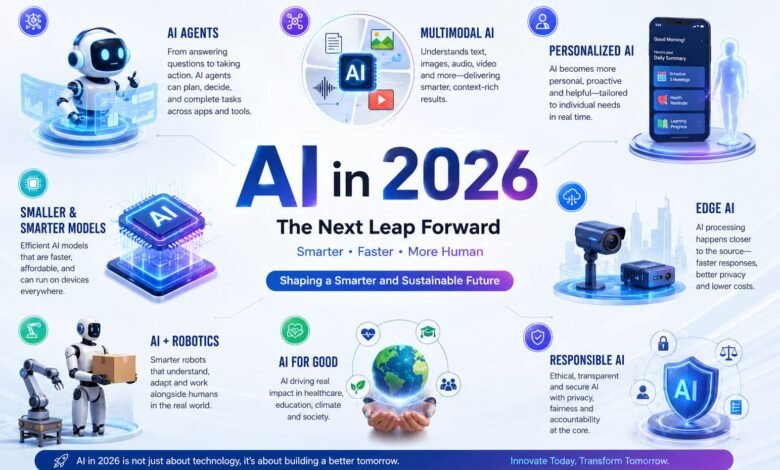
One of the biggest developments in 2026 is agentic AI. AI agents are designed to do more than generate text. They can break larger objectives into smaller steps, use digital tools, gather information, and complete parts of a workflow.
For example, instead of asking an AI tool to write a report, a user could ask it to research a topic, organize the findings, compare information, create a draft, and prepare the final report.
That doesn’t mean humans disappear from the process. In many situations, people will still need to review important decisions and approve sensitive actions. The difference is that AI can take care of more of the repetitive work.
AI Agents Could Change the Way We Work
The rise of AI agents could have a major impact on office and business workflows.
Think about a typical marketing team. Employees may have to move between analytics platforms, spreadsheets, CRM software, email, project-management tools, and content systems every day.
An AI agent could potentially connect these activities into a single workflow.
For example, an employee might give an instruction such as:
“Find out why website leads dropped this month and prepare a summary of the main problems.”
An AI system could potentially collect analytics data, compare it with previous periods, identify unusual changes, and prepare a report.
The real value isn’t simply that AI can produce a report. It is that AI can potentially handle several steps required to create it.
Multimodal AI Will Become More Useful
AI is no longer limited to text.
Modern AI systems can increasingly understand combinations of text, images, audio, video, documents, and other forms of information.
This is known as multimodal AI.
Imagine uploading a product photograph, a customer complaint, and a short video showing a problem. Instead of analyzing each item separately, a multimodal AI system could examine all of them together and provide a combined explanation.
This could be useful in industries such as customer service, education, healthcare, manufacturing, marketing, and software development.
The more types of information AI can understand, the more naturally it can fit into everyday workflows.
Smaller AI Models Will Matter More
The biggest AI model isn’t necessarily the best choice for every job.
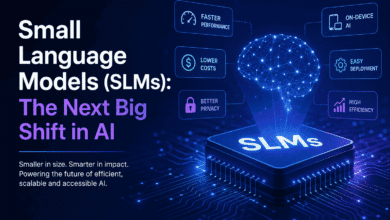
Businesses often need AI that is affordable, fast, private, and easy to deploy. That’s why small language models and efficient AI models are becoming increasingly important.
Smaller models can be used on laptops, smartphones, industrial equipment, cameras, and other edge devices.
This approach can reduce dependence on cloud processing and may also make certain AI applications faster.
For example, an industrial camera could use a local AI model to identify a manufacturing defect immediately instead of sending every image to a remote server.
Edge AI Could Make Devices Smarter
Edge AI means processing AI tasks closer to where the data is actually produced.
Instead of sending everything to a cloud data center, a device can perform some analysis locally.
This has several potential benefits:
- Faster responses
- Lower network usage
- Better privacy
- Reduced cloud costs
- Greater reliability when connectivity is limited
We could see more AI-powered capabilities built directly into smartphones, vehicles, security cameras, industrial machines, and smart devices throughout 2026.
AI and Robotics Are Coming Together
AI is also becoming more connected to the physical world.
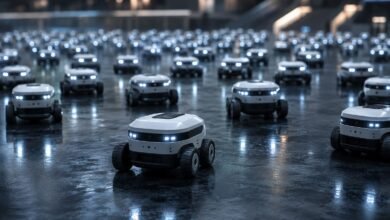
Robots have existed for decades, but traditional robots usually perform a limited set of carefully programmed movements. Newer AI-powered robots are being developed to understand their surroundings and respond to changing situations.
This is where AI and robotics become particularly interesting.
An intelligent robot could potentially recognize objects, understand spoken instructions, plan a sequence of actions, and adjust its behavior when something changes.
Applications could include:
- Warehouses
- Manufacturing plants
- Agriculture
- Healthcare facilities
- Logistics
- Inspection
- Construction
The technology is still developing, but the direction is clear: AI is increasingly being designed not just to understand the digital world, but also to interact with the physical one.
Humanoid Robots Will Get More Attention
Humanoid robots are one of the most visible areas of AI development.
Their human-like shape makes them potentially useful in environments already designed for people, such as factories, warehouses, offices, and homes.
However, it is important to separate demonstrations from everyday reality.
Humanoid robots still have difficult problems to solve. They need reliable movement, good battery life, accurate perception, safe interaction, and the ability to deal with unpredictable environments.
So while 2026 may bring impressive progress, widespread use of general-purpose humanoid robots will likely remain a gradual process.
AI Will Become a Bigger Part of Software Development
Software developers are already using AI for coding, debugging, testing, documentation, and code review.
In 2026, these capabilities are becoming more sophisticated.
AI coding tools can increasingly understand larger parts of a software project instead of focusing only on a single code snippet.
A developer might use AI to:
- Explain an unfamiliar codebase
- Generate a new feature
- Create automated tests
- Find possible bugs
- Refactor existing code
- Write documentation
- Review changes
This doesn’t make programming unnecessary.
Good software still requires people who understand architecture, security, user requirements, performance, and business goals.
Instead, AI can act more like an additional development partner that handles routine work while developers focus on more complicated decisions.
AI Could Speed Up Scientific Research
One of the most exciting uses of AI isn’t necessarily something consumers will see.
AI is increasingly being used in scientific research.
Researchers can use machine learning to examine large datasets, recognize patterns, simulate possibilities, and identify promising areas for further investigation.
Potential applications include:
- Drug discovery
- Protein research
- Materials science
- Climate research
- Astronomy
- Chemistry
- Biology
The advantage is simple: computers can process enormous amounts of information much faster than people can manually examine it.
AI doesn’t replace scientific expertise, but it can help researchers explore more possibilities in less time.
Healthcare Could Become More AI-Assisted
Healthcare is another area where AI could have a significant impact.
AI can help doctors and healthcare organizations analyze information, summarize records, support research, and identify patterns in complex datasets.
There is also growing interest in AI-assisted diagnostics and personalized healthcare.
However, healthcare is different from many consumer applications. A mistake can have serious consequences.
That means medical AI needs strong testing, clinical validation, privacy protection, and human oversight.
The goal should not be to let AI make every medical decision. Instead, AI can support professionals by helping them process information and identify useful insights.
AI Security Will Become More Important
As AI becomes more powerful, security becomes a bigger concern.
A chatbot that only generates text creates one type of risk. An AI agent that can access company systems, databases, email, or financial tools creates a very different level of risk.
Security teams will need to think about issues such as:
- Prompt injection
- Data leakage
- Unauthorized access
- Malicious instructions
- AI-generated phishing
- Deepfakes
- Automated cyberattacks
- Unsafe AI actions
Businesses will need to monitor what their AI systems can access and what actions they are allowed to perform.
In other words, AI security will increasingly become part of the broader cybersecurity strategy.
AI Governance Will Become a Business Requirement
The more organizations depend on AI, the more important governance becomes.
Companies need clear answers to questions such as:
Who is responsible when an AI system makes a mistake?
What information is the AI allowed to access?
When does a human need to approve an AI-generated decision?
How should AI activity be monitored?
These questions aren’t just technical.
They involve legal, ethical, operational, and business considerations.
Organizations that establish sensible AI policies early will have an easier time scaling AI safely.
AI Will Become Less Visible
One interesting change may be that people don’t always realize when they’re using AI.
Instead of opening a dedicated AI application, users may encounter AI inside tools they already use.
AI could become part of:
- Smartphones
- Search engines
- Office applications
- CRM platforms
- Customer-support systems
- Vehicles
- Cameras
- Smart-home devices
- Business software
This could make AI feel less like a separate technology and more like an invisible layer built into everyday products.
AI Infrastructure Will Become Increasingly Important
Behind every impressive AI application is a large infrastructure ecosystem.
AI needs computing power, storage, networking, data centers, specialized processors, and enormous amounts of electricity.
As AI adoption grows, infrastructure will become a major competitive factor.
Organizations will need to think about more than model performance. They will also need to consider:
- Computing costs
- Energy consumption
- Data security
- Model-serving speed
- Infrastructure availability
- Scalability
Efficient AI could become just as important as powerful AI.
What Does All This Mean for Businesses?
For businesses, 2026 shouldn’t simply be about adding AI because everyone else is doing it.
The better question is:
Where can AI solve a real business problem?
A company might use AI to reduce repetitive administrative work, improve customer support, analyze data, assist employees, or speed up software development.
The most successful implementations will probably start with a clear problem rather than a specific AI tool.
For example:
Instead of saying, “We need an AI chatbot,” a company could ask, “How can we reduce the time our support team spends answering repetitive questions?”
That shift in thinking can lead to much better AI strategies.
What Should Everyday Users Expect?
For regular users, AI may become more helpful without requiring technical knowledge.
AI could assist with:
- Planning
- Writing
- Research
- Learning
- Translation
- Scheduling
- Data analysis
- Software development
- Creative projects
The biggest change may be that users won’t always need to provide detailed instructions.
Instead of telling AI exactly how to complete every step, people may increasingly describe the result they want and let the system figure out the process.
AI Still Has Major Limitations
Despite all the excitement, AI is far from perfect.
AI systems can still produce incorrect information, misunderstand instructions, struggle with unusual situations, and behave unpredictably in certain environments.
There are also concerns around privacy, copyright, cybersecurity, employment, energy consumption, and responsible use.
That is why human judgment remains important.
The goal shouldn’t be to trust AI blindly. The goal should be to understand where AI works well, where it struggles, and where human expertise is still essential.
What Could Make 2026 Different?
Previous AI waves focused heavily on generating content.
The next stage is increasingly about using intelligence to complete tasks.
That’s a meaningful difference.
A system that writes a paragraph is useful.
A system that understands a goal, gathers information, uses several tools, completes a workflow, and asks for human approval when necessary could be much more valuable.
This is why AI agents, multimodal systems, robotics, edge AI, and AI-powered scientific research are attracting so much attention.
Final Thoughts
AI in 2026 is not simply about creating smarter chatbots.
It is about making artificial intelligence more useful, more connected, and more capable of taking action.
AI agents could automate complex workflows. Smaller models could bring intelligence to everyday devices. Robotics could give AI a physical presence. Multimodal systems could make human-computer interaction more natural. And AI-powered research could help scientists solve problems that were previously difficult to explore.
At the same time, security, privacy, governance, and human oversight will become increasingly important.
The most exciting part of AI’s future isn’t knowing exactly what will happen. It’s seeing how quickly the technology is evolving and discovering where it can genuinely improve the way we work and live.
2026 could be the year AI moves from being something we use occasionally to something that quietly works alongside us every day.
Frequently Asked Questions
1. How can AI agents automate tasks in 2026?
AI agents can connect with software tools, process information, follow multiple steps, and complete repetitive workflows with less manual input.
2. Will AI replace software developers in 2026?
AI can help developers write, test, debug, and review code, but human developers are still needed for architecture, security, decision-making, and complex problem-solving.
3. Why is edge AI important in 2026?
Edge AI allows devices to process information locally instead of sending everything to the cloud. This can improve response time, privacy, and efficiency.
4. What are the biggest challenges of AI in 2026?
Major challenges include inaccurate AI outputs, cybersecurity threats, privacy concerns, high infrastructure costs, regulation, and the need for effective human oversight.