Artificial intelligence has evolved rapidly over the past few years, with Large Language Models (LLMs) becoming the driving force behind chatbots, content creation, coding assistants, and enterprise automation. While these models have transformed industries, they also require significant computing power, memory, and operational costs.
As AI adoption continues to expand, businesses are looking for solutions that deliver intelligence without the high infrastructure demands of massive AI models. This is where Small Language Models (SLMs) are making a significant impact. Designed to be lightweight, efficient, and cost-effective, SLMs are quickly becoming one of the most important innovations in artificial intelligence.
In many real-world scenarios, organizations don’t need a model with hundreds of billions of parameters. Instead, they need an AI system that is fast, secure, affordable, and capable of performing specific tasks exceptionally well. Small Language Models provide exactly that balance.
In this guide, we’ll explore what Small Language Models are, how they work, their advantages, limitations, use cases, and why many experts believe they represent the next major shift in AI.
What Are Small Language Models (SLMs)?
Small Language Models (SLMs) are AI language models that contain significantly fewer parameters than Large Language Models while still performing many natural language processing tasks effectively.
Instead of attempting to solve every possible problem, SLMs are typically designed or fine-tuned for targeted applications such as:
- Customer support
- Document summarization
- Email generation
- Code completion
- Internal enterprise assistants
- Search assistance
- Mobile AI applications
- Edge computing
Because they are smaller, they require less computing power, lower memory, and faster inference times.
How Do Small Language Models Work?
Like larger AI models, SLMs are based on transformer architectures and are trained using massive collections of text data. However, developers optimise them using techniques such as:
- Knowledge distillation
- Parameter pruning
- Quantization
- Fine-tuning
- Domain-specific training
These optimisation methods allow SLMs to retain much of the language understanding of larger models while dramatically reducing computational requirements.
Instead of becoming “general experts,” SLMs become highly capable specialists.
Why Are Small Language Models Becoming Popular?
Businesses are shifting toward AI that delivers practical value rather than maximum model size.
Several trends are driving the adoption of SLMs:
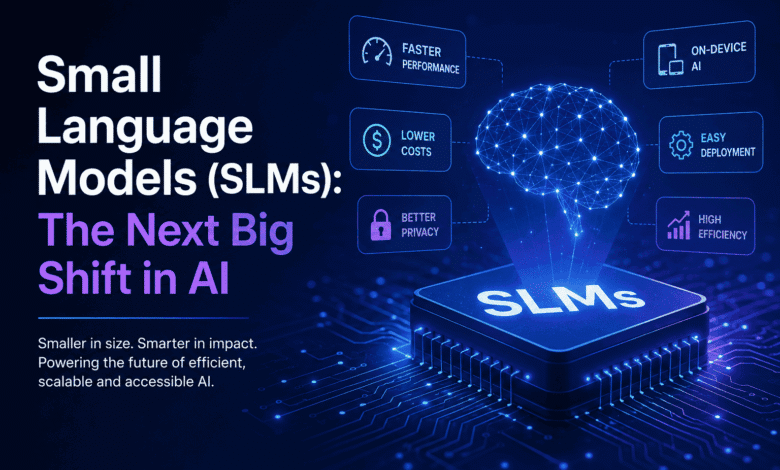
Lower Infrastructure Costs
Running large AI models often requires expensive GPUs and cloud infrastructure. SLMs reduce operational expenses, making AI accessible to organisations of all sizes.
Faster Response Times
Smaller models process information more quickly, providing near real-time responses for customer-facing applications.
Better Privacy
Many SLMs can run on local devices or private servers, reducing the need to send sensitive business data to external cloud services.
Improved Energy Efficiency
Lower computational requirements mean reduced electricity consumption, helping organisations lower both costs and environmental impact.
Easier Deployment
SLMs can be deployed across smartphones, laptops, IoT devices, and embedded systems where larger models would be impractical.
Small Language Models vs Large Language Models
| Feature | Small Language Models | Large Language Models |
|---|---|---|
| Model Size | Small | Very Large |
| Processing Speed | Faster | Slower |
| Hardware Requirements | Low | High |
| Deployment | Local and Cloud | Mostly Cloud |
| Operating Cost | Lower | Higher |
| Energy Consumption | Lower | Higher |
| General Knowledge | Moderate | Extensive |
| Customisation | Easier | More Complex |
Rather than replacing LLMs, SLMs complement them by handling specialised tasks efficiently while reducing costs.
Key Benefits of Small Language Models
1. Faster AI Applications
SLMs deliver responses quickly, making them ideal for live chat, customer support, and productivity tools.
2. Cost-Effective AI
Organisations can reduce cloud computing expenses without sacrificing performance for targeted tasks.
3. Enhanced Security
Running AI locally helps organisations keep confidential information within their own infrastructure.
4. Better Mobile Experiences
SLMs can operate directly on smartphones and tablets, enabling offline AI capabilities.
5. Easier Fine-Tuning
Smaller models are easier to customise for industries such as healthcare, finance, manufacturing, and education.
Real-World Applications of Small Language Models
Customer Support
Businesses deploy SLM-powered chatbots to answer FAQs, troubleshoot issues, and improve customer service.
Enterprise Knowledge Management
Employees can quickly search internal documentation and retrieve accurate information without relying on external AI services.
Healthcare
Medical organisations use specialised SLMs for summarising clinical notes, organising records, and supporting administrative workflows while maintaining privacy.
Finance
Financial institutions automate report generation, compliance documentation, and customer interactions using secure AI models.
Software Development
Developers use lightweight coding assistants for code suggestions, documentation, and debugging within local environments.
Education
Educational platforms provide personalised tutoring, language learning, and automated assessment using efficient AI systems.
Small Language Models for Edge AI
One of the biggest advantages of SLMs is their ability to run on edge devices.
Examples include:
- Smartphones
- Smart speakers
- Industrial sensors
- Medical devices
- Autonomous robots
- Connected vehicles
Processing AI directly on devices reduces latency and enables faster decision-making without constant internet connectivity.
Challenges of Small Language Models
Despite their advantages, SLMs are not suitable for every task.
Limited General Knowledge
Smaller models may not possess the extensive world knowledge found in the largest AI systems.
Reduced Context Window
Some SLMs can process shorter conversations or documents compared to advanced LLMs.
Domain Dependency
SLMs often perform best when trained for specific industries or use cases rather than broad, open-ended tasks.
Training Quality Matters
The effectiveness of an SLM depends heavily on the quality of its training data and fine-tuning process.
Are Small Language Models Replacing Large Language Models?
Not entirely.
Instead, the AI industry is moving toward selecting the right model for the right task.
Large Language Models remain valuable for:
- Complex reasoning
- Research
- Multi-step problem solving
- Creative writing
- Broad knowledge tasks
Small Language Models excel in:
- Speed
- Efficiency
- Cost savings
- On-device AI
- Enterprise automation
- Domain-specific applications
Many organisations now adopt a hybrid AI strategy, using LLMs for advanced reasoning while relying on SLMs for routine, high-volume operations.
The Future of Small Language Models
As AI hardware improves and optimisation techniques continue to evolve, Small Language Models are expected to become increasingly powerful.
Future developments may include:
- More capable on-device AI assistants
- Enterprise-specific AI models
- Offline generative AI applications
- Improved multilingual support
- Greater integration with IoT ecosystems
- Enhanced privacy-focused AI solutions
Rather than pursuing ever-larger models, the industry is increasingly focused on delivering smarter, faster, and more efficient AI systems tailored to practical business needs.
Best Practices for Implementing SLMs
To maximise the value of Small Language Models, organisations should:
- Clearly define the specific tasks the model will perform.
- Use high-quality, domain-specific training data.
- Evaluate model accuracy and response quality regularly.
- Prioritise privacy and security when handling sensitive information.
- Combine SLMs with larger AI systems where advanced reasoning is required.
- Monitor performance and update models as business needs evolve.
Conclusion
Small Language Models represent a major evolution in artificial intelligence by making AI more practical, affordable, and accessible. While Large Language Models continue to power advanced generative AI applications, SLMs offer an efficient alternative for businesses seeking fast, secure, and cost-effective AI solutions.
From customer support and enterprise search to mobile applications and edge computing, Small Language Models are enabling organisations to deploy intelligent systems without the heavy computational burden of massive models. As AI adoption accelerates, SLMs are likely to become a core component of modern AI strategies, helping businesses achieve greater efficiency while maintaining performance, privacy, and scalability.
For organisations exploring AI implementation, understanding when to use Small Language Models—and when to complement them with larger models—will be key to building intelligent, sustainable, and future-ready solutions.
FAQs
1. What is a Small Language Model (SLM)?
A Small Language Model (SLM) is a lightweight AI model designed for fast, efficient, and cost-effective language processing.
2. How is an SLM different from an LLM?
SLMs are smaller, faster, and require fewer computing resources, while LLMs handle more complex tasks.
3. What are the benefits of Small Language Models?
SLMs offer faster performance, lower costs, improved privacy, and easier deployment.
4. Where are SLMs used?
SLMs are used in chatbots, customer support, mobile apps, enterprise tools, and edge devices.