How AI-Powered Digital Twins Are Helping Scientists Test New Ideas

Scientific discoveries often begin with a simple question: What would happen if we tried something different? Finding the answer, however, is not always easy. Some experiments require expensive equipment, specialized laboratories, large datasets, and months of research. In certain cases, testing a single idea repeatedly can consume considerable time and resources.
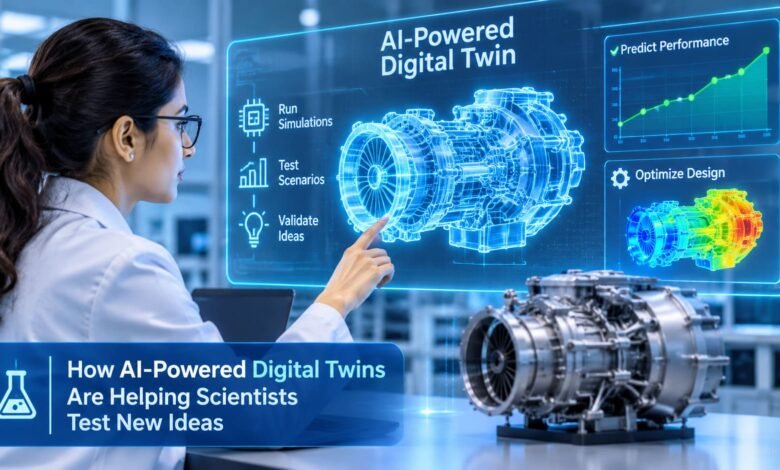
Artificial intelligence (AI) and digital twin technology are providing scientists with a new way to approach these challenges. Instead of relying entirely on physical experiments, researchers can create virtual representations of real-world objects, processes, and systems. These digital environments allow them to explore different conditions, examine possible outcomes, and understand how changes might affect a particular system.
When artificial intelligence is combined with digital twins, the technology becomes even more powerful. AI can analyze large amounts of information, identify patterns, and help researchers understand complex relationships. This makes it easier to investigate scientific questions and decide which ideas deserve further testing.
From medical research and climate science to engineering and materials development, AI-powered digital twins are creating new opportunities for scientific exploration.
What Are AI-Powered Digital Twins?
A digital twin is a virtual representation of a physical object, system, or process. It is developed using information collected from real-world sources, including sensors, experiments, historical records, and operational data.
For example, scientists can create a digital representation of a human heart to study its structure, movement, and blood flow. Similarly, engineers can develop virtual models of machines to understand how they may perform under different operating conditions.
Artificial intelligence adds another layer of capability to these digital models. It helps process complex datasets, recognize patterns, and estimate how a system might respond when specific variables change.
Unlike a basic simulation, a digital twin can be connected to real-world information and updated as new data becomes available. This connection helps researchers maintain a more accurate representation of the system they are studying.
The combination of AI, real-world data, and virtual modeling gives scientists a flexible environment for investigating ideas before moving toward physical experiments.
How AI-Powered Digital Twins Are Changing Scientific Experiments
Traditional scientific research often involves repeated testing. Researchers develop a hypothesis, conduct an experiment, observe the results, and make adjustments. Digital twins introduce another stage into this process by allowing scientists to explore possible outcomes virtually.
1. Testing Different Ideas in a Virtual Environment
Scientists frequently work with multiple research possibilities. However, testing every idea through physical experiments may not be practical.
AI-powered digital twins allow researchers to modify conditions within a virtual model and observe how those changes could influence the results.
For example, a materials scientist studying a new material can examine how it might respond to different temperatures, pressure levels, or environmental conditions. Instead of immediately preparing multiple physical samples, researchers can use simulations to identify promising possibilities.
This approach helps narrow down research options and provides a better starting point for laboratory testing.
2. Understanding Complex Scientific Systems
Many scientific processes involve several connected factors. A small change in one variable can influence the behavior of an entire system.
AI-powered digital twins help researchers examine these relationships by combining information from different sources.
In climate research, scientists can use digital models to study how temperature, rainfall, ocean movement, and atmospheric conditions interact. AI can help analyze large environmental datasets and identify patterns that may require additional investigation.
This makes it easier to understand complicated scientific processes and develop more focused research questions.
3. Reducing Experimentation Time and Costs
Physical research can be expensive, particularly when it requires specialized equipment, rare materials, or repeated laboratory procedures.
Digital twins offer an additional way to evaluate ideas before investing in physical testing. Researchers can compare different designs, examine possible weaknesses, and identify conditions that deserve attention.
For example, engineers developing aircraft components can simulate how different designs may respond to pressure, temperature changes, and mechanical stress.
Although physical testing remains necessary, virtual experimentation can help researchers identify which designs are worth investigating further.
4. Improving Scientific Predictions With Machine Learning
Machine learning allows computer systems to identify patterns in data and use those patterns to make predictions.
When integrated into digital twins, machine learning can help researchers estimate how a modeled system might respond under different conditions.
For instance, scientists studying biological processes can use AI models to examine relationships between different variables and explore possible research outcomes.
These predictions are not guaranteed to be correct. Their reliability depends on data quality, model design, and scientific validation. However, they can help researchers identify patterns and decide where further investigation may be useful.
5. Making Research Safer
Some scientific experiments involve hazardous chemicals, extreme temperatures, high pressure, or challenging environmental conditions.
Digital twins can help scientists examine these situations in virtual environments before attempting physical experiments.
For example, researchers working with industrial chemical processes can simulate changes in temperature, pressure, and material quantities to understand how a system might behave.
This can help identify potential risks and improve experimental planning. Digital models do not replace laboratory safety procedures, but they can provide additional information during the research process.
Major Scientific Fields Using Digital Twin Technology
AI-powered digital twins have applications across several scientific disciplines. Their usefulness depends on the research objective, available information, and complexity of the system being studied.
1. Healthcare and Medical Research
Healthcare research is an important area for digital twin development. Scientists are exploring virtual representations of human organs, biological processes, and individual health conditions.
For example, a digital model of the heart can help researchers investigate blood flow, heart movement, and responses to different conditions. AI can analyze medical images and other relevant information to support these models.
Researchers are also exploring how patient-specific digital twins could contribute to personalized medicine by helping investigate how different individuals may respond to particular treatments.
However, these applications require careful clinical testing and validation before they can be widely used in medical decisions.
2. Materials Science and Chemical Research
Developing new materials and chemical compounds often involves repeated experiments. Scientists need to understand how different substances behave before identifying their potential applications.
AI-powered digital twins can help simulate chemical processes, material properties, and experimental conditions.
Researchers at Lawrence Berkeley National Laboratory have been exploring digital twin approaches for chemical sciences. These efforts combine AI, experimental observations, and computational methods to help investigate chemical reactions and improve scientific experimentation.
Such developments could help researchers explore new materials and chemical processes more efficiently.
3. Climate and Environmental Science
Climate systems involve several connected elements, including atmospheric conditions, ocean temperatures, rainfall, soil quality, and environmental changes.
Digital twins can combine environmental observations with computational models to help researchers investigate these relationships.
Scientists can explore different environmental scenarios, study possible ecosystem changes, and examine how certain conditions might influence natural systems.
AI can support this work by analyzing large datasets and identifying patterns that may be difficult to recognize through traditional analysis alone.
These insights can contribute to environmental research and help scientists evaluate potential approaches to environmental challenges.
4. Space and Aerospace Research
Space exploration requires equipment that can operate under demanding conditions. Testing every possibility directly in space is expensive and often impractical.
Digital twins allow aerospace researchers to create virtual representations of spacecraft components, propulsion systems, and other equipment.
Scientists and engineers can use these models to examine how different components might respond to temperature changes, mechanical stress, and operating conditions.
AI can help analyze performance data and estimate potential problems. This provides researchers with additional information when developing and improving aerospace technologies.
5. Physics and Advanced Scientific Equipment
Modern scientific equipment, including particle accelerators and fusion research systems, produces large amounts of complex information.
Digital twins can help scientists understand how these systems behave and investigate different operating conditions.
For example, researchers can use virtual models to study particle accelerator components, analyze system performance, and examine how adjustments may affect experimental conditions.
By combining measurements, simulations, and machine learning, scientists can develop a clearer understanding of advanced research equipment.
Key Benefits of AI-Powered Digital Twins for Scientists
The combination of artificial intelligence and digital twin technology offers several advantages for scientific research.
Better Data Analysis: AI helps researchers process large datasets and identify patterns that may support new scientific investigations.
Faster Research Planning: Scientists can explore multiple virtual scenarios before selecting the most promising physical experiments.
Reduced Testing Costs: Digital simulations can help reduce unnecessary early-stage physical testing and improve resource planning.
Improved Understanding: Virtual models help researchers examine how different variables interact within complex systems.
Better Research Collaboration: Digital models can provide a shared environment where researchers from different disciplines can study related systems and information.
Continuous Improvement: Digital twins can be updated with new measurements, allowing researchers to improve their models as additional evidence becomes available.
Challenges of Using AI-Powered Digital Twins in Scientific Research
Despite their potential, AI-powered digital twins are not without limitations. Scientists must address several challenges before relying on them for important research activities.
Data Quality and Accuracy
Digital twins depend on reliable information. Incomplete, outdated, or inaccurate datasets can affect how well a virtual model represents the real-world system.
Researchers must carefully collect, organize, and validate the information used to build their models.
Model Reliability
A digital twin may not capture every detail of a complicated physical or biological system. AI predictions can also contain errors or uncertainty.
Scientists need to compare virtual results with real experimental observations to determine whether their models are sufficiently reliable.
High Computing Requirements
Advanced digital twins can require substantial computing resources, particularly when modeling large environmental systems, biological processes, or complex engineering equipment.
Developing and maintaining these models may require specialized infrastructure and technical expertise.
Data Privacy and Security
Medical and biological research may involve sensitive information. Researchers must protect these datasets and follow appropriate privacy and security practices.
Integration Difficulties
Scientific institutions often use different software platforms, instruments, and data formats. Connecting these systems can be challenging.
Improved technical standards and data-sharing practices will be important for expanding the use of digital twins across research environments.
The Future of AI-Powered Digital Twins in Science
The future of AI-powered digital twins will depend on improvements in artificial intelligence, computing capabilities, data collection, and scientific modeling.
One important development is the possibility of connecting multiple digital twins. Instead of studying only one object or process, scientists could combine different models to understand how entire systems influence one another.
For example, environmental researchers could connect models of weather patterns, water resources, soil conditions, and ecosystems. This could provide a broader understanding of environmental changes.
Another promising direction is the development of AI-supported laboratories. These research environments could connect automated laboratory equipment with digital models. Scientists may be able to plan experiments, collect measurements, analyze results, and update virtual models through a more connected workflow.
Advances in machine learning could also help researchers work with increasingly complex scientific datasets. However, human expertise will remain important for interpreting results, checking assumptions, and confirming findings through physical experiments.
As these technologies mature, digital twins could become an increasingly valuable part of scientific research and experimentation.
Conclusion
AI-powered digital twins are changing how scientists explore research ideas and understand complex systems. By combining virtual representations with real-world data and machine learning, researchers can investigate different possibilities before committing significant time and resources to physical experiments.
From healthcare and materials science to climate research, aerospace, and advanced physics, digital twin technology is creating new opportunities for scientific investigation.
Although challenges involving data quality, model accuracy, computing resources, and security remain, continued technological development could make these tools more useful across research disciplines.
Digital twins are not replacements for laboratories or scientific expertise. They are additional tools that help researchers explore possibilities, improve experimental planning, and approach difficult scientific questions with greater understanding.
Frequently Asked Questions
1. What are AI-powered digital twins?
They are virtual models of real-world systems that use AI and data to analyze behavior and predict possible outcomes.
2. How do digital twins help scientists?
They allow scientists to test ideas virtually, explore different conditions, and plan physical experiments.
3. Which fields use digital twin technology?
Healthcare, aerospace, climate science, materials research, and physics are exploring this technology.
4. Can digital twins replace physical experiments?
No. They support virtual testing, but physical experiments are still necessary to validate scientific results.