Technology is changing the way people work, learn, design, and interact with the world around them. Among the technologies driving this change, Augmented Reality (AR) and Mixed Reality (MR) are becoming increasingly useful across industries.
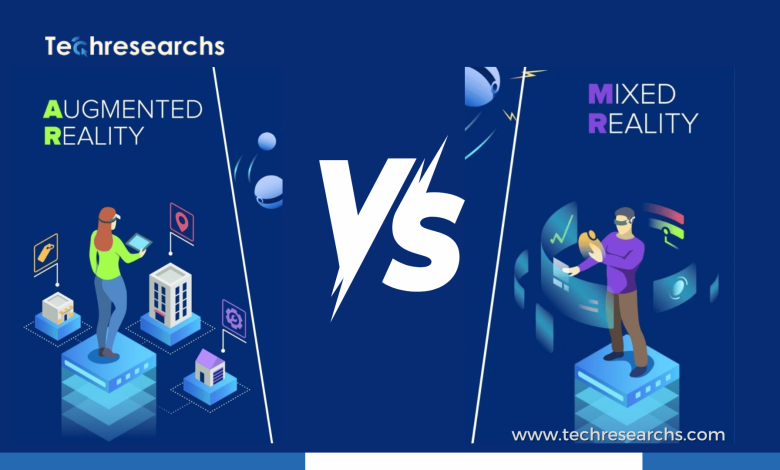
Although the two terms are sometimes used interchangeably, they are not exactly the same. AR adds digital information to the real world, while MR goes a step further by allowing digital objects to interact with the physical environment.
Understanding the difference can help businesses decide where these technologies can create real value.
What Is Augmented Reality (AR)?
Augmented Reality adds digital elements to the user’s view of the physical world. These elements can include images, instructions, animations, 3D models, or information displayed through a smartphone, tablet, or AR headset.
A simple example is an AR navigation application that places directions over a live camera view. Instead of looking at a separate map, users can see digital directions positioned within their surroundings.
AR is particularly useful when businesses want to provide additional information without completely changing the user’s environment.
Common Uses of AR
AR is already being applied in areas such as:
- Retail product visualization
- Healthcare education
- Industrial maintenance
- Navigation
- Marketing campaigns
- Employee training
- Architecture and interior design
- Tourism and entertainment
For example, a furniture retailer can use AR to let customers see how a sofa or table might look inside their home before purchasing it.
What Is Mixed Reality (MR)?
Mixed Reality combines physical and digital environments in a more interactive way. Instead of simply placing digital information over the real world, MR allows virtual objects to appear as if they occupy physical space and respond to the user’s environment.
Imagine an engineer wearing an MR headset and seeing a 3D model of a machine placed directly on the factory floor. The engineer could examine different components, interact with the model, and potentially collaborate with another person using the same digital workspace.
This makes MR especially interesting for training, engineering, product development, healthcare, and industrial applications.
AR vs MR: What Is the Difference?
The biggest difference is how digital content behaves in relation to the physical environment.
| Feature | Augmented Reality | Mixed Reality |
|---|---|---|
| Main purpose | Adds digital information to the real world | Blends digital objects with the physical environment |
| Interaction | Usually limited or straightforward | More interactive and spatially aware |
| Devices | Smartphones, tablets, AR glasses | Advanced MR headsets and spatial devices |
| Digital objects | Often appear as overlays | Can appear anchored within physical surroundings |
| Complexity | Generally easier to deploy | Usually requires more advanced hardware and software |
| Business use | Marketing, retail, navigation, training | Engineering, simulation, design, advanced training |
The distinction is becoming less rigid as modern spatial-computing devices combine capabilities associated with both AR and MR.
How AR Is Changing Different Industries
1. Healthcare
AR can support healthcare professionals by providing digital information while they remain focused on the real environment.
Medical students can use AR-based models to explore anatomy, while healthcare workers can access visual guidance during training. AR can also help explain procedures and medical concepts in a more interactive way.
The key advantage is that complex information can become easier to understand without relying entirely on traditional diagrams or textbooks.
2. Retail and E-Commerce
AR is changing the online shopping experience by allowing customers to visualize products before making a purchase.
For example, customers may be able to preview furniture in their room, experiment with home décor, or virtually try certain products.
This can make online shopping more engaging and give customers greater confidence in their buying decisions.
3. Manufacturing
Manufacturers can use AR to support assembly, inspection, maintenance, and employee training.
Instead of constantly checking a manual, a worker could receive visual instructions through an AR device. Step-by-step guidance can appear alongside the equipment being serviced.
This approach can make complex processes easier to follow and potentially reduce avoidable mistakes.
4. Education
AR can turn traditional learning materials into interactive experiences.
Students studying science, history, engineering, or geography can explore 3D models and digital information from their physical surroundings. Rather than simply reading about a concept, they can interact with visual representations of it.
This can make lessons more engaging, particularly when the subject is difficult to explain through text alone.
How MR Is Changing Different Industries
1. Engineering and Product Design
MR can allow designers and engineers to examine virtual prototypes in a physical workspace.
A team could inspect a 3D representation of a product before a physical prototype is created. Designers can identify potential problems earlier and discuss changes around the same digital model.
This can help organizations reduce unnecessary iterations during product development.
2. Industrial Training
Training employees on expensive or complex machinery can be challenging.
MR can create realistic training environments where workers interact with digital equipment while remaining aware of their physical surroundings. This can provide a safer and more flexible environment for practicing procedures.
3. Healthcare and Medical Training
MR can provide immersive environments for medical education and simulation.
Students and professionals can interact with three-dimensional anatomical models or simulated scenarios. This creates opportunities for more hands-on learning without always requiring access to physical models or clinical environments.
4. Architecture and Construction
Architects and construction teams can use MR to visualize digital building models within real locations.
A team might walk through a space while viewing a virtual representation of planned structures, equipment, or design elements. This can make it easier to identify design conflicts and communicate ideas with clients and project teams.
Why Businesses Are Interested in AR and MR
The biggest attraction is not the technology itself. It is what the technology can help businesses accomplish.
AR and MR can support organizations by helping them:
- Improve employee training
- Create more engaging customer experiences
- Visualize products before production
- Support remote collaboration
- Present complex information visually
- Improve design and prototyping workflows
- Make technical instructions easier to understand
- Create more interactive marketing experiences
However, businesses should avoid adopting AR or MR simply because the technology is popular. A successful implementation should solve a specific business problem.
Challenges Businesses Need to Consider
Despite their potential, AR and MR come with practical challenges.
Hardware Costs
Advanced MR devices can be expensive, particularly when an organization needs to equip a large workforce.
Development Complexity
Creating high-quality spatial experiences often requires specialized developers, 3D designers, and technical expertise.
User Adoption
Employees and customers may need time to become comfortable using new devices and interfaces.
Privacy and Security
AR and MR devices can collect information about physical environments, users, and interactions. Businesses therefore need appropriate privacy and security policies.
Integration With Existing Systems
For enterprise applications, AR and MR solutions may need to connect with existing software such as ERP, CRM, healthcare, manufacturing, or design platforms.
AR or MR: Which One Should a Business Choose?
There is no universal winner.
AR may be the better option when the goal is to add useful digital information to an existing environment. It can be practical for customer experiences, training, retail, navigation, and field support.
MR may be more suitable when users need to interact with digital objects as part of a physical workflow. It can be particularly valuable for engineering, simulation, advanced training, design, and industrial applications.
The right choice depends on the business objective, available infrastructure, target users, budget, and level of interaction required.
The Future of AR and MR
AR and MR are moving toward a broader spatial-computing ecosystem where digital content becomes increasingly connected to the physical world.
As hardware improves, devices become more comfortable, and software becomes easier to develop, businesses may find more practical ways to integrate immersive technologies into everyday workflows.
The most important shift is that AR and MR are moving beyond entertainment. Their potential increasingly lies in solving real problems—helping employees understand information, helping customers make decisions, helping designers visualize ideas, and helping organizations create better training experiences.
Final Thoughts
AR and MR may share similar foundations, but they serve different purposes.
AR primarily enhances the real world with digital information, while MR creates a deeper interaction between digital content and physical surroundings. Both technologies can deliver meaningful business value when they are used for the right purpose.
For businesses exploring immersive technology, the best starting point is not asking, “Should we use AR or MR?” Instead, ask, “What problem are we trying to solve, and which technology can solve it most effectively?”
That shift in thinking can turn AR or MR from an interesting technology experiment into a useful business tool.
Frequently Asked Questions
What is the main difference between AR and MR?
AR adds digital information or objects to the real world, while MR allows digital objects to interact more naturally with the physical environment.
Which industries benefit most from AR?
Retail, healthcare, education, manufacturing, marketing, tourism, and maintenance can benefit significantly from AR applications.
How is MR useful for businesses?
MR can support product design, engineering, employee training, healthcare simulations, architecture, and collaboration by placing interactive digital models into physical spaces.
Is AR or MR better for a business?
Neither technology is universally better. AR is useful for adding digital information to real-world activities, while MR is better suited to applications that require deeper interaction with 3D digital objects.