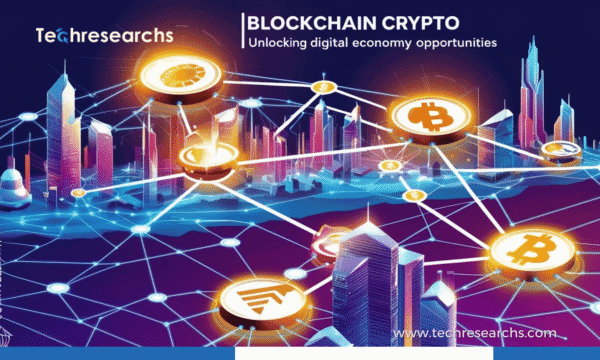
The digital economy is changing faster than ever, and blockchain crypto is becoming an important part of that transformation. What started with Bitcoin has grown into a much broader technology ecosystem involving digital payments, smart contracts, tokenized assets, decentralized applications, and new ways of managing digital ownership.
In 2026, the conversation around blockchain is also becoming more practical. Instead of asking only whether cryptocurrency prices will rise or fall, businesses and technology teams are increasingly asking a different question: How can blockchain solve real problems?
That shift is creating new opportunities across finance, retail, gaming, supply chains, entertainment, and other industries.
Understanding Blockchain Crypto
Blockchain is essentially a shared digital record that stores transactions across a distributed network. Once information is recorded and verified, changing it can be extremely difficult without the required network agreement.
Cryptocurrency is one of the most well-known uses of blockchain. Bitcoin introduced the idea of transferring digital value without depending entirely on a traditional financial intermediary. Other blockchain networks have expanded the concept by allowing developers to create applications and programmable digital assets.
So, blockchain and cryptocurrency are connected, but they are not exactly the same thing.
Blockchain is the technology. Cryptocurrency is one of the applications built on that technology.
Why Blockchain Crypto Is Gaining Attention
There is a reason blockchain continues to attract attention from both startups and established companies.
Traditional digital systems often depend on centralized databases and intermediaries. Blockchain offers another approach where multiple participants can share and verify records through a distributed network.
That can be useful when several organizations need to work with the same information but do not necessarily want one party to control the entire database.
Some of the areas attracting the most interest include:
- Digital payments
- Tokenized assets
- Smart contracts
- Decentralized finance
- Digital identity
- Supply-chain tracking
- Gaming and virtual assets
- Web3 applications
The technology is not a solution for every problem, but in the right situation, it can offer an interesting alternative to conventional systems.
1. Blockchain Is Creating New Payment Opportunities
Digital payments are one of the clearest areas where blockchain can make a difference.
Blockchain-based transactions can allow value to move between users without following exactly the same process as traditional payment systems. This can be particularly interesting for international transactions, where businesses may deal with different currencies, banking systems, and payment intermediaries.
Stablecoins have also attracted attention because they attempt to combine blockchain-based transfers with greater price stability than many traditional cryptocurrencies.
For businesses, this could create new options for receiving payments, moving funds, and serving customers in different markets.
Still, companies need to consider transaction fees, regulations, taxation, security, and local payment requirements before adopting crypto payments.
2. Tokenization Could Change Digital Ownership
One of the more interesting ideas in blockchain is tokenization.
Simply put, tokenization involves representing an asset, right, or piece of information digitally on a blockchain.
Depending on the use case and legal structure, tokens could represent things such as:
- Digital collectibles
- Investment interests
- Loyalty rewards
- In-game items
- Real-world assets
- Membership rights
The real opportunity is not simply creating another digital token. It is making ownership and transfer easier to manage within digital environments.
Imagine buying a digital asset and being able to verify its ownership through a blockchain record rather than relying entirely on a company’s internal database. That concept is helping shape new business models.
3. DeFi Is Expanding Financial Possibilities
Decentralized finance, or DeFi, is another major area of blockchain innovation.
DeFi applications use blockchain networks and smart contracts to provide financial functions such as lending, borrowing, trading, and asset management.
The appeal is straightforward: users can interact with financial applications through blockchain-based systems rather than depending on traditional intermediaries for every transaction.
However, DeFi should not be viewed as risk-free.
Smart-contract bugs, fraudulent projects, market volatility, liquidity problems, and security attacks can lead to serious losses. The technology offers opportunities, but users need to understand the risks before putting money into a decentralized application.
4. Web3 Is Opening Doors for New Digital Experiences
Blockchain is also closely connected with the development of Web3.
Traditional online platforms usually control the infrastructure, user accounts, and digital assets within their ecosystems. Web3 experiments with models where users can have greater control over digital assets and participate directly in decentralized networks.
This is creating opportunities in areas such as:
- Blockchain gaming
- Creator economies
- Digital communities
- Decentralized marketplaces
- Digital collectibles
- Online memberships
The Web3 space is still developing, but it has introduced new ideas about how people can own and interact with digital assets.
5. Businesses Can Use Blockchain Beyond Cryptocurrency
A common misconception is that a company needs to launch its own cryptocurrency to benefit from blockchain.
That is not necessarily true.
Businesses can explore blockchain without creating a new coin. For example, companies may investigate blockchain for tracking products, verifying records, automating agreements, or managing digital assets.
A retailer could explore blockchain for product authenticity. A logistics company could use it to improve shipment tracking. A gaming company could experiment with blockchain-based digital assets.
The important question should always be:
Does blockchain solve this problem better than the existing technology?
If the answer is no, there may be little reason to use it.
6. Supply Chains Could Become More Transparent
Modern supply chains can involve manufacturers, suppliers, distributors, retailers, and customers spread across different locations.
Keeping track of information across all these participants can be difficult.
Blockchain can provide a shared record that authorized participants can use to verify information about products and transactions.
For example, a company could potentially record information about where a product originated, when it changed hands, and where it was delivered.
This could be useful in industries where authenticity and traceability matter, including food, pharmaceuticals, luxury goods, and manufacturing.
Blockchain alone cannot guarantee that every piece of information entered into the system is accurate. However, it can make the recorded history easier to track and verify once information has been entered.
7. Smart Contracts Can Reduce Manual Work
Smart contracts are programs that run on blockchain networks and can automatically perform predefined actions when certain conditions are met.
Think of them as digital agreements with automated rules.
For example, a smart contract could be designed to release a digital payment after a specified condition is fulfilled.
This type of automation could reduce some manual processes and make certain digital transactions more efficient.
At the same time, smart contracts need careful development and testing. If the underlying code contains a serious mistake, the consequences can be difficult to reverse.
Challenges Blockchain Crypto Still Needs to Solve
Blockchain has plenty of potential, but it also has some significant obstacles.
Regulation
Cryptocurrency and digital-asset regulations differ from one country to another and continue to evolve. Companies need to understand the legal requirements that apply to their specific activities.
Security
A blockchain network may be secure, but applications built on top of it can still contain vulnerabilities. Exchanges, wallets, bridges, and smart contracts have all become important security targets.
Volatility
Many cryptocurrencies can experience large price movements. This makes them different from blockchain technology itself.
A business can use blockchain infrastructure without necessarily exposing itself to the same level of cryptocurrency price volatility.
Scalability
Some blockchain networks have struggled with transaction speed, network congestion, and fees during periods of high demand.
Newer architectures and scaling technologies are being developed to address these limitations.
User Experience
Crypto can still feel complicated to newcomers.
Managing wallet addresses, private keys, network fees, and transactions can be confusing. For blockchain to reach a much wider audience, the technology needs to become easier to use without requiring users to understand everything happening behind the scenes.
How Businesses Can Start Exploring Blockchain
Companies do not have to make a huge investment immediately.
A better approach is to start small.
First, identify a genuine business problem. Then determine whether blockchain could realistically improve the process.
A company can then:
- Define the specific problem.
- Compare blockchain with conventional alternatives.
- Research the appropriate blockchain network or architecture.
- Review security and compliance requirements.
- Build a small proof of concept.
- Test the solution with a limited group of users.
- Measure whether it actually delivers business value.
This approach helps businesses avoid adopting blockchain simply because it is popular.
What Does the Future Hold?
The future of blockchain crypto will probably be less about hype and more about practical applications.
Blockchain may gradually become part of the infrastructure behind digital payments, tokenized assets, financial applications, online marketplaces, gaming platforms, and enterprise systems.
The technology will still face challenges, particularly around regulation, security, scalability, and ease of use. But those challenges do not eliminate its potential.
The biggest opportunity may not be a single cryptocurrency or blockchain project. It could be the gradual integration of blockchain technology into everyday digital services.
Final Thoughts
Blockchain crypto is opening up new ways to think about money, ownership, transactions, and digital services.
The technology has moved beyond its early association with Bitcoin and speculative trading. Today, developers and businesses are exploring how blockchain can support payments, tokenization, smart contracts, decentralized applications, and more transparent digital systems.
That does not mean blockchain is automatically the best answer to every technology problem. Its value depends on the situation.
For businesses, the smartest strategy is to focus on real-world usefulness rather than hype. Organizations that understand both the opportunities and the limitations of blockchain will be in a stronger position to decide where the technology genuinely makes sense.
Frequently Asked Questions
What is blockchain crypto?
Blockchain crypto combines blockchain technology with digital currencies and digital assets.
How can businesses use blockchain?
Businesses can use blockchain for payments, smart contracts, supply-chain tracking, and digital assets.
Is blockchain the same as cryptocurrency?
No. Blockchain is the technology, while cryptocurrency is one application built on blockchain networks.
Is cryptocurrency safe?
Cryptocurrency has risks such as price volatility, scams, security threats, and regulatory uncertainty.