Augmented Reality (AR) and Virtual Reality (VR) are no longer technologies limited to gaming and entertainment. Businesses across retail, healthcare, education, manufacturing, real estate, tourism, and marketing are using immersive technology to improve customer experiences, train employees, visualize products, and streamline operations.
But there is an important question for businesses: AR or VR – which one is actually better for your business?
The answer depends on what you want to achieve. AR and VR work differently, require different levels of investment, and are suited to different business situations. Understanding those differences can help you choose the technology that delivers real value instead of simply following the latest trend.
What Is Augmented Reality?
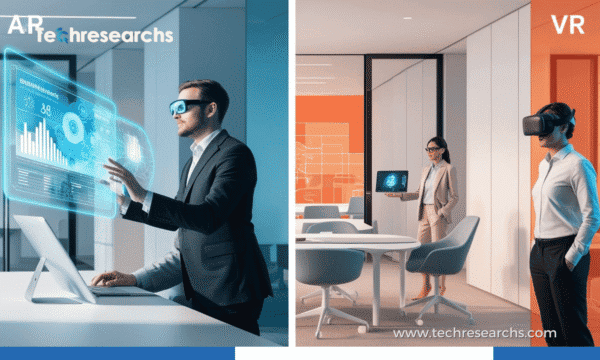
Augmented Reality adds digital information or virtual objects to the real-world environment. Instead of replacing your surroundings, AR enhances what you can already see.
Most people have experienced AR through smartphone filters, navigation apps, shopping applications, or interactive product previews. Modern AR can also work through specialized smart glasses and enterprise devices.
For businesses, AR can be useful when customers or employees need digital information while still interacting with the physical world.
Common Business Uses of AR
- Retail: Customers can virtually preview furniture, clothing, accessories, or other products before purchasing.
- Manufacturing: Workers can view instructions, equipment information, or maintenance guidance while working with machinery.
- Healthcare: AR can support medical education, visualization, and certain clinical workflows.
- Real Estate: Buyers can explore property information and visualize potential layouts.
- Marketing: Brands can create interactive product experiences and campaigns.
- Education: Students can interact with 3D models and digital learning materials.
The biggest advantage of AR is convenience. Users usually do not need to completely disconnect from their surroundings to use it.
What Is Virtual Reality?
Virtual Reality creates a fully digital environment that users can enter through a VR headset. Instead of adding digital elements to the real world, VR replaces the user’s visual environment with a simulated one.
This makes VR particularly useful when a business wants to create an immersive experience or simulate a situation that would be difficult, expensive, or unsafe to reproduce physically.
Common Business Uses of VR
- Employee training: Companies can simulate workplace situations and technical procedures.
- Healthcare: VR can support training, simulation, and therapeutic applications.
- Real Estate: Customers can take immersive virtual property tours.
- Automotive: Designers and engineers can evaluate digital vehicle environments.
- Education: Learners can explore simulated locations and environments.
- Tourism: Businesses can provide virtual previews of destinations and attractions.
- Product development: Teams can examine and interact with digital prototypes.
VR’s biggest strength is immersion. It gives users an opportunity to experience a digital environment rather than simply viewing digital information.
AR vs VR: What’s the Difference?
Although AR and VR are often discussed together, they solve different problems.
| Factor | AR | VR |
|---|---|---|
| Environment | Enhances the real world | Creates a completely virtual world |
| Immersion | Moderate | High |
| Typical Devices | Smartphones, tablets, smart glasses | VR headsets |
| User Awareness | Users remain aware of surroundings | Users are largely inside the virtual environment |
| Best For | Product visualization, assistance, interactive experiences | Training, simulations, immersive experiences |
| Setup | Usually easier | Usually requires dedicated equipment |
| Physical Interaction | Strong | Limited while immersed |
| Business Entry Barrier | Generally lower | Generally higher |
Neither technology is automatically better. The right choice depends on your business objective, audience, budget, and operating environment.
When AR Makes More Sense for Your Business
AR can be the better option when your customers or employees need digital information while continuing to interact with the physical environment.
For example, imagine a furniture company that allows customers to see how a sofa would look inside their living room. The customer does not need to enter a virtual world. They simply use their phone or another compatible device to see the product in their actual space.
AR can also be valuable for field-service teams. A technician could potentially use an AR device to view digital instructions while inspecting equipment.
Choose AR if you want to:
- Improve product visualization
- Create interactive marketing campaigns
- Support employees during physical tasks
- Provide digital information in real-world environments
- Reach customers through familiar devices
- Build experiences that do not require complete immersion
When VR Makes More Sense for Your Business
VR becomes more attractive when immersion is central to the experience.
Consider employee training in industries where mistakes can be costly or dangerous. Instead of immediately putting a new employee into a complicated environment, a company can use VR simulations to create a controlled training experience.
VR can also help businesses demonstrate environments that customers cannot easily visit in person. A real estate company, for instance, could offer an immersive virtual tour of a property that is still under development.
Choose VR if you want to:
- Create immersive training programs
- Simulate complex or risky environments
- Deliver virtual tours
- Demonstrate digital environments
- Test or visualize prototypes
- Create highly engaging experiences
AR vs VR for Customer Experience
Customer experience is one of the strongest areas for both technologies, but their approaches are different.
AR works particularly well when customers want to visualize something in their own environment. For example, a customer might use AR to preview a product before purchasing it.
VR is more appropriate when a company wants customers to enter a completely different environment. Travel companies, property developers, automotive brands, and entertainment businesses can use VR to provide experiences that would otherwise require physical travel or expensive demonstrations.
The key question is simple:
Do you want to bring digital content into the customer’s world, or take the customer into a digital world?
AR vs VR for Employee Training
Both technologies can transform training, but VR has a natural advantage when realistic simulation is the main requirement.
A VR training environment can recreate scenarios that would be difficult to reproduce in a classroom. Employees can practice procedures, respond to simulated events, and learn from mistakes without necessarily facing the same real-world consequences.
AR, on the other hand, can be useful when employees need assistance while performing actual tasks. Digital instructions, visual indicators, or contextual information can appear alongside the physical equipment they are working with.
For simulation-heavy training, VR may be the stronger choice. For on-the-job guidance, AR may be more practical.
Which Technology Is More Affordable?
Cost depends heavily on the project.
AR can sometimes be less expensive to deploy because basic experiences can run through smartphones and tablets that customers already own. Enterprise AR projects using specialized hardware can still require significant investment.
VR typically requires compatible headsets, software, content development, and sometimes dedicated physical space. A sophisticated VR training platform can therefore involve a larger initial investment.
However, businesses should avoid comparing technologies based only on purchase price.
The more useful question is:
Which technology can generate the strongest business value for the specific problem you are trying to solve?
A VR training system might cost more initially but potentially reduce travel, physical training expenses, equipment downtime, or other operational costs. Similarly, an AR shopping experience may require development investment but could improve product engagement and purchasing confidence.
AR vs VR: Which Is Better for Marketing?
For marketing, AR often has an accessibility advantage because consumers can interact with experiences using devices they already have.
Brands can use AR for:
- Product previews
- Interactive packaging
- Social experiences
- Virtual try-ons
- Location-based experiences
- Product demonstrations
VR can create deeper experiences, especially for events, showrooms, brand activations, and specialized campaigns.
However, VR usually requires customers to have access to compatible hardware. That can make AR easier to scale for broad consumer campaigns.
How to Choose Between AR and VR
Before investing in immersive technology, ask these questions:
1. What business problem are you solving?
Do not start with the technology. Start with the problem.
If customers struggle to visualize a product, AR may help. If employees need realistic simulation training, VR could be more appropriate.
2. Who will use the experience?
Consider whether your users are customers, employees, technicians, students, or business partners.
Their devices, technical comfort, environment, and expectations will influence the right choice.
3. How immersive does the experience need to be?
If users need to remain connected to the physical world, AR is usually a better fit.
If the experience requires complete attention inside a simulated environment, VR may be the better option.
4. What hardware is required?
Consider smartphones, tablets, smart glasses, VR headsets, computers, sensors, and supporting infrastructure.
Hardware requirements can significantly affect adoption and deployment costs.
5. Can the project scale?
A successful pilot is useful, but businesses should think beyond the first demonstration.
Ask whether the experience can be expanded across locations, teams, products, or customer segments without creating unsustainable costs.
Could Businesses Use AR and VR Together?
Absolutely.
AR and VR do not have to compete. In some business environments, they can complement each other.
For example, a manufacturer might use VR to train employees on a machine before they work with the real equipment and then use AR to provide guidance when employees begin working on the actual machine.
This combination creates a broader immersive technology strategy:
VR for preparation and simulation → AR for real-world assistance.
Businesses that need both capabilities can therefore treat AR and VR as complementary tools rather than choosing only one.
The Future of AR and VR in Business
The business case for immersive technology is becoming more focused. Instead of using AR or VR simply because it looks impressive, organizations are increasingly looking at practical outcomes such as training effectiveness, customer engagement, product visualization, collaboration, and operational efficiency.
As hardware becomes more capable and software becomes easier to develop, immersive experiences are likely to become more integrated into everyday business processes.
The important shift is from “Can we use AR or VR?” to “Where can immersive technology solve a real business problem?”
That mindset can help companies avoid expensive experiments that have little practical value.
Final Verdict: AR or VR?
There is no universal winner.
AR is generally the better choice when you want to enhance real-world experiences, improve product visualization, support employees, or reach customers through accessible devices.
VR is generally the better choice when you need immersive simulations, realistic training, virtual environments, or experiences that require complete user attention.
For many businesses, the smartest strategy is not choosing one technology permanently. Start with a specific business problem, test the technology on a manageable scale, measure the results, and expand only when the business value is clear.
In other words, AR vs VR is not really about which technology is better. It is about which technology is better for your particular business goal.
Frequently Asked Questions
Is AR or VR better for most businesses?
Neither technology is universally better. AR is often more practical for product visualization and real-world assistance, while VR is stronger for immersive training and simulations.
Which is easier for customers to use, AR or VR?
AR can be easier to adopt because many experiences work through smartphones or tablets. VR usually requires a compatible headset, which adds an extra step for users.
Can small businesses benefit from AR and VR?
Yes. Small businesses can start with focused applications such as AR product previews, virtual property tours, interactive marketing, or VR-based demonstrations instead of building large platforms.
Can a business use AR and VR at the same time?
Yes. A company can use VR for simulations or employee training and AR for guidance, product information, or assistance during real-world activities.