Technology is changing so quickly that something considered “new” today can feel ordinary a few months later. In 2026, though, the biggest changes are not just about faster phones or smarter apps. We are seeing technology become more capable of thinking, assisting, predicting, automating, and interacting with the physical world.
Artificial intelligence is still leading the conversation, but it is only one part of the bigger picture. AI is moving into software development, robotics, healthcare, cybersecurity, manufacturing, and even everyday devices. At the same time, technologies such as quantum computing, edge AI, advanced chips, and biotechnology are continuing to develop.
For businesses and everyday users, the real question is not simply “What is the newest technology?” It is “Which technologies are actually going to make a difference?”
Here are the major technology trends worth watching in 2026.
1. Agentic AI Is Taking AI Beyond Chatbots
Most people have already experienced generative AI through chatbots and AI assistants. You ask a question, give an instruction, and receive an answer.
Agentic AI takes that idea a step further.
Instead of only responding to individual requests, an AI agent can work toward a larger goal. It may break a task into smaller steps, use different software tools, collect information, and complete parts of a workflow with limited human intervention.
For example, imagine asking an AI system to research a group of competitors. Rather than simply giving you a list of websites, it could collect information, organize the findings, compare companies, and prepare a report.
That is where agentic AI becomes interesting.
Businesses are particularly interested because many everyday operations involve repetitive tasks that don’t necessarily require constant human involvement.
However, AI agents also need proper permissions, monitoring, and security. Giving an autonomous system access to sensitive business information without appropriate controls can create serious risks.
2. AI Is Moving Into the Physical World
AI used to be mostly associated with screens and software. That’s changing.
Robotics is giving AI a physical presence.
Modern robots can combine cameras, sensors, machine learning, and advanced control systems to understand their surroundings and respond to changes.
This could be useful in places such as:
- Warehouses
- Factories
- Hospitals
- Farms
- Construction sites
- Distribution centers
- Retail environments
Humanoid robots are especially interesting because they are designed to operate in environments built for humans.
That doesn’t mean every home or office will suddenly have a humanoid robot in 2026. The technology still has plenty of challenges to overcome, including cost, reliability, safety, and practical performance.
But the direction is clear: AI is moving from the digital world into the physical world.
3. AI Is Changing Software Development
Writing software has traditionally required developers to spend considerable time writing, testing, debugging, and documenting code.
AI is changing that workflow.
Today’s AI coding tools can help developers generate code, explain unfamiliar code, find bugs, write tests, and create documentation.
This can make development faster, especially for repetitive tasks.
But there is an important distinction: AI is becoming a developer’s assistant, not necessarily a replacement for the developer.
Someone still needs to understand what the software should do, check whether the generated code is correct, review security issues, and make important architectural decisions.
In the future, developers may spend less time typing code and more time directing, reviewing, and improving what AI produces.
4. Edge AI Is Bringing AI Closer to Users
A lot of AI processing happens in cloud data centers, but that isn’t always the best option.
Sometimes a device needs to make a decision immediately.
That’s where edge AI comes in. Instead of sending every piece of information to a remote server, some processing can happen directly on the device or nearby.
You can find this approach in areas such as:
- Smartphones
- Security cameras
- Cars
- Wearables
- Industrial equipment
- Smart appliances
The biggest advantages are speed and efficiency. Local processing can reduce delays and decrease the amount of information that needs to travel across a network.
Privacy can also improve because certain information can remain on the device rather than being sent elsewhere.
As more products become AI-powered, edge computing is likely to become a much bigger part of the technology landscape.
5. Smaller AI Models Could Become More Useful
There is a common assumption that bigger AI models are always better.
That’s not necessarily true.
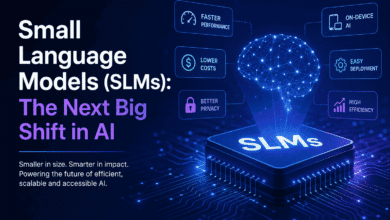
A large general-purpose model may be excellent at handling many different tasks, but a smaller model designed for one specific purpose can sometimes be faster, cheaper, and easier to manage.
For example, a company might use a specialized model for:
- Customer support
- Financial documents
- Legal information
- Internal company knowledge
- Manufacturing data
- Healthcare applications
This is why smaller and domain-specific AI models are gaining attention.
Instead of using one enormous model for everything, businesses may increasingly use different AI models for different jobs.
6. AI and Cybersecurity Are Becoming Closely Connected
The relationship between AI and cybersecurity is complicated.
On one side, security teams can use AI to detect unusual activity, analyze security logs, identify suspicious patterns, and respond to threats more quickly.
On the other side, attackers can also use AI.
AI can help create more convincing phishing messages, automate certain tasks, and make attacks easier to scale.
This means cybersecurity teams have to adapt quickly.
There is also a new security challenge created by AI agents. If an agent can access company systems, files, applications, or customer information, organizations need to carefully control what that agent is allowed to do.
In 2026, securing AI systems is becoming just as important as using them.
7. Digital Content Verification Is Becoming More Important
AI can now create remarkably realistic images, videos, voices, and written content.
That’s useful for creators and businesses, but it also creates a problem.
How do you know whether something you see online is genuine?
This is where digital provenance and content authenticity technologies become important.
They can help provide information about where a piece of digital content came from and whether it has been changed.
This could become particularly useful for news organizations, financial companies, governments, businesses, and social platforms.
As AI-generated content becomes more common, trust will become a technology problem of its own.
8. Quantum Computing Is Still One to Watch
Quantum computing has been attracting attention for years, but it remains an emerging technology rather than something most people will use every day.
Quantum computers approach certain calculations differently from traditional computers, potentially making them useful for highly complex problems.
Researchers are exploring applications in areas such as:
- Drug discovery
- Chemistry
- Materials science
- Optimization
- Finance
- Cryptography
There are still significant challenges, especially around stability, error correction, and scaling quantum systems.
So don’t expect quantum computers to replace your laptop anytime soon.
Instead, 2026 is a year to watch for meaningful progress in quantum hardware, algorithms, and practical experiments.
9. Post-Quantum Security Is Getting More Attention
Quantum computing creates another issue: today’s encryption methods may not all remain secure against powerful future quantum computers.
That’s why researchers are developing post-quantum cryptography.
The idea is to create encryption methods that can protect information even against future quantum-based attacks.
For large organizations, preparing early makes sense because changing security infrastructure can take years.
This makes post-quantum security an important trend even before large-scale quantum computers become commercially available.
10. AI Is Becoming More Important in Healthcare
Healthcare is another industry where AI could make a lasting difference.
Researchers are using AI to analyze large amounts of medical and biological information, assist with drug discovery, identify patterns, and support research.
AI may also help make healthcare more personalized by allowing researchers and medical professionals to consider more information about individual patients.
But healthcare technology comes with a higher level of responsibility.
Accuracy, privacy, safety, regulation, and human oversight all matter.
AI can be a powerful assistant, but it cannot remove the need for qualified medical professionals.
11. Robots Will Work Alongside People
The conversation around robotics often focuses on whether robots will replace human workers.
A more realistic possibility is that many robots will work alongside people.
Machines are particularly good at repetitive, physically demanding, or highly consistent tasks.
People, meanwhile, are still better suited to many situations involving creativity, communication, judgment, empathy, and unexpected problems.
A warehouse worker might supervise robotic systems. A technician might use robots for inspection. A farmer might use autonomous machines to monitor crops.
The most useful question may not be “Will robots replace humans?”
It may be:
“Which jobs can humans and robots do better together?”
12. Smarter Devices Are Becoming Normal
AI is also becoming part of everyday devices.
Smartphones, watches, cars, cameras, home appliances, and other connected products are becoming better at understanding voice commands, recognizing images, predicting user needs, and processing information.
The next generation of devices may feel less like tools that simply wait for instructions and more like assistants that understand context.
But this convenience comes with an obvious concern: privacy.
The smarter our devices become, the more personal information they may collect. Companies will need to make privacy and security a central part of product design.
13. Advanced Chips Are Driving the AI Boom
Behind every impressive AI application is a large amount of computing power.
AI models require specialized hardware, including powerful processors, memory, networking equipment, and data-center infrastructure.
As AI adoption grows, companies are looking for chips that can deliver more performance without consuming excessive amounts of energy.
This is creating a major technology race around:
- AI accelerators
- GPUs
- Specialized processors
- High-speed memory
- Data-center networking
- Energy-efficient computing
These developments may not be as visible to consumers as a new smartphone, but they are essential to the future of AI.
14. Energy Efficiency Is Becoming a Technology Priority
Power consumption is becoming a bigger issue as AI and data centers expand.
Running large AI systems requires significant computing resources, which means businesses are paying more attention to electricity, cooling, and infrastructure costs.
This is encouraging innovation in areas such as:
- Energy-efficient chips
- Better cooling systems
- Renewable energy
- Efficient data centers
- Smaller AI models
- Local AI processing
The future of technology isn’t only about making systems more powerful.
It is also about making them more efficient.
15. Technology Convergence Could Be the Biggest Trend
Perhaps the most interesting trend of 2026 is that technologies are increasingly working together.
AI is being combined with robotics.
AI is being used in biotechnology.
Edge computing is powering intelligent devices.
Advanced chips are supporting AI workloads.
Cybersecurity is adapting to autonomous systems.
Quantum computing is influencing the future of encryption.
When these technologies come together, they can create possibilities that wouldn’t exist if each technology were developed separately.
This is why businesses should look beyond individual technology buzzwords and think about how different tools can work together to solve real problems.
How Businesses Can Prepare for These Technology Trends
Businesses don’t need to adopt every new technology simply because it is popular.
A better strategy is to start with a genuine business challenge.
For example, a company might ask:
- Which repetitive tasks are taking employees too much time?
- Could AI improve customer service?
- Where are cybersecurity weaknesses?
- Could automation reduce operating costs?
- Does the company have valuable data that isn’t being used?
- Which new technologies are relevant to the industry?
- What skills will employees need in the next few years?
Testing technology through a small project or pilot can be a good way to understand its actual value before making a larger investment.
Businesses should also think about data protection, employee training, security, and compliance from the beginning.
What Can We Expect From Technology After 2026?
Some technology trends will develop faster than expected, while others will take years to reach their full potential.
That’s normal.
Technology rarely follows a perfectly predictable path.
What is becoming clear, however, is that technology is moving toward systems that are more intelligent, autonomous, connected, and responsive.
AI won’t exist only inside chatbots. Robots won’t simply perform pre-programmed movements. Devices won’t always need to rely on the cloud. Cybersecurity won’t be limited to reacting after an attack.
The different pieces are starting to connect.
Final Thoughts
2026 is an exciting year for technology because several major developments are moving from experimentation toward practical applications.
Agentic AI could change how people handle digital work. Robotics could transform physical workplaces. Edge AI could make devices faster and more private. Specialized AI models could make business applications more affordable. Meanwhile, quantum computing, biotechnology, and post-quantum security could shape the longer-term future.
But it’s important not to get carried away by the hype.
The technologies that truly matter will be the ones that solve real problems, improve people’s lives, and provide measurable value.
Frequently Asked Questions
1. What is the biggest technology trend in 2026?
Artificial intelligence remains one of the biggest technology trends in 2026, especially agentic AI, AI-powered software development, robotics, and specialized AI models.
2. Are humanoid robots becoming common in 2026?
Humanoid robots are developing quickly, particularly for manufacturing, logistics, and other industrial applications. However, widespread everyday adoption is still developing.
3. Is quantum computing ready for everyday use?
Quantum computing is still an emerging technology. Researchers are making progress, but it is not yet ready to replace traditional computers for everyday tasks.
4. Why is cybersecurity important with the growth of AI?
AI can help security teams detect threats, but attackers can also use AI to create more sophisticated attacks. Businesses therefore need stronger security and responsible AI practices.