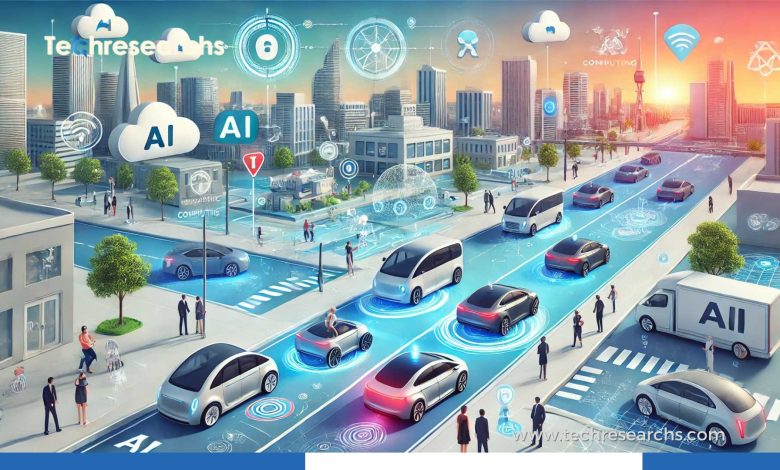
Autonomous vehicles are changing the way people think about transportation. Instead of relying entirely on a human driver, these vehicles use cameras, radar, lidar, sensors, artificial intelligence, and advanced software to understand their surroundings and make driving decisions.
While fully self-driving cars are still being developed and tested, many vehicles already include technologies that can assist drivers with steering, braking, parking, and maintaining a safe distance from other vehicles. Understanding how autonomous vehicles work, their different levels of automation, and their benefits and limitations can help you understand where transportation is heading.
What Is an Autonomous Vehicle?
An autonomous vehicle is a vehicle designed to perform some or all driving tasks with limited or no direct human control, depending on its automation level.
The technology combines several systems to create a digital understanding of the road. Sensors detect vehicles, pedestrians, road markings, traffic signals, and obstacles. Artificial intelligence then processes this information and helps the vehicle decide what action to take.
It is important to distinguish driver assistance from full autonomy. A vehicle that can keep itself centered in a lane or automatically brake in an emergency is not necessarily a fully self-driving vehicle.
How Do Autonomous Vehicles Work?
Autonomous driving depends on several technologies working together.
1. Cameras
Cameras help vehicles identify traffic lights, road signs, lane markings, pedestrians, vehicles, and other visual information.
2. Radar
Radar uses radio waves to detect objects and estimate their distance and movement. It can be particularly useful in situations where visibility is reduced.
3. Lidar
Lidar uses laser pulses to create detailed information about the vehicle’s surroundings. It can help determine the position and shape of nearby objects.
4. Artificial Intelligence
AI software combines information from different sensors and analyzes the environment. Machine-learning systems can help the vehicle recognize patterns and respond to different driving situations.
5. Navigation and Mapping
Navigation systems help the vehicle understand its location and plan a route. Some autonomous systems also use highly detailed maps to improve their understanding of roads and intersections.
6. Vehicle Control Systems
After interpreting its surroundings, the vehicle must translate decisions into actions. Control systems manage steering, acceleration, braking, and other vehicle functions.
Understanding the Levels of Driving Automation
The Society of Automotive Engineers (SAE) commonly describes driving automation using six levels, from Level 0 to Level 5.
Level 0: No Driving Automation
The driver performs the driving task. The vehicle may still provide warnings or emergency assistance.
Level 1: Driver Assistance
The vehicle can assist with one aspect of driving, such as steering or acceleration and braking, while the driver remains responsible.
Level 2: Partial Automation
The system can control steering and acceleration or braking under certain conditions. The driver must remain attentive and responsible for driving.
Level 3: Conditional Automation
The system can perform the driving task under specific conditions. However, the human driver may need to take control when requested.
Level 4: High Automation
The vehicle can perform driving tasks without human control within defined operating conditions or areas.
Level 5: Full Automation
A Level 5 vehicle would be capable of driving under essentially all roadway and environmental conditions that a human driver could reasonably handle.
Benefits of Autonomous Vehicles
Autonomous driving technology could offer several potential advantages.
Improved road safety: Human mistakes contribute to many crashes. Automation could reduce some risks associated with distraction, fatigue, and delayed reactions.
Greater mobility: Autonomous transportation could eventually help people who cannot drive independently access transportation more easily.
Better traffic management: Connected and automated vehicles could potentially communicate with infrastructure and other vehicles, helping improve traffic flow.
Reduced driving workload: Automation could make long or repetitive journeys less demanding when the system is designed and approved for those conditions.
Potential transportation efficiency: More coordinated driving could reduce unnecessary acceleration, braking, and congestion in some environments.
Challenges and Limitations
Autonomous vehicles also face significant challenges.
Safety
A self-driving system must respond safely to unpredictable situations, including unusual road conditions, pedestrians, construction zones, and unexpected driver behavior from other vehicles.
Weather and Visibility
Heavy rain, fog, snow, dust, or glare can affect sensors and make environmental perception more difficult.
Cybersecurity
Connected vehicles contain software, communications systems, and data. Protecting these systems against unauthorized access and other cyber threats is essential.
Regulation
Governments and transportation authorities must establish rules covering testing, deployment, liability, safety requirements, and data protection.
Cost
Advanced sensors, computing hardware, software development, testing, and maintenance can increase the cost of autonomous vehicle systems.
Human Behavior
Drivers may misunderstand what an automated system can actually do. Overreliance on driver-assistance features can create safety risks if people assume the vehicle is more capable than it really is.
Autonomous Vehicles and Artificial Intelligence
AI is at the center of modern autonomous driving research. A vehicle must interpret large amounts of information and make decisions within fractions of a second.
For example, the system may need to determine whether an object ahead is a pedestrian, cyclist, vehicle, road barrier, or another object. It then needs to predict how that object might move and select an appropriate response.
This makes autonomous driving more than a simple navigation problem. It requires perception, prediction, planning, decision-making, and vehicle control to work together.
Are Autonomous Vehicles Fully Self-Driving Today?
Not generally.
Many vehicles available today provide advanced driver-assistance features, but these should not automatically be considered fully autonomous. The amount of automation depends on the vehicle, software, operating conditions, and regulatory approval.
Consumers should always check what a particular system is designed to do and understand their responsibilities when using it.
What Does the Future Look Like?
The future of autonomous transportation is likely to develop gradually rather than arrive as a single technological breakthrough.
Autonomous systems may first become more common in controlled environments and specific use cases, such as robotaxis, logistics, industrial transportation, delivery services, and highway driving.
Over time, improvements in AI, sensors, computing, connectivity, mapping, testing, and safety validation could expand the environments in which automated systems operate.
The broader impact could extend beyond passenger cars. Autonomous technology may influence public transportation, freight, agriculture, construction, warehouses, and emergency-response operations.
How to Prepare for the Autonomous Vehicle Era
Whether you are a driver, business owner, technology professional, or policymaker, it is useful to understand the capabilities and limitations of autonomous systems.
When purchasing a vehicle with automated features, look beyond marketing terms. Check the actual automation level, operating conditions, driver responsibilities, and safety documentation.
Businesses exploring autonomous transportation should also consider cybersecurity, infrastructure, regulatory requirements, insurance, workforce implications, and long-term maintenance.
Final Thoughts
Autonomous vehicles represent one of the most significant developments in transportation technology. They combine AI, sensors, computing, connectivity, and vehicle engineering to automate parts of the driving process.
Although fully autonomous driving remains a complex technical and regulatory challenge, driver-assistance systems and autonomous applications are already influencing the transportation industry.
The key is to view autonomous vehicles realistically: they offer major potential benefits, but safe deployment depends on reliable technology, careful testing, appropriate regulation, strong cybersecurity, and responsible human use.
Frequently Asked Questions
What is an autonomous vehicle?
An autonomous vehicle uses sensors, cameras, AI, radar, lidar, and software to perform some or all driving tasks with limited or no human input.
Are autonomous vehicles completely self-driving?
Not all autonomous vehicles are fully self-driving. Many current vehicles provide driver-assistance features that still require the driver to monitor the road.
What technologies do autonomous vehicles use?
Autonomous vehicles commonly use cameras, radar, lidar, GPS, mapping systems, artificial intelligence, machine learning, and onboard computers.
Are autonomous vehicles safe?
Autonomous vehicles are designed with safety in mind, but their safety depends on the technology, operating conditions, testing, and responsible use.