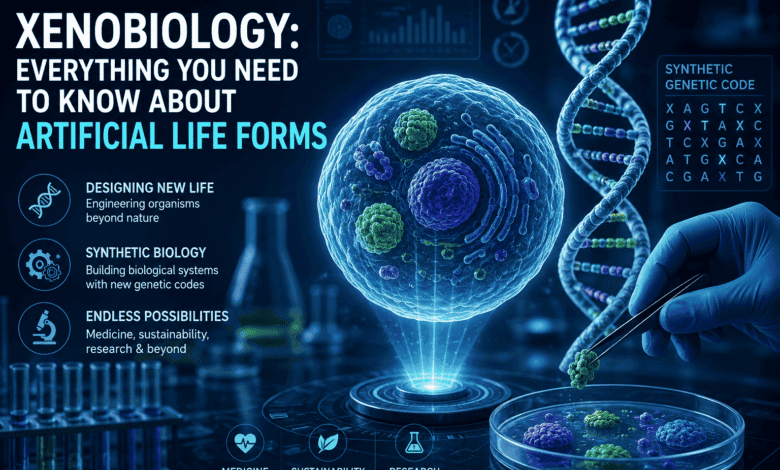
Biology has traditionally focused on understanding the living organisms that exist in nature. However, rapid advances in synthetic biology, genetic engineering, and biotechnology have given rise to an exciting new field known as xenobiology. Rather than simply modifying existing organisms, xenobiology explores the possibility of designing entirely new biological systems with characteristics not found in nature.
By expanding the building blocks of life, scientists hope to develop organisms capable of solving some of humanity’s greatest challenges, including sustainable manufacturing, environmental protection, disease treatment, and advanced scientific research.
Although xenobiology is still an emerging discipline, it represents one of the most innovative frontiers in modern biotechnology.
What Is Xenobiology?
Xenobiology is a branch of synthetic biology that focuses on designing and engineering biological systems using alternative genetic components or biochemical structures that do not naturally occur in living organisms.
Unlike traditional genetic engineering, which edits existing DNA, xenobiology aims to create new forms of biological function by introducing synthetic molecules, modified genetic codes, or entirely new biological pathways.
The goal is to build organisms that can perform specialised tasks while remaining biologically separate from naturally occurring life.
How Does Xenobiology Work?
Scientists combine several advanced technologies to create artificial biological systems, including:
- Synthetic biology
- Genetic engineering
- Genome editing
- Bioinformatics
- Artificial intelligence
- Computational biology
Researchers design biological instructions, test them using computer models, and introduce them into specially engineered cells. These artificial systems can then perform specific functions such as producing valuable compounds, detecting environmental pollutants, or supporting medical research.
Why Is Xenobiology Important?
As global challenges become more complex, traditional biological approaches may not always provide sufficient solutions. Xenobiology expands the possibilities of biotechnology by enabling scientists to design organisms with capabilities beyond those found in nature.
Potential benefits include:
- Faster scientific innovation
- Improved environmental sustainability
- Advanced medical treatments
- Safer industrial biotechnology
- Better control over engineered organisms
Applications of Xenobiology
Healthcare
Artificial biological systems may help develop next-generation vaccines, targeted drug delivery systems, and personalised therapies for complex diseases.
Pharmaceutical Manufacturing
Engineered organisms could produce medicines, proteins, enzymes, and therapeutic compounds more efficiently than conventional manufacturing methods.
Environmental Protection
Scientists are exploring synthetic organisms capable of breaking down plastics, removing environmental pollutants, and supporting ecosystem restoration.
Agriculture
Xenobiology could contribute to the development of disease-resistant crops, improved soil health, and sustainable farming solutions.
Industrial Biotechnology
Artificial microorganisms may be used to manufacture biodegradable materials, renewable chemicals, and environmentally friendly industrial products.
Scientific Research
Researchers use xenobiological systems to better understand how life functions and to explore alternative biological possibilities beyond natural evolution.
Advantages of Xenobiology
Expands Biological Innovation
Scientists can design biological systems that perform functions impossible for naturally occurring organisms.
Improved Biosafety
Many xenobiological organisms are designed to survive only under controlled laboratory conditions, reducing environmental risks.
Sustainable Manufacturing
Engineered organisms can help produce valuable products while reducing waste and energy consumption.
Accelerated Research
Artificial biological systems enable researchers to test scientific ideas more efficiently.
New Medical Opportunities
Xenobiology may support breakthroughs in personalised medicine, regenerative therapies, and disease prevention.
Challenges of Xenobiology
Despite its promise, xenobiology presents several scientific and ethical challenges.
Technical Complexity
Designing entirely new biological systems requires advanced knowledge of genetics, chemistry, and computational biology.
Regulatory Oversight
Governments and scientific organisations must establish regulations to ensure the safe development and use of artificial organisms.
Ethical Considerations
Creating synthetic life raises important questions about responsible innovation, environmental protection, and long-term societal impacts.
High Development Costs
Research, laboratory equipment, and specialised expertise require significant investment.
The Role of Artificial Intelligence
Artificial intelligence plays an increasingly important role in xenobiology by helping scientists:
- Analyse biological datasets
- Predict genetic interactions
- Design synthetic DNA sequences
- Optimise laboratory experiments
- Accelerate biological discovery
AI reduces research time while improving the accuracy of engineered biological systems.
Future Trends in Xenobiology
The future of xenobiology is expected to include several groundbreaking developments:
- Artificial cells for targeted medicine
- Environmentally friendly biological manufacturing
- Smart microorganisms for pollution control
- Next-generation vaccine development
- Sustainable bio-based materials
- AI-assisted biological design
- Space biology applications for long-term exploration
As research continues, xenobiology could become a key technology supporting healthcare, environmental sustainability, and industrial innovation.
Best Practices for Responsible Xenobiology
To ensure safe and ethical progress, researchers should:
- Follow strict biosafety protocols.
- Conduct thorough risk assessments.
- Protect sensitive biological data.
- Maintain transparency in research.
- Collaborate with regulators and ethics experts.
- Use AI responsibly to support scientific decision-making.
Conclusion
Xenobiology is transforming the future of biotechnology by exploring entirely new possibilities for designing artificial life forms. By combining synthetic biology, genetic engineering, and artificial intelligence, researchers are developing innovative biological systems that could revolutionise medicine, environmental science, agriculture, and industrial manufacturing.
Although challenges related to safety, ethics, and regulation remain, the potential benefits of xenobiology are immense. As research advances, this emerging field is expected to unlock new scientific discoveries and create sustainable solutions for some of the world’s most pressing global challenges, making it one of the most exciting areas of modern biotechnology.
FAQs
1. What is xenobiology?
Xenobiology is a branch of synthetic biology that designs artificial biological systems using modified genetic components not found in nature.
2. How is xenobiology different from synthetic biology?
Synthetic biology modifies existing organisms, while xenobiology creates biological systems with alternative genetic structures and functions.
3. What are the applications of xenobiology?
Xenobiology is used in healthcare, drug development, agriculture, environmental protection, and industrial biotechnology.
4. Is xenobiology safe?
Researchers follow strict biosafety guidelines and regulatory standards to ensure the safe development and use of xenobiological systems.