Technology is becoming smaller, smarter, and more closely connected to our daily lives. From smartphones and smartwatches to wireless earbuds, people are already using wearable devices to make everyday activities easier. But what if the next major technological development was something people could wear directly on their eyes?
This is where smart contact lenses come into the picture.
Unlike traditional contact lenses, which mainly help people see clearly, smart contact lenses are being developed to offer additional capabilities through miniature sensors, electronic components, and advanced materials. Researchers are exploring how these lenses could monitor certain health conditions, provide digital information, and create new ways to interact with technology.
Although this technology is still developing, it has the potential to change how people experience healthcare, communication, and everyday activities.
Let’s explore how smart contact lenses could become an important part of future technology.
What Are Smart Contact Lenses?
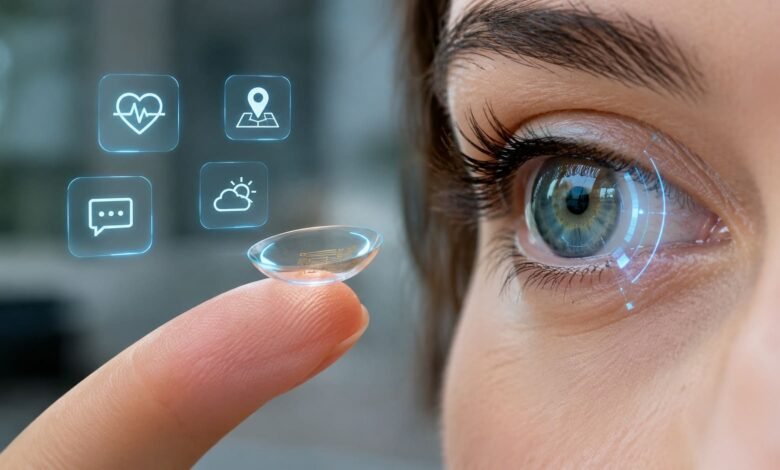
Smart contact lenses are technologically advanced lenses designed to perform functions beyond ordinary vision correction. They may contain tiny sensors, flexible electronic circuits, wireless communication components, and other miniature technologies.
These components could allow the lenses to collect information from the user’s eyes or surrounding environment and communicate with compatible external devices.
For example, researchers are exploring contact lenses that can monitor eye pressure, detect certain substances in tears, or support augmented reality experiences.
The idea is simple: instead of carrying multiple devices to access information or monitor certain health indicators, people could eventually use a lightweight wearable device that sits directly on their eyes.
However, smart contact lenses are not all designed for the same purpose. Some focus on medical applications, while others are being developed for digital experiences.
1. Making Health Monitoring More Convenient
One of the most promising applications of smart contact lenses is health monitoring.
Our tears contain different biological substances that researchers are studying to understand how certain health conditions can be monitored. Smart lenses equipped with miniature sensors could potentially detect specific changes and collect useful health information.
For example, researchers are investigating ways to monitor glucose-related changes in tear fluid and measure eye pressure in people with glaucoma.
Imagine someone who needs regular eye-pressure monitoring. In the future, a specially designed smart contact lens could potentially collect measurements throughout the day and help healthcare professionals understand changes over time.
This could make certain types of health monitoring more convenient and support better-informed medical decisions.
However, these technologies still require further clinical validation and should not be considered replacements for established medical tests.
2. Bringing Digital Information Closer to Our Eyes
Another interesting possibility is the combination of smart contact lenses and augmented reality.
Today, people depend on smartphones and smartwatches to check notifications, read messages, and access digital information. Future smart contact lenses could offer another way to view selected information directly within the user’s field of vision.
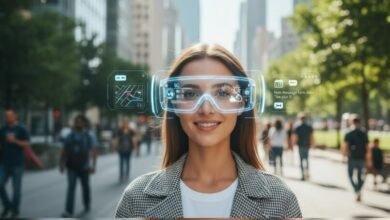
For instance, someone travelling in an unfamiliar city might eventually see navigation guidance without repeatedly looking down at a smartphone.
Similarly, people could potentially access reminders, simple notifications, or useful information while keeping their hands free.
This could make digital interaction feel more natural, especially in situations where using a smartphone is inconvenient.
However, creating a display that is small, clear, comfortable, and safe enough to fit inside a contact lens remains a major engineering challenge.
3. Improving Convenience in Everyday Activities
Small improvements in everyday routines can make a meaningful difference.
Smart contact lenses could eventually help people access useful information without constantly switching between different devices.
Consider a few possible situations:
- Travelling: Access directions and location-related information while exploring unfamiliar places.
- Shopping: View relevant product information through connected digital services.
- Working: Receive important reminders or instructions without repeatedly checking another screen.
- Exercising: Access selected activity information while keeping hands free.
These applications are still potential developments rather than features available in ordinary contact lenses today.
If successfully developed, smart lenses could make certain digital activities easier and reduce dependence on physical screens.
4. Supporting Advanced Eye Care
Smart contact lenses could also contribute to the future of eye healthcare.
Researchers are investigating how advanced lenses could help monitor eye conditions and support controlled medication delivery.
For example, people living with certain eye conditions may need regular treatment and monitoring. A specially designed contact lens could potentially help deliver medication gradually or collect information about changes in eye health.
This could offer another approach to managing certain conditions and make treatment more convenient for some patients.
However, medical applications must undergo extensive testing to establish their safety and effectiveness before they can become part of routine healthcare.
5. Changing the Way People Work
The workplace could be another area where smart contact lenses create new opportunities.
Many professionals need to access information while performing tasks that require both hands. Looking at a computer, tablet, or smartphone repeatedly can interrupt their workflow.
Future augmented reality contact lenses could potentially provide relevant instructions or visual information directly within a person’s field of view.
For example, a technician working on industrial equipment might receive step-by-step guidance while repairing a machine. Similarly, certain healthcare professionals could benefit from quick access to relevant information during specific procedures.
These applications could make some tasks more convenient and improve access to information.
However, their usefulness will depend on accuracy, workplace safety, and how well the technology fits existing professional processes.
6. Creating More Personalized Digital Experiences
Every individual uses technology differently. Some people want better health-monitoring options, while others are more interested in convenience and digital assistance.
Smart contact lenses could eventually support more personalized experiences by connecting with compatible applications and devices.
For example, a person using a medically approved lens might collect specific eye-health measurements, while another user could benefit from digital navigation or visual assistance.
This could make wearable technology more adaptable to individual needs.
At the same time, developers will need to consider data privacy, security, and user consent. Health-related information should always be handled responsibly.
Challenges That Smart Contact Lenses Still Need to Overcome
Despite their potential, smart contact lenses face several technical and practical challenges before they can become widely available.
Comfort and Eye Safety: Contact lenses sit directly on the eye. Adding electronic components must not affect comfort, oxygen flow, or overall eye health.
Power Supply: Miniature electronic systems need energy to function. Finding safe and efficient power solutions within such a small device remains difficult.
Measurement Accuracy: Health-monitoring sensors must provide consistent and reliable results. Changes in tear composition can make accurate measurements challenging.
Manufacturing Costs: Producing lenses with miniature sensors, electronic circuits, and medical-grade materials can be complicated and expensive.
Data Privacy: Connected lenses could collect sensitive personal information. Strong security measures and clear privacy controls will be essential.
Solving these challenges will be important before smart contact lenses can become a practical everyday technology.
What Does the Future Hold for Smart Contact Lenses?
The future of smart contact lenses will depend on how successfully researchers combine medical technology, electronics, and advanced materials.
As these technologies develop, smart lenses could potentially offer more convenient health monitoring, new augmented reality experiences, and better access to digital information.
Healthcare professionals may gain additional tools for monitoring certain eye conditions, while everyday users could eventually experience digital assistance in new ways.
However, widespread adoption will not happen simply because the technology is innovative. It must first prove that it is safe, comfortable, reliable, and affordable.
Smart contact lenses may not replace smartphones or traditional wearable devices, but they could introduce another useful way to bring technology into everyday life.
Conclusion
Smart contact lenses represent an interesting step in the development of wearable technology. They could eventually combine vision-related functions, health monitoring, and digital experiences in a device small enough to sit directly on the eye.
From making certain health measurements more convenient to exploring new ways of accessing information, their potential applications are worth watching.
However, safety, comfort, affordability, and data privacy will determine how successfully this technology enters everyday life.
The future of technology may not always involve bigger screens or more powerful devices. Sometimes, the next important innovation could be something as small as a contact lens.
Frequently Asked Questions
1. What are smart contact lenses used for?
Smart contact lenses are being developed for health monitoring, vision-related applications, and future digital experiences.
2. Can smart contact lenses display digital information?
Future smart contact lenses may display digital information through augmented reality technology, including notifications and navigation details.
3. How do smart contact lenses monitor health?
Some smart contact lenses use miniature sensors to study changes in tear fluid or monitor eye pressure for specific health applications.
4. What is the future of smart contact lenses?
Smart contact lenses could become useful wearable devices for healthcare, digital assistance, and everyday convenience as the technology develops.