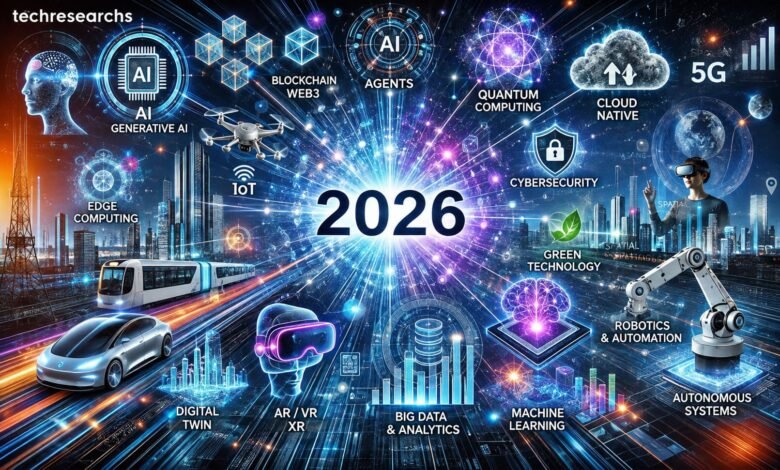
Technology is changing at a remarkable pace. Every year brings new tools, platforms, and ideas, but 2026 feels different because many technologies that once seemed experimental are now moving closer to everyday use.
Artificial intelligence is no longer limited to chatbots and content generation. Robots are becoming smarter, computing is becoming more specialized, biotechnology is becoming increasingly data-driven, and cybersecurity is evolving to deal with increasingly sophisticated digital threats.
For businesses, researchers, developers, and everyday technology users, keeping an eye on these developments can help identify where the next major opportunities may come from.
Here are 10 emerging technologies that are worth watching closely in 2026.
1. Agentic AI
One of the biggest developments in artificial intelligence is the rise of agentic AI.
Traditional AI generally waits for a user to provide an instruction. Agentic AI aims to handle a series of tasks, make decisions along the way, use digital tools, and work toward a specific goal with less constant supervision.
For example, an AI agent could potentially research a topic, organize the information, prepare a report, update a business system, and notify a team member when the work is completed.
This could have a major impact on areas such as customer service, software development, marketing, finance, and business operations.
The important change is simple: AI is gradually moving from answering questions to completing tasks.
2. Physical AI and Smarter Robots
Robotics is entering an interesting new phase.
For years, robots have been excellent at performing repetitive tasks in controlled environments. The challenge has been making machines capable of understanding unpredictable real-world situations.
The combination of advanced AI, computer vision, sensors, and robotics is beginning to change that.
Modern robots are being developed for warehouses, factories, healthcare facilities, agriculture, logistics, and other environments where they need to interact with people and physical objects.
Humanoid robots are also receiving significant attention. While widespread household use is still uncertain, improvements in movement, perception, and decision-making could make robots considerably more useful in the coming years.
3. World Models
AI systems are becoming better at understanding more than just text.
World models are designed to build an internal representation of an environment and predict how that environment might change.
Imagine a robot looking at a room and understanding that moving one object could affect another. Or imagine an autonomous vehicle predicting how pedestrians, vehicles, and road conditions may change over the next few seconds.
This type of technology could become particularly valuable for robotics, autonomous vehicles, simulations, and other applications where AI needs to understand the physical world.
World models could help bridge an important gap between AI that generates information and AI that understands environments.
4. Quantum Computing
Quantum computing has been discussed for years, but the technology continues to make progress.
Quantum computers approach certain problems differently from traditional computers. Instead of relying only on conventional bits, they use quantum states to perform specialized computations.
The technology is not expected to replace everyday computers. Its potential lies in solving particular types of complex problems that are extremely difficult for classical systems.
Possible applications include:
- Drug discovery
- Materials research
- Financial modelling
- Optimization
- Scientific simulation
- Advanced cryptography
In 2026, quantum computing remains an emerging field rather than a mainstream replacement for conventional computing. However, continued research and investment make it a technology worth following closely.
5. Post-Quantum Cryptography
Quantum computing creates an important cybersecurity question: what happens if future quantum machines become powerful enough to break some of today’s widely used encryption methods?
That is where post-quantum cryptography comes in.
Researchers are developing cryptographic techniques intended to remain secure against attacks from both conventional and quantum computers.
This may sound like a distant concern, but organizations often need years to migrate their security infrastructure. Sensitive information that is encrypted today could potentially remain valuable for decades.
As a result, companies are beginning to think about quantum-resistant security before large-scale quantum attacks become practical.
6. AI-Powered Biotechnology
Artificial intelligence is becoming an increasingly useful tool in biological research.
Researchers can use AI to process enormous biological datasets, identify patterns, predict molecular behaviour, assist with drug discovery, and explore complex biological systems.
This combination of AI and biotechnology could help researchers investigate possibilities that would be extremely time-consuming to evaluate manually.
The potential applications include:
- Drug discovery
- Protein research
- Medical diagnostics
- Genomics
- Personalized medicine
- Agricultural biotechnology
The real promise is not simply replacing scientists with AI. Instead, AI can act as a powerful research assistant, helping scientists explore more possibilities and make better use of complex datasets.
7. AI Security
The rapid adoption of AI is creating a new security challenge.
Companies are connecting AI models to databases, applications, internal systems, and business workflows. As these systems become more powerful, they also become attractive targets for attackers.
AI security focuses on protecting models, data, applications, users, and AI-driven processes.
Areas receiving increased attention include:
- Prompt injection
- Data leakage
- Model manipulation
- Unauthorized AI access
- Adversarial attacks
- Identity management
- AI governance
Security teams will increasingly need to think about AI as both a technology to protect and a technology that can help protect other systems.
8. Edge AI
AI does not always need to run in a large cloud data center.
With edge AI, processing can happen directly on or near the device collecting the data. Smartphones, cameras, industrial machines, vehicles, and other connected devices can perform AI tasks locally.
This approach offers several advantages.
Local processing can reduce delays, limit the amount of information sent to the cloud, and potentially improve privacy. It can also be useful in situations where a reliable internet connection is unavailable.
As AI becomes part of more everyday devices, efficient edge computing could become an important part of the technology infrastructure behind them.
9. Brain-Computer Interfaces
Brain-computer interfaces, commonly called BCIs, are another technology attracting growing interest.
A BCI attempts to create a communication pathway between brain activity and an external computer or device.
The technology has potentially important applications in healthcare. For example, researchers are investigating ways it could help people with certain disabilities communicate or control assistive devices.
However, BCIs are still an emerging technology. Technical limitations, safety considerations, privacy questions, and ethical issues all need to be addressed before widespread adoption becomes realistic.
Even so, the idea of controlling digital systems through neural signals could eventually change how humans interact with computers.
10. Intelligent Energy Systems
The growth of AI, electric vehicles, cloud computing, and data centers is increasing the demand for reliable and efficient energy infrastructure.
This is creating opportunities for smarter energy systems.
AI can help predict energy demand, identify unusual patterns, optimize power distribution, and coordinate renewable energy sources with storage systems.
Electric vehicles may also become more closely connected to energy networks, potentially allowing batteries to play a role in managing electricity demand.
The future energy system is therefore likely to involve more than generating electricity. It will also depend on software, sensors, automation, storage, and intelligent decision-making.
Why These Technologies Matter
The most interesting part of today’s technology landscape is that these innovations are beginning to overlap.
AI can make robots more capable. Better chips can make AI run on smaller devices. Biotechnology can provide AI with new scientific applications. Quantum computing can influence cybersecurity. Intelligent software can help manage increasingly complex energy infrastructure.
In other words, the next wave of innovation may not come from one technology working alone. It could come from several technologies working together.
For businesses, this creates both opportunities and challenges.
Companies that understand these developments early can identify potential applications, experiment with new solutions, and prepare their workforce for changing technology requirements.
At the same time, businesses should avoid adopting a technology simply because it is trending. A successful implementation should solve a real problem, provide measurable value, and take security and privacy into account.
How Businesses Can Prepare for Emerging Technologies
Businesses do not need to invest in every new technology immediately.
A better strategy is to start with a specific business problem and then determine whether an emerging technology can provide a practical solution.
Companies can begin by:
- Monitoring technology developments relevant to their industry
- Running small pilot projects
- Training employees in emerging technologies
- Reviewing cybersecurity and privacy requirements
- Measuring results before making large investments
- Building flexible digital infrastructure
- Keeping track of changing regulations and industry standards
This approach allows organizations to experiment without taking unnecessary risks.
Final Thoughts
2026 is shaping up to be an important year for emerging technology.
Agentic AI, physical AI, world models, quantum computing, post-quantum cryptography, AI-powered biotechnology, AI security, edge AI, brain-computer interfaces, and intelligent energy systems each have the potential to influence different parts of our digital and physical lives.
Not every technology on this list will become mainstream at the same speed. Some may develop gradually, while others could experience rapid adoption as costs fall and practical applications become clearer.
The bigger trend, however, is easy to see: technology is becoming more intelligent, more connected, and increasingly capable of interacting with the physical world.
For anyone interested in technology, business, or innovation, these are developments worth watching throughout 2026 and beyond.
Frequently Asked Questions
What are the most promising technologies to watch in 2026?
Some of the most promising technologies in 2026 include agentic AI, physical AI and robotics, world models, quantum computing, post-quantum cryptography, AI-powered biotechnology, edge AI, brain-computer interfaces, and intelligent energy systems.
Why is agentic AI becoming important in 2026?
Agentic AI is becoming important because it can handle multi-step tasks, use digital tools, and work toward specific goals with less continuous human supervision. Businesses are exploring it for automation, customer service, software development, research, and other workflows.
Will quantum computing become mainstream in 2026?
Quantum computing is still an emerging technology, so it is unlikely to replace traditional computers in 2026. However, continued research is making it increasingly relevant for areas such as scientific simulation, optimization, drug discovery, and advanced cybersecurity.
How will emerging technologies affect businesses?
Emerging technologies can help businesses automate repetitive work, improve decision-making, strengthen cybersecurity, develop new products, and create more efficient operations. Companies should evaluate each technology based on its practical business value rather than adopting a trend simply because it is popular.