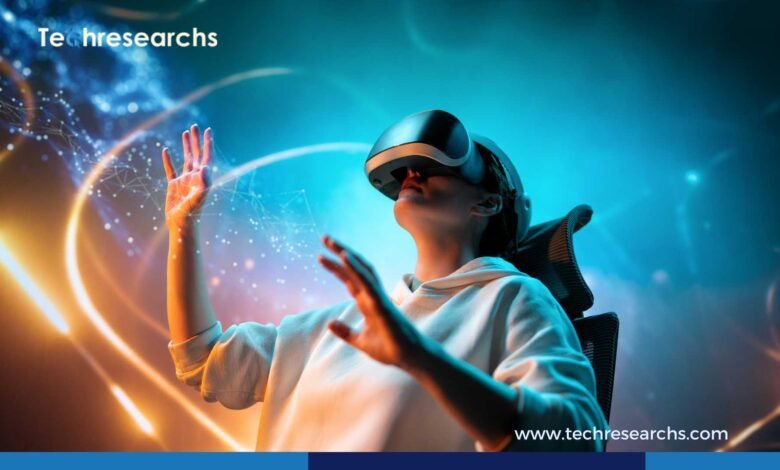
Augmented Reality (AR) is rapidly evolving from a technology associated mainly with games and smartphone filters into a powerful platform for business, education, healthcare, manufacturing, retail, navigation, and digital interaction.
The combination of artificial intelligence, computer vision, spatial computing, advanced sensors, faster connectivity, and wearable devices is creating new possibilities for how people interact with digital information.
This updated guide explores the future of augmented reality, its major opportunities, practical applications, challenges, and the role businesses can play in the next phase of AR development.
What Is Augmented Reality?
Augmented Reality is a technology that adds digital information to a user’s view of the physical world. Unlike Virtual Reality, which creates a completely simulated environment, AR keeps the real world visible while adding digital elements such as:
- 3D objects
- Text and information
- Digital instructions
- Animations
- Navigation directions
- Interactive graphics
- Real-time data
AR can be experienced through smartphones, tablets, smart glasses, head-mounted devices, vehicle displays, and specialized industrial equipment.
The technology is increasingly moving toward spatial computing, where digital information can understand and interact with physical surroundings.
Why Is Augmented Reality Becoming More Important?
The early versions of AR were often designed primarily for entertainment and marketing. Today, businesses are increasingly exploring AR because it can solve practical problems.
Several technological developments are accelerating this transition.
Artificial Intelligence
AI enables AR systems to recognize objects, understand environments, process natural language, and provide contextual information.
For example, an AR application could recognize a piece of machinery and display relevant maintenance instructions when a technician looks at it.
Improved Spatial Understanding
Modern AR devices can use cameras and sensors to understand surfaces, depth, movement, and physical objects.
This makes it possible to position digital content more naturally within real environments.
Advanced Wearable Devices
AR glasses and head-mounted devices are becoming more capable, with improvements in displays, cameras, sensors, processing, and interaction methods.
Faster Connectivity
Modern wireless networks can support AR applications that require rapid data transfer and low latency, particularly for enterprise collaboration and cloud-connected experiences.
Major Opportunities for Augmented Reality
1. AI-Powered AR Assistants
One of the most promising developments is the integration of generative AI with AR.
Instead of displaying fixed information, future AR systems could understand what users are looking at and provide relevant assistance.
For example, a technician could look at a machine and ask an AI assistant:
“Why is this component showing an error?”
The system could analyze the visible equipment, retrieve relevant information, and display possible troubleshooting steps directly within the user’s field of view.
This could transform AR from a simple visualization technology into a context-aware digital assistant.
2. AR Glasses and Everyday Computing
AR glasses could become an important computing interface in the future.
Potential applications include:
- Navigation
- Real-time translation
- Notifications
- Calendar information
- Communication
- Workplace instructions
- Accessibility features
- Contextual search
- Hands-free productivity
However, widespread adoption will depend on improvements in battery life, comfort, display quality, privacy, price, and social acceptance.
3. Healthcare and Medical Training
Healthcare is one of the areas where AR could provide significant value.
Medical professionals can use AR concepts to visualize anatomy, access information, support procedures, and improve training.
Students can also explore complex anatomical structures through interactive 3D models.
Potential applications include:
- Medical education
- Surgical visualization
- Remote assistance
- Patient education
- Rehabilitation
- Medical training
AR could make complicated medical concepts easier to understand by providing visual information in three dimensions.
4. Manufacturing and Industrial Applications
Manufacturing is another major opportunity for AR.
Workers can potentially receive digital instructions while performing physical tasks.
AR applications can provide:
- Assembly instructions
- Equipment information
- Maintenance procedures
- Safety alerts
- Quality-control guidance
- Remote expert assistance
- Employee training
- Inventory information
Instead of repeatedly checking printed manuals or separate computer screens, employees can access relevant information directly within their working environment.
5. Education and Interactive Learning
AR can make education more visual and interactive.
Students could explore:
- Human anatomy
- Historical locations
- Solar systems
- Molecules
- Engineering structures
- Biological processes
- Mathematical concepts
The biggest advantage is not simply making education more entertaining. AR can help students visualize subjects that are difficult to understand through traditional two-dimensional materials.
6. Retail and E-Commerce
AR is creating new opportunities for online and physical retailers.
Customers can use AR to visualize products before making purchasing decisions.
Examples include:
- Placing virtual furniture inside a room
- Trying virtual accessories
- Previewing products
- Exploring product features
- Viewing interactive demonstrations
This can provide customers with greater confidence when evaluating products.
7. Automotive Applications
AR could significantly change how drivers interact with vehicle information.
Potential applications include:
- Navigation directions
- Road information
- Parking assistance
- Safety warnings
- Vehicle information
- Pedestrian alerts
However, automotive AR must be carefully designed because excessive visual information could distract drivers.
8. Tourism and Cultural Experiences
AR can provide additional information when people visit historical sites, museums, landmarks, and tourist destinations.
For example, visitors could point an AR-enabled device at an old building and see a digital reconstruction of how it may have looked historically.
Museums could also use AR to create interactive experiences around exhibits.
9. Remote Assistance and Collaboration
AR can make remote technical assistance more visual.
A remote expert could potentially guide a technician by identifying equipment and providing digital annotations or instructions.
This could be useful in:
- Engineering
- Construction
- Manufacturing
- Healthcare
- Field services
- Equipment maintenance
- Technical support
This type of application could reduce travel requirements while improving access to specialized expertise.
AR and Spatial Computing
The future of AR is closely connected to spatial computing.
Traditional computing primarily revolves around screens. Spatial computing allows digital information to interact with three-dimensional physical environments.
The broader concept can be represented as:
Physical Environment + Sensors + AI + 3D Content + Computing = Spatial Digital Experiences
This could eventually change how people interact with software, information, and digital services.
How AI Could Transform AR
AI may become one of the most important technologies supporting next-generation AR.
A future AR system could follow a process such as:
Computer Vision → Environmental Understanding → AI Processing → Contextual Response → AR Visualization
For example:
- The device identifies an object.
- Computer vision analyzes the object.
- AI interprets what the user wants to accomplish.
- Relevant information is retrieved or generated.
- The AR system displays the information in the appropriate location.
This combination could make AR more intelligent, personalized, and useful.
Business Opportunities in Augmented Reality
Businesses should not adopt AR simply because it is a growing technology. The strongest implementations are those that address genuine customer or operational problems.
Customer Experience
Businesses can create interactive product experiences and personalized digital interactions.
Employee Training
AR can provide step-by-step visual instructions for complex tasks.
Sales and Marketing
Companies can allow customers to interact with products virtually before purchasing.
Operations
Workers can access information without constantly switching between physical tasks and computer screens.
Technical Support
AR can support remote troubleshooting and visual guidance.
Product Development
Engineers and designers can use 3D visualizations to examine concepts before physical production.
Challenges Facing Augmented Reality
Despite its potential, AR still has several challenges.
Hardware Limitations
AR devices need to balance processing power, battery life, weight, heat, display quality, and portability.
Privacy Concerns
AR devices may capture information about users and their surroundings. This creates important questions regarding consent, data collection, facial recognition, and environmental privacy.
Cybersecurity
Connected AR devices can become targets for cyberattacks. Strong authentication, encryption, secure software updates, and responsible data management will be important.
Cost
Advanced AR hardware and enterprise solutions can require significant investment.
User Experience
Poorly designed AR interfaces can overwhelm users with unnecessary information.
Successful AR experiences should provide useful information without creating distraction.
Content Development
Creating high-quality 3D content can require specialized skills and resources. AI-assisted development tools may help reduce this barrier in the future.
How Businesses Can Prepare for the Future of AR
Companies interested in AR should begin with specific business problems rather than technology-first investments.
A practical approach includes:
1. Identify a Real Business Problem
Determine where visual or spatial information could improve an existing process.
2. Select the Appropriate Hardware
Decide whether smartphones, tablets, AR glasses, or specialized devices are appropriate for the use case.
3. Develop a Small Pilot
Start with a limited project and test it with a specific audience.
4. Measure Results
Evaluate improvements in productivity, training, customer engagement, sales, accuracy, or operational efficiency.
5. Address Security and Privacy
Establish policies for collecting, processing, storing, and protecting AR-related information.
6. Scale Successful Projects
Expand applications that demonstrate measurable business value.
What Could the Future of AR Look Like?
The future of augmented reality may be less about simply placing digital objects over the real world and more about creating environment-aware computing experiences.
Instead of opening an application and searching for information, users could receive useful information when and where they need it.
A technician could see maintenance instructions.
A student could explore a 3D scientific model.
A traveler could receive information about a landmark.
A customer could visualize a product before purchasing it.
A professional could receive guidance from a remote expert.
These examples show how AR could gradually move computing from traditional screens into the surrounding environment.
Final Thoughts
Augmented Reality is evolving into a broader technology platform supported by AI, spatial computing, computer vision, advanced sensors, wearable hardware, and modern connectivity.
The most valuable AR applications will not necessarily be the most visually impressive. They will be the applications that solve real problems, simplify complex information, improve productivity, enhance customer experiences, and support better decision-making.
For businesses and technology leaders, understanding AR now can help identify opportunities before the technology becomes more widely adopted. As hardware and software continue to mature, augmented reality could become an increasingly important part of how people interact with digital information.
Frequently Asked Questions
1. What is the future of augmented reality?
The future of AR includes AI-powered assistants, smart glasses, spatial computing, industrial applications, healthcare, education, retail, navigation, and remote collaboration.
2. How will AI improve augmented reality?
AI can help AR systems recognize objects, understand environments, interpret natural language, personalize information, and provide context-aware assistance.
3. Will AR replace smartphones?
AR is unlikely to immediately replace smartphones. Instead, AR devices are more likely to complement smartphones while gradually taking over some screen-based tasks.
4. Which industries can benefit from AR?
Healthcare, manufacturing, education, retail, automotive, construction, tourism, logistics, engineering, and field services can all benefit from AR applications.