Imagine replacing a factory filled with large machines with something much smaller: a microscopic organism working inside a controlled fermentation tank. Instead of producing food or traditional fermentation products, these engineered microbes can be programmed to create useful proteins, chemicals, fibers, and other advanced materials.
This idea is at the heart of precision fermentation.
Precision fermentation combines biotechnology, microbiology, genetic engineering, and industrial production to turn microorganisms into tiny biological manufacturing systems. Researchers can modify microbes so they produce a specific substance with greater control and consistency.
As industries look for cleaner production methods and alternatives to resource-intensive manufacturing, precision fermentation is attracting growing attention.
What Is Precision Fermentation?
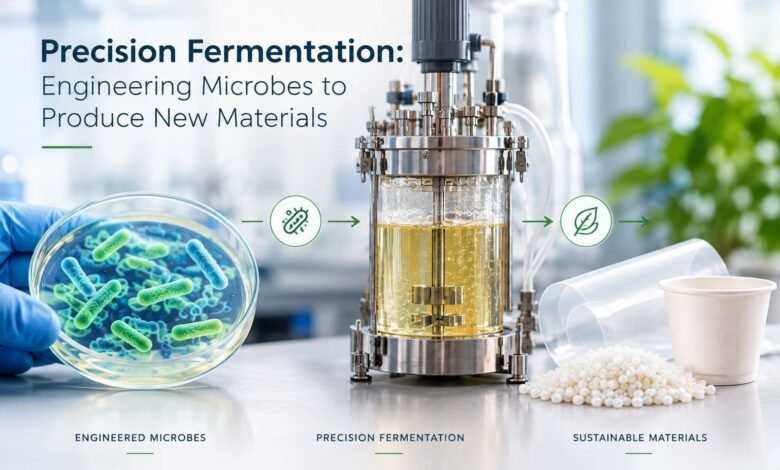
Precision fermentation is a biotechnology process in which microorganisms such as yeast, bacteria, or fungi are engineered to produce a particular compound.
The basic concept is surprisingly straightforward. Scientists identify the biological instructions needed to make a desired substance and introduce those instructions into a suitable microorganism. The microbe is then grown in a controlled environment where it uses nutrients to produce the target material.
After fermentation, the desired product is separated and purified.
Unlike traditional fermentation, which often relies on naturally occurring microorganisms to transform ingredients, precision fermentation focuses on producing a specific target molecule.
This makes the technology particularly interesting for manufacturing materials that are difficult, expensive, or environmentally demanding to produce using conventional methods.
How Does Precision Fermentation Work?
The process generally involves several stages.
1. Selecting the Target Material
Everything begins with a specific production goal. Scientists determine what they want the microorganism to make, such as a protein, enzyme, polymer ingredient, or specialty chemical.
The desired characteristics of the final material are also considered. For example, manufacturers may want a material with greater strength, flexibility, durability, or heat resistance.
2. Designing the Microorganism
Researchers then determine which biological pathways can produce the target substance.
Using genetic engineering techniques, they can modify a microorganism so that it carries the necessary genetic instructions. The goal is to turn the microbe into a biological production platform.
3. Growing the Microbes
The engineered microorganisms are placed in fermentation equipment containing carefully controlled nutrients and environmental conditions.
Temperature, acidity, oxygen, feeding rates, and other factors can influence how efficiently the microbes produce the desired compound.
4. Harvesting the Product
Once the fermentation process reaches the appropriate stage, the target substance is collected.
Depending on the product, it may need to be separated from the cells or fermentation liquid and then purified through additional processing.
5. Scaling the Process
A successful laboratory experiment is only the beginning. To become commercially useful, the process needs to work reliably at a much larger scale.
Engineers must consider production costs, energy consumption, raw materials, contamination risks, equipment requirements, and product consistency.
Why Are Microbes Being Used as Tiny Factories?
Microorganisms have several characteristics that make them attractive for biotechnology.
They reproduce quickly, can grow under controlled conditions, and can be engineered to perform specific biological functions. Some microbes are already widely used in industrial biotechnology, making them familiar platforms for large-scale fermentation.
The real advantage is programmability.
Instead of depending entirely on natural biological processes, researchers can modify microorganisms to produce substances that they would not normally make in useful quantities.
This creates an entirely different way of thinking about manufacturing: design the biological system first, then let it manufacture the product.
What New Materials Can Precision Fermentation Produce?
The technology has applications far beyond food.
Bio-Based Proteins
Engineered microorganisms can produce specialized proteins that have applications in food, medicine, cosmetics, and industrial processes.
Alternative Fibers and Textiles
Researchers are exploring biological approaches for producing proteins and materials that could be used in next-generation fibers and textile applications.
Some companies are investigating fermentation-derived alternatives inspired by materials found in nature, including proteins associated with exceptionally strong biological structures.
Specialty Chemicals
Precision fermentation can also be used to produce specific chemical compounds that are traditionally manufactured through petrochemical or other industrial processes.
This could create new options for producing ingredients used in coatings, adhesives, polymers, and other materials.
Biomaterials
Another promising area is the development of biomaterials with carefully controlled properties.
By changing the biological production process, researchers may be able to create materials designed for particular applications rather than relying on a one-size-fits-all manufacturing approach.
Precision Fermentation and Sustainable Manufacturing
One of the biggest reasons precision fermentation is attracting interest is its potential role in more sustainable production.
Traditional manufacturing can require large amounts of land, water, fossil-based raw materials, or high-temperature processing. Biological production may offer alternative pathways for making certain products.
However, precision fermentation should not automatically be considered environmentally friendly in every situation.
Large fermentation facilities still require electricity, water, nutrients, equipment, transportation, and downstream processing. The environmental impact depends heavily on how the entire production system is designed and operated.
For this reason, researchers increasingly look at the complete lifecycle of a product rather than focusing only on the fermentation stage.
The Role of Genetic Engineering
Genetic engineering is a key part of precision fermentation.
Microorganisms can be given genetic instructions that allow them to produce a desired molecule. Scientists may also modify metabolic pathways to improve production efficiency.
The challenge is finding the right balance.
A microorganism that produces a useful compound in a laboratory may not behave exactly the same way when production is scaled up. Biological systems can be sensitive to changes in temperature, nutrient availability, oxygen levels, and other conditions.
This means successful precision fermentation requires more than simply inserting a gene. It involves optimizing the entire biological and industrial process.
Challenges Facing Precision Fermentation
Despite its potential, precision fermentation still has several hurdles to overcome.
High Production Costs
Developing engineered microbes and maintaining controlled fermentation systems can be expensive, particularly for new materials that do not yet have large markets.
Scaling Up
Moving from a small laboratory vessel to a commercial-scale fermentation facility is a major engineering challenge.
A process that works efficiently at a small scale may experience different oxygen-transfer, heat-management, mixing, or contamination issues when production increases.
Raw Material Requirements
Microorganisms need nutrients to grow and produce materials. The cost and sustainability of these inputs can significantly influence the overall economics of the process.
Purification
Producing a compound is only one part of the job. The product often needs to be extracted, purified, dried, or otherwise processed before it can be used.
Downstream processing can represent a significant portion of manufacturing costs.
Regulatory Considerations
Products made using engineered microorganisms may need to meet regulatory requirements depending on their intended use and market.
Companies must demonstrate that their processes and products meet appropriate safety and quality standards.
How AI Could Improve Precision Fermentation
Artificial intelligence and machine learning could become important tools for optimizing biological manufacturing.
Researchers can use computational models to analyze large amounts of fermentation data and identify patterns that may be difficult to spot manually.
AI could help optimize variables such as:
- Microbial growth conditions
- Nutrient feeding
- Fermentation timing
- Product yield
- Energy consumption
- Process stability
- Strain performance
The combination of AI and biotechnology could eventually make it faster to design and improve microbial production systems.
Precision Fermentation vs. Traditional Manufacturing
The biggest difference is where the production process takes place.
Traditional manufacturing often depends on chemical reactions, mechanical processes, extraction, or resource-intensive industrial systems.
Precision fermentation moves part of the manufacturing process into a biological environment.
Instead of asking, “How can we chemically manufacture this material?” researchers can also ask, “Can we teach a microorganism to make it?”
That shift could open the door to materials that are difficult to produce through conventional methods.
What Could the Future Look Like?
The long-term potential of precision fermentation extends across multiple industries.
We could see more fermentation-based materials appearing in areas such as textiles, packaging, cosmetics, chemicals, agriculture, healthcare, and advanced manufacturing.
The technology may also support customized production. Instead of producing a generic material, manufacturers could potentially engineer biological systems to create compounds with specific characteristics.
However, widespread adoption will depend on economics as much as scientific progress.
Companies will need to demonstrate that fermentation-based materials can compete with established alternatives in terms of price, performance, reliability, scalability, and environmental impact.
Final Thoughts
Precision fermentation represents a fascinating change in how we think about manufacturing.
Rather than depending solely on traditional factories and chemical processes, scientists are exploring how engineered microorganisms can become miniature production systems. These biological factories could help create proteins, chemicals, fibers, and other materials with carefully controlled properties.
The technology is not a universal replacement for conventional manufacturing, and significant challenges remain. Scaling, cost, energy use, purification, and regulation will all influence how quickly precision fermentation develops.
Still, the concept is powerful: use biology as a manufacturing platform and engineer microorganisms to make materials that meet specific human needs.
As biotechnology, automation, and artificial intelligence continue to advance, precision fermentation could become an important part of the next generation of material production.
Frequently Asked Questions
1. What is precision fermentation?
Precision fermentation is a biotechnology process that uses engineered microorganisms such as yeast, bacteria, or fungi to produce specific proteins, chemicals, and other useful materials.
2. How does precision fermentation produce new materials?
Scientists modify microorganisms with specific genetic instructions so they can produce a desired substance. The microbes are then grown in controlled fermentation systems, and the resulting material is collected and purified.
3. What materials can be made through precision fermentation?
Precision fermentation can be used to produce proteins, specialty chemicals, enzymes, biomaterials, and ingredients for applications across industries such as textiles, healthcare, cosmetics, food, and advanced manufacturing.
4. Is precision fermentation sustainable?
Precision fermentation has the potential to reduce dependence on some resource-intensive manufacturing methods. However, its overall environmental impact depends on factors such as energy use, raw materials, water consumption, facility design, and downstream processing.