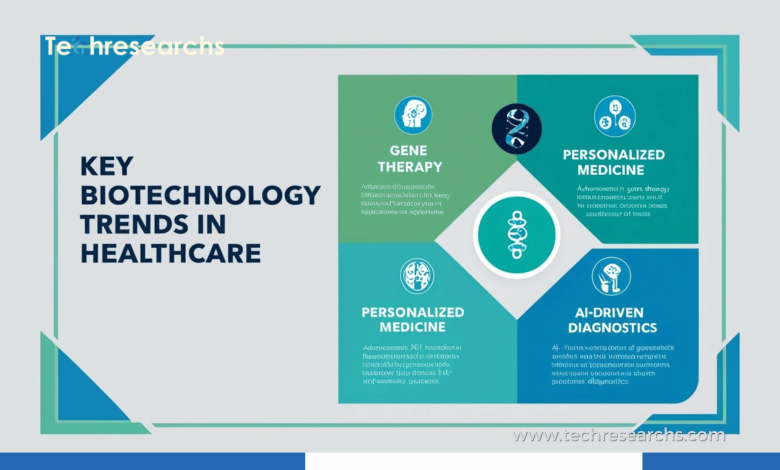
Biotechnology is changing healthcare in ways that once seemed far away. From treatments designed around a patient’s genetic profile to artificial intelligence helping researchers discover new medicines, biotechnology is becoming a central part of modern healthcare.
In 2026, the biggest shift is not happening in one area alone. Genomics, artificial intelligence, cell and gene therapies, precision medicine, advanced diagnostics, and biomanufacturing are increasingly working together. This convergence is helping researchers understand diseases more deeply and develop treatments that are more targeted and potentially more effective.
India is also becoming an important part of this transformation. Government initiatives in 2026 have highlighted the growing role of genomics, AI, multi-omics research, precision medicine, and biomanufacturing in the country’s healthcare ecosystem.
Let’s look at the biotechnology trends that are shaping healthcare in 2026.
1. AI-Powered Drug Discovery
Developing a new medicine has traditionally been a lengthy and expensive process. Researchers need to identify promising biological targets, discover candidate molecules, test them, and eventually move successful candidates into clinical trials.
Artificial intelligence is changing several parts of this process.
AI models can analyze enormous biological and chemical datasets to identify patterns that may be difficult for researchers to spot manually. Generative AI can also help researchers explore potential drug molecules and predict biological interactions.
The focus in 2026 is moving beyond simply using AI to generate ideas. AI is increasingly being integrated into development decisions, clinical-trial planning, patient selection, and analysis of biological data. Recent research reviews describe generative AI, large language models, reinforcement learning, and other computational approaches as important forces in modern drug discovery.
However, AI does not remove the need for scientists. Generated predictions still need laboratory validation, clinical testing, regulatory review, and careful human oversight.
2. Precision Medicine Is Becoming More Practical
Healthcare has traditionally relied heavily on treatments designed for broad groups of patients. Precision medicine takes a different approach.
Instead of asking only, “What disease does this person have?”, researchers can increasingly ask, “What biological characteristics make this patient’s disease different?”
Genomic information, biomarkers, lifestyle factors, clinical history, and other datasets can be combined to create a more detailed picture of an individual’s health.
This can help doctors and researchers identify patients who may respond differently to particular treatments.
India is placing increasing emphasis on this area. Government initiatives in 2026 have highlighted the convergence of genomics, AI, biotechnology, and multi-omics research as a foundation for personalized and precision medicine.
3. Genomics and Multi-Omics
Genomics remains one of biotechnology’s most important healthcare technologies.
Modern sequencing allows researchers to examine DNA at increasingly large scales. But DNA is only one part of the biological picture.
Researchers can also study:
- Transcriptomics — how genes are expressed
- Proteomics — proteins produced by cells
- Metabolomics — small molecules involved in biological processes
- Epigenomics — changes that influence gene activity
- Single-cell analysis — differences between individual cells
Together, these approaches are known as multi-omics.
The advantage is that researchers can study disease from several biological angles instead of relying on a single dataset.
In 2026, India’s biotechnology ecosystem is also emphasizing multi-omics research as an important component of precision medicine, diagnostics, and drug discovery.
4. Cell and Gene Therapies
Cell and gene therapies are moving healthcare toward treatments that can address disease at a much deeper biological level.
Gene therapy aims to modify genetic material to treat or potentially correct the underlying cause of certain diseases. Cell therapy uses living cells as part of the treatment.
These technologies are particularly promising in areas such as:
- Certain inherited disorders
- Blood cancers
- Rare diseases
- Immune-system disorders
- Some forms of genetic disease
The field is still developing, and challenges remain around safety, manufacturing complexity, cost, and accessibility.
Nevertheless, the continued development of cell and gene therapies is one of the clearest signs that biotechnology is moving healthcare beyond traditional small-molecule medicines.
5. mRNA Technology Moves Beyond Vaccines
The success of mRNA vaccines demonstrated that messenger RNA could be developed at large scale for medical use.
Researchers are now exploring mRNA technology for applications beyond infectious diseases, including oncology and other therapeutic areas.
Cancer is particularly interesting because mRNA approaches may allow researchers to train the immune system to recognize tumor-specific targets.
In 2026, cancer vaccines based on mRNA technology remain an active area of development, with major pharmaceutical companies pursuing personalized and immune-based approaches.
The long-term potential is significant, although clinical effectiveness, manufacturing, cost, and regulatory approval remain important considerations.
6. Advanced Cancer Biotechnology
Cancer treatment is becoming increasingly personalized.
Instead of treating cancer based only on where a tumor is located in the body, researchers can examine its molecular characteristics.
Modern biotechnology can help identify:
- Specific genetic mutations
- Tumor biomarkers
- Immune-system interactions
- Potential therapeutic targets
- Mechanisms behind treatment resistance
This information can support more targeted treatment strategies.
Antibody-drug conjugates are another important area. These therapies combine antibodies that recognize specific cancer cells with drug payloads designed to attack those cells.
Industry forecasts for 2026 indicate continued interest in large molecules, cell and gene therapies, RNA-based therapies, and antibody-drug conjugates.
7. AI-Driven Diagnostics
Biotechnology and AI are also changing how diseases are detected.
AI systems can analyze medical images, pathology information, genomic data, and other clinical information to identify patterns that may help healthcare professionals.
For example, AI can assist with:
- Medical imaging
- Pathology
- Genomic analysis
- Biomarker identification
- Disease-risk prediction
- Clinical decision support
The important point is that AI-assisted diagnosis should support qualified healthcare professionals rather than replace them.
Healthcare systems also need to address reliability, explainability, privacy, bias, and clinical validation before these technologies can be widely trusted.
8. Single-Cell Biotechnology
Traditional biological studies often examine groups of cells together. Single-cell technologies allow researchers to investigate individual cells.
This matters because cells that appear similar can behave very differently.
Single-cell sequencing can help scientists understand:
- Tumor diversity
- Immune responses
- Disease progression
- Drug resistance
- Cell development
- Rare cell populations
The combination of single-cell datasets with AI is creating new opportunities for drug discovery and biological research. Recent 2026 research is exploring AI-based approaches for analyzing single-cell data and identifying potential therapeutic targets.
9. Virtual Cells and Digital Biology
One of the more futuristic biotechnology trends is the development of computational models that represent biological systems.
Researchers are increasingly using AI and computational modeling to predict how cells might respond to different genetic or drug-related interventions.
These models cannot simply replace real biological experiments. However, they may help scientists prioritize which experiments are worth performing.
This could eventually reduce the number of unsuccessful experiments and make research workflows more efficient.
Recent research into AI-driven virtual-cell models demonstrates growing interest in predicting cellular responses to genetic perturbations and exploring those predictions through specialized analytical systems.
10. Biomanufacturing Is Becoming Smarter
Discovering a treatment is only one part of the healthcare journey. Manufacturing it reliably and at scale is another major challenge.
Biomanufacturing is increasingly adopting:
- Automation
- Artificial intelligence
- Robotics
- Digital twins
- Advanced analytics
- Real-time monitoring
- Predictive maintenance
These technologies can help manufacturers identify problems earlier and improve consistency.
Industry analysis for 2026 points to digitalization, machine learning, digital twins, and more flexible manufacturing processes as important trends in biopharmaceutical production.
For countries such as India, stronger biomanufacturing capabilities could also contribute to domestic healthcare production and global supply chains.
11. Personalized Cancer Vaccines
Personalized cancer vaccines are another biotechnology area receiving significant attention.
The basic concept is straightforward: cancers can contain mutations that differ from one patient to another. Researchers can potentially identify tumor-specific targets and design an immune-based treatment around those characteristics.
mRNA technology could make this approach more adaptable.
However, personalized cancer vaccines are still an emerging field. Researchers need to establish long-term safety, effectiveness, manufacturing scalability, and cost-effectiveness before these treatments become routine healthcare options.
12. Biotechnology for Rare Diseases
Rare diseases often create a difficult research problem because patient populations are small and the underlying biological mechanisms may be poorly understood.
Advances in genomics are helping researchers identify disease-causing genetic variants.
Once the underlying mutation or pathway is understood, biotechnology may provide opportunities for highly targeted treatments.
This is particularly important because a therapy designed for a rare genetic condition may not need to work in millions of patients to have meaningful medical value.
13. AI and Robotics in the Laboratory
The modern biotechnology laboratory is becoming increasingly automated.
Robotic systems can perform repetitive tasks such as:
- Sample handling
- Liquid transfer
- Screening
- Data collection
- Laboratory preparation
- High-throughput experiments
When robotics is combined with AI, researchers can create more automated experimental workflows.
The idea is not to remove scientists from the laboratory. Instead, automation can allow researchers to spend more time on experimental design, interpretation, and strategic decisions.
14. More Focus on Sustainable Biotechnology
Healthcare innovation also has an environmental cost.
Biopharmaceutical manufacturing can require significant amounts of energy, water, raw materials, and specialized infrastructure.
As biotechnology expands, companies are looking for ways to make production more sustainable.
This includes:
- Reducing manufacturing waste
- Improving energy efficiency
- Optimizing production processes
- Developing more sustainable materials
- Improving resource utilization
- Using smarter manufacturing systems
Sustainability is therefore becoming part of the broader conversation around the future of biotechnology.
15. The Growing Role of Biotechnology in India
India has significant potential to become an important global biotechnology hub.
The country’s large scientific workforce, expanding research infrastructure, growing startup ecosystem, and pharmaceutical manufacturing capabilities provide a strong foundation.
In 2026, Indian government initiatives have emphasized genomics, AI-enabled sequencing, precision medicine, multi-omics, and biomanufacturing. Government statements also highlight the country’s expanding biotechnology startup ecosystem and ambitions in biomanufacturing.
The opportunity is not limited to drug development. India can potentially contribute to diagnostics, biological research, healthcare data platforms, manufacturing, medical technologies, and affordable healthcare innovation.
Challenges Biotechnology Still Needs to Solve
Despite the excitement around biotechnology, the industry faces several challenges.
High Development Costs
Advanced therapies can require expensive research, specialized manufacturing, and complex clinical trials.
Regulatory Complexity
New technologies such as AI-assisted drug development, gene editing, and personalized therapies require careful regulatory frameworks.
Data Privacy
Genomic and health information is extremely sensitive. Strong data governance is essential as more healthcare systems become data-driven.
Accessibility
A breakthrough treatment has limited impact if only a small number of patients can afford it.
Scientific Validation
AI-generated predictions and laboratory discoveries still need rigorous testing. A promising model or early-stage result does not automatically translate into an effective treatment.
Workforce Changes
As AI and automation become more common, biotechnology professionals will need new skills combining biology, data science, computing, engineering, and regulatory knowledge.
What Does the Future of Biotechnology Look Like?
The future of biotechnology is likely to be highly connected.
Instead of treating genomics, AI, robotics, drug discovery, diagnostics, and manufacturing as separate technologies, healthcare organizations are increasingly bringing them together.
Imagine a future workflow where a patient’s biological information is analyzed using advanced computational tools, a potential treatment is identified using AI-assisted research, the therapy is produced using automated biomanufacturing, and treatment response is continuously monitored through biomarkers.
That vision is not fully realized yet, but the technologies needed to move toward it are developing rapidly.
The key question for 2026 is therefore no longer whether biotechnology will influence healthcare. It already does.
The bigger question is how responsibly, affordably, and effectively healthcare systems can turn biotechnology breakthroughs into real-world patient benefits.
Final Thoughts
Biotechnology is entering a new phase in 2026.
AI-powered drug discovery, precision medicine, genomics, multi-omics, cell and gene therapies, mRNA technologies, advanced diagnostics, virtual biology, and automated biomanufacturing are creating a healthcare ecosystem that is more data-driven and increasingly personalized.
The most exciting developments may come from the combination of these technologies rather than from any single breakthrough.
For patients, the ultimate goal remains simple: earlier diagnosis, better treatments, fewer side effects, and improved health outcomes.
If biotechnology can continue translating scientific discoveries into safe, accessible, and affordable healthcare solutions, 2026 could become an important milestone in the transition toward a more personalized era of medicine.
Frequently Asked Questions
What are the biggest biotechnology trends in healthcare in 2026?
The biggest trends include AI-powered drug discovery, precision medicine, genomics, multi-omics, cell and gene therapies, mRNA technology, advanced diagnostics, and automated biomanufacturing.
How is artificial intelligence transforming biotechnology?
AI helps biotechnology researchers analyze complex biological data, identify potential drug targets, discover new molecules, predict biological interactions, and improve laboratory and manufacturing processes.
How does biotechnology support personalized healthcare?
Biotechnology enables doctors and researchers to study genetic, molecular, and biological differences between patients. This information can support more personalized diagnosis, treatment selection, and disease monitoring.
What is the future of biotechnology in healthcare?
Biotechnology is expected to play a growing role in precision medicine, gene and cell therapies, advanced diagnostics, AI-assisted drug discovery, cancer treatment, genomic research, and next-generation biomanufacturing.